
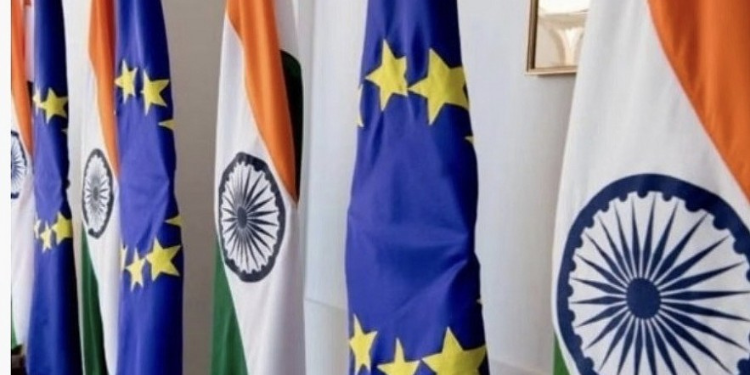
In 2025, India’s foreign and economic policy reflected a steady consolidation of long-term strategic thinking enabled by domestic political continuity under Prime Minister Narendra Modi. As global politics became increasingly fragmented and power-driven, relations with the European Union emerged as a central pillar of New Delhi’s international engagement.
India’s strong economic performance, expanding trade footprint, defense modernization, and rising defense exports reinforced its global standing. At the same time, Europe’s growing awareness of its own structural vulnerabilities—exposed by prolonged inflationary pressures and stress on the euro—created a shared imperative: preserving economic sovereignty and strategic autonomy in an increasingly unpredictable international system.
Rather than pursuing rigid alignments, India continued to follow a policy of strategic autonomy, engaging all major powers while avoiding exclusive blocs. In 2025, this approach evolved beyond passive non-alignment. New Delhi actively expanded partnerships, invested in institutional continuity, and leveraged economic resilience and multidimensional diplomacy as tools for development and influence.
This posture gained international visibility at the 17th BRICS Summit held in Rio de Janeiro in July 2025. Leaders of the BRICS focused on strengthening cohesion within the group and advancing the interests of the Global South. Discussions centered on global governance reform, development financing, technology, and structural inequalities in the international system. Despite internal differences and external pressures, the summit’s joint declaration reaffirmed BRICS as a key platform for emerging economies and strengthened India’s position ahead of its assumption of the bloc’s presidency in 2026.
India also played an active role within the G20, particularly at the 2025 summit in Johannesburg. Amid ongoing geopolitical tensions and the absence of several leaders, India participated in deliberations on climate change, economic resilience, and development. The summit’s final declaration emphasized multilateral cooperation and support for developing countries—priorities consistently advanced by India and other emerging economies. Hosting the G20 in Africa for the first time underscored the growing importance of broader regional representation in global decision-making.
Domestically, governing cohesion provided the foundation for India’s strategic patience. The Modi government continued to implement reforms aimed at sustaining economic stability and political continuity, enabling long-term foreign policy planning even amid global volatility.
Within this context, relations with Europe assumed heightened strategic importance. New Delhi increasingly viewed European states as like-minded partners capable of balancing major powers while offering investment capital, advanced technologies, and meaningful defense cooperation. Europe’s rising defense spending and renewed geopolitical seriousness reinforced this convergence, positioning the EU as a credible strategic partner in India’s global calculus.
Economic growth remained the cornerstone of India’s international influence. In 2025, India sustained one of the fastest growth rates among major economies, with GDP expanding by approximately 6.7% and exceeding 8% in one quarter. Growth was driven by strong domestic demand and investment, while exports demonstrated notable resilience despite global headwinds.
Total exports of goods and services reached an estimated $73.99 billion in November 2025, a year-on-year increase of 15.5%. Cumulative exports from April to November stood at approximately $562 billion, up 5.4%. The government presented these figures as evidence that its focus on manufacturing, skills development, and supply-chain resilience was transforming trade policy into a flexible instrument of foreign policy.
India also expanded market access through free trade agreements with New Zealand, the United Kingdom, and Oman, while deepening ties with Gulf states and Southeast Asia. Preparatory work continued for future agreements, including a prospective trade deal with the United States in 2026.
On the security front, 2025 marked a decisive acceleration in defense reforms. The government approved approximately $4.6 billion in emergency military procurement, advanced the development of an indigenous stealth fighter, expanded the acquisition of armed drones, and finalized a $7 billion agreement with France for the purchase of 26 naval Rafale fighter jet aircraft. Designating 2025 as the “Year of Defense Reforms” underscored India’s push to reduce reliance on foreign suppliers and establish itself as a defense exporter, with exports rising 12% to $2.76 billion.
Ultimately, the strengthening of India and the resilience of Europe in 2025 were not parallel developments but interlinked responses to the same strategic challenge: safeguarding economic management and sovereignty in a volatile global system.
In this context, deeper India–EU cooperation is no longer optional. Enhanced trade integration, technological convergence, and substantive security collaboration offer both sides a means to counter the growing weaponization of economic power by major actors. For India and Europe alike, strategic convergence is not an act of confrontation, but a necessary form of stability in an international environment where uncertainty has become institutionalized.