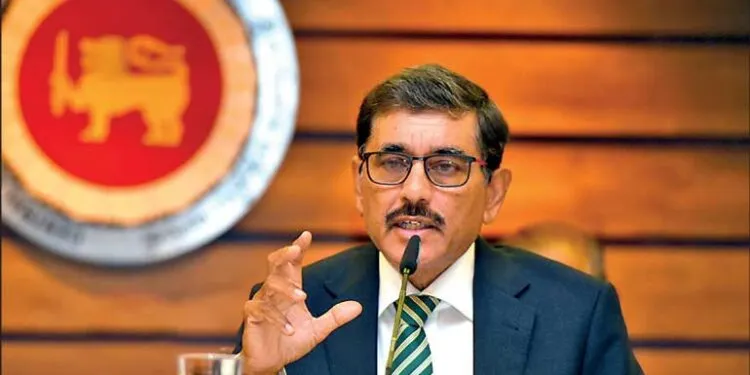
Central Bank Governor Nandalal Weerasinghe stated that it was not Sri Lankan policy to inform parliament of upcoming IMF programmes in advance. Similarly, lawmakers would only be informed of upcoming tax changes prior to their implementation.
Sri Lanka’s intermediate regime central bank prints money to suppress market interest rates, which causes forex shortages and subsequently balance of payments trouble, leading to 16 previous IMF programmes.
According to Governor Weerasinghe, as part of a programme, Sri Lanka’s finance minister typically signs a memorandum of economic policies with the IMF.
In an interview with Sri Lanka’s Newsfirst television, he said, “At that stage it has never been tabled in the parliament to my knowledge and has not even been submitted to the cabinet.”
He said that while it was beneficial for transparency purposes, the programme contained market sensitive information.
He also noted that taxes are typically not made public prior to their actual enactment.
Until that is essentially put in place, it will be difficult, if not impossible, to inform or announce the parliament of pending tax reforms. He specifically mentioned income taxes.
According to the IMF, the policies include a wealth tax, higher income tax rates, broadening the tax base, and enhancing the efficiency of government.
The public and the government have only so much access to certain information. Former Governor Weerasinghe explained the reasoning behind the policy, saying that the information should have been shared with parliament since it is the ultimate authority on public finances.
To be submitted to the parliament at the time of implementation.
IMF staff level agreement should be presented to parliament, as requested by Harsha de Silva, chairman of the Committee on Public Finance of Sri Lanka’s parliament.
The current president, Ranil Wickremesinghe, previously assured an opposition lawmaker, M A Sumanthiran, that he would update the legislature on the program’s development.
There’s been no word on whether or not external creditors will be given access to the service level agreement.
The most up-to-date IMF programmes for Sri Lanka have been published by the agency following approval by its Executive Board; these programmes are based on a letter of intent signed by the country’s Finance Minister and Central Bank Governor and outline specific policies and targets.
Activists have claimed that IMF programmes are undemocratic and antithetical to liberalism.
The New Deal economic interventionists of the 1930s United States are widely held responsible for exacerbating the Great Depression by setting off what is now known as “Regime Uncertainty,” which in turn led to the creation of the International Monetary Fund (IMF).
In the 1930s, US interventionists devalued the dollar and banned the public from holding gold, just as central banks in countries with monetary instability now print money, creating a forex shortage and causing police to arrest hapless members of the public who hold foreign currency.
Beginning in the mid-1990s, however, the agency became more open, publishing agreements and its economic analysis in Article IV staff reports while redacting any information that could be construed as market sensitive.
Bank of Sri Lanka has occasionally prevented them from making purchases.
It has been argued that state-owned central banks are undemocratic and unaccountable because they impose a money monopoly on the people and because decisions are made by unelected officials through illiberal and opaque processes in order to suppress market rates in the name of ‘central bank independence.’
Critics say that the underlying flaw in Sri Lanka’s plan to create a law giving the central bank ‘independence’ to operate discretionary ‘flexible’ inflation targeting and a ‘flexible’ exchange rate is at the root of the country’s recent rapid-fire currency crises.
Meanwhile, an IMF official has stated that the organization’s plans necessitate the adoption of a budget for 2023 that is consistent with the programme in order to gain public consent and legitimacy.
In the 1970s, Sri Lanka began the undemocratic practise of imposing new taxes after the budget was passed and through the use of a midnight gazette, both of which run counter to the principle of ‘taxation of consent’ that ultimately led to the establishment of parliament in Britain.
IMF programmes and budgets in Sri Lanka mirror the arbitrary nature of taxes imposed by the former monarchy before parliaments were established.
But detractors assert that a “Minister’s Prerogative” has returned through the use of the midnight gazette and other methods.
As an egregious example of how not to adhere to the principle of taxation by consent, Sri Lanka’s 2019 tax cuts were a major problem. No parliament, which supposedly has its origins in the Westminster system, was present at the time of the taxation to even give it a rubber stamp.
King John of England imposed a series of taxes known as scuttage, and the British Magna Carta codified this principle. In contrast, modern Sri Lanka imposes taxes on its barons without consulting them first.
Unlike the unarmed citizens of a modern nation state, barons could fight back if they had their own soldiers.
After William and Mary assumed power, the British Bill of Rights was passed, officially ending the royal prerogative on taxation.
Apparently by “President’s Prerogative,” interventionist economists in Sri Lanka cut taxes in December 2019 to reduce the country’s deficit and close the country’s “persistent output gap” (fiscal stimulus).
The central bank then printed vast sums of money, leading to massive capital outflows and imports, a collapse of the pegged exchange rate, and the subsequent collapse of the economy.