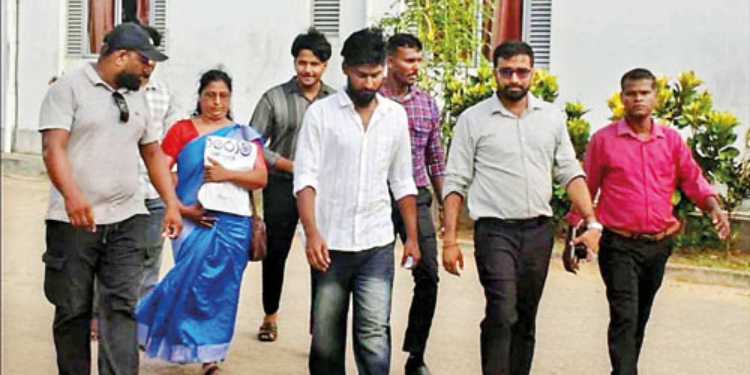
The arrest of a 24-year-old rapper in Jaffna under the Prevention of Terrorism Act (PTA) sparked protests from Tamil political parties, but the controversy eased after a magistrate released the suspect when the Attorney General withdrew the PTA charge and filed fresh charges under another law.
The rapper, Ganeshkumar Sangeethsan, popularly known as “Hiphop Sangee,” was granted bail by the Chavakachcheri Magistrate’s Court on Friday under strict conditions after the Attorney General decided to drop the PTA charge and proceed instead under Section 120 of the Penal Code.
The case was called three times due to delays in submitting the Attorney General’s written undertaking to the court.
In a development that surprised many present in court, including lawyers appearing on behalf of Mr. Sangeethsan, a new counsel appeared with the consent of the singer’s mother to hand over the written undertaking.
Following his release on bail, the singer expressed gratitude to President Anura Kumara Dissanayake and Jaffna District National People’s Power (NPP) Parliamentarian K. Ilankumaran for their support. He also thanked those who organised protests demanding his release.
Initially, the rapper was represented by lawyer K. Sayanthan, who is also a prominent member of the Ilankai Thamil Arasu Katchchi (ITAK). A fundamental rights petition was filed in the Supreme Court on Monday after former ITAK parliamentarian M.A. Sumanthiran and lawyer Sayanthan visited the singer in prison.
The arrest stemmed from a temple festival held on May 31, where Mr. Sangeethsan performed songs that were allegedly sympathetic to the now-defunct Liberation Tigers of Tamil Eelam (LTTE).
The following day, he uploaded to his TikTok account several heavily edited video clips, along with footage from the event, featuring popular songs from the war period. The uploads prompted the Chavakachcheri Police to arrest him.
Mr. Sangeethsan later stated that he had been unaware that using what authorities considered “problematic” content and publishing it online could result in serious legal consequences.
Tamil political activists claimed that the government’s last-minute intervention was prompted by a series of protests in the Northern and Eastern Provinces, as well as sustained pressure from Tamil political parties questioning the continued use of the PTA.
The issue was also raised in Parliament, where Public Security Minister Aananda Wijepala indicated that fresh charges could be filed against the singer.
Meanwhile, the Sunday Times learns that ITAK Parliamentary Group Leader Shanakiyan Rasamanickam, who was in Brussels, Belgium, raised the matter during a meeting on Thursday (11) with Charles Whiteley, Head of the South Asia Division (ASIAPAC) of the European External Action Service (EEAS). The discussion covered a range of issues, including the continued use of the PTA and concerns related to the GSP+ trade concession scheme.
During the meeting, the ITAK MP expressed serious concern over the case and highlighted its implications for freedom of expression, democratic freedoms, and human rights in Sri Lanka.
Mr. Rasamanickam handed over a letter from ITAK General Secretary M.A. Sumanthiran regarding the arrest of Hiphop Sangee and reiterated the party’s longstanding demand for the repeal of the PTA. He emphasized that despite repeated commitments by successive governments to abolish the legislation, it continues to be used against individuals, particularly within the Tamil community.
He also drew attention to the implications of the continued use of the PTA in relation to Sri Lanka’s obligations under the European Union’s GSP+ trade concession scheme. According to Mr. Rasamanickam, the continued arrest and detention of individuals under the PTA, including the recent detention of Hiphop Sangee, raise serious concerns about Sri Lanka’s compliance with international human rights commitments that form the basis of GSP+ eligibility.
Mr. Rasamanickam’s office stated that he stressed how repeated assurances by successive governments to repeal the PTA have remained unfulfilled, and that the continued use of the law undermines Sri Lanka’s commitments to fundamental rights, freedom of expression, due process, and democratic governance.
The meeting also addressed the urgent need to hold the long-delayed Provincial Council elections, with Mr. Rasamanickam emphasizing that meaningful devolution of power and democratic representation remain essential to addressing the political aspirations of the Tamil people.
Discussions further focused on ongoing constitutional reform proposals, with emphasis on ensuring that any future constitutional arrangements safeguard the political rights, equality, and aspirations of the Tamil people.
Mr. Rasamanickam also raised the issue of enforced disappearances, highlighting the continued struggle of families seeking truth and justice for their missing loved ones. He stressed the importance of accountability, credible truth-seeking mechanisms, and justice in accordance with international standards.
Courtesy: The Sunday Times.