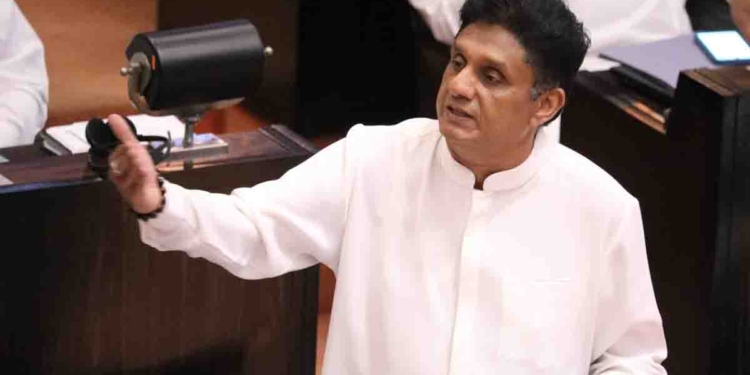
Opposition Leader Sajith Premadasa stated that a serious debate has emerged in the country regarding the proposed increase in the retirement age of judges of the Supreme Court and the Court of Appeal. He noted that the Bar Association of Sri Lanka (BASL) has also emphasized the need to pay close attention to judicial independence, the rule of law, and public confidence in the judiciary in relation to this matter. Therefore, he stressed that the government must provide an explanation regarding this issue of national importance.
The Opposition Leader made these remarks in Parliament today while raising the matter under Standing Order 27(2).
Sajith Premadasa stated that if the government intends to present a proposal or legal amendment to revise the retirement age of Supreme Court and Court of Appeal judges, it should first table an official needs assessment, policy report, or relevant data-based study supporting such a move. He further questioned how the government could justify increasing the retirement age when the number of judges in the Supreme Court and Court of Appeal had already been expanded through the 20th Amendment to the Constitution.
A Matter Affecting Judicial Independence
Referring to the letter sent by the Bar Association of Sri Lanka to the President on 25 May 2026, the Opposition Leader pointed out that the BASL had warned that an unplanned extension of the tenure of currently serving judges could adversely affect both the dignity of judges and public confidence in the independence of the judiciary.
He stated that the official position of the Ministry of Justice on this matter should be presented to Parliament. He also emphasized the need to ascertain whether the Bar Association of Sri Lanka had conducted a formal consultation process with the Judicial Service Commission and other legal professional bodies regarding the proposal. If such consultations had not taken place, he argued that presenting a constitutional amendment of national significance without adequate stakeholder engagement would be problematic.
Eight Vacancies in Superior Courts
The Opposition Leader further highlighted that the judicial system is currently facing significant challenges, including delays in court proceedings, a growing backlog of cases, a shortage of judges, and delays in delivering justice to the public.
He pointed out that four positions in the Supreme Court and four positions in the Court of Appeal have remained vacant for an extended period. He questioned why these vacancies have not been filled and called on the government to explain the national interest served by prioritizing an increase in the retirement age of judges instead of appointing judges to the existing vacancies.
A Dangerous Precedent for the Judiciary
Sajith Premadasa warned that implementing such a proposal could create a dangerous precedent, allowing future governments to alter the structure of the judiciary according to political requirements.
He stated that if it is the responsibility of the Ministry of Justice to safeguard judicial independence, impartiality, and public confidence, then the government must clearly outline the measures it intends to take to address public concerns arising from these proposals.
Qualified Judges Have Already Retired
The Opposition Leader stated that the matter cannot be addressed through a simple response. He emphasized that good governance requires accountability and responsibility in safeguarding judicial independence.
He further noted that several highly qualified and experienced judges have already retired because the existing vacancies were not filled for more than six months. According to him, these judges had rendered valuable service to the judicial system, yet retired without being replaced.
Not the Change the Public Mandated
Sajith Premadasa stated that although the government received a mandate for systemic change, the current proposal does not represent the type of reform that people expected.
He reiterated the need for the government to explain why it has failed to address the vacancies in the Supreme Court. He added that the Bar Association of Sri Lanka has not raised objections on unreasonable grounds and stressed that the government must uphold the principles of democratic governance by protecting the system of checks and balances among the Executive, Legislature, and Judiciary.