
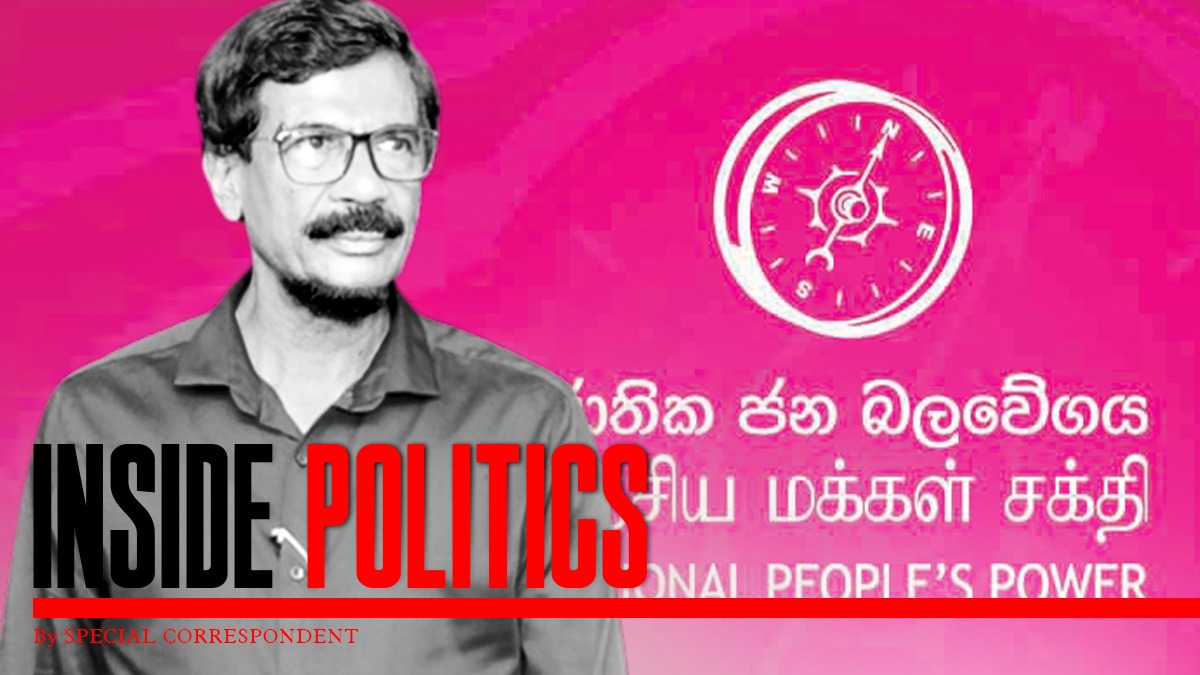
Tilvin’s Jaffna Remark Exposes Hidden Rift Within Government
Tamil Arasu Kachchi to Meet Tilvin and the President
ICC Pushes for Swift Cricket Elections Within Three Months
Tilvin can’t win?
Following the statement made by Science and Technology Minister Krishantha Abeyasinghe regarding the Provincial Council elections, both the public and political parties showed considerable enthusiasm and anticipation in recent weeks. However, that optimism proved short-lived. A significant development soon emerged, causing much of that excitement to fade.
Former President Ranil Wickremesinghe played a central role in every obstacle, delay, political manoeuvre, and behind-the-scenes effort that ultimately led to the Provincial Council elections due in 2017 being shelved indefinitely. His actions were driven by a simple political calculation: it had become increasingly clear that if the elections were held, the opposition of the day would secure a decisive victory.
Delimitation excuse
During the 2015 “Good Governance” government, when Ranil served as Prime Minister, it had become obvious that the then-opposition Sri Lanka Podujana Peramuna (Pohottuwa) would secure victory if the Provincial Council elections were held on schedule. Ranil used the delimitation as an excuse and shelved the elections. Later, after he was elected President through Parliament in 2022, Ranil again avoided holding the Provincial Council elections because it had become equally clear that the main opposition party at the time, the Samagi Jana Balawegaya, would win all provincial councils.
Ranil had realised that if he could not wield political power, he lacked the strength to lead the United National Party to electoral victory. This realisation became the driving force behind the conspiracy to bury the Provincial Council elections. What Ranil effectively did was use Parliament in a disgraceful manner to erase Provincial Council elections from the political map.
Following Ranil
However, the irony of fate is that the current “Compass” government led by President Anura Kumara Dissanayake — which came to power criticising Ranil’s government from every direction while preaching democracy — is now following the very same cheap path initiated by Ranil to sideline the Provincial Council elections.
The Compass government has now turned Ranil’s constitutional amendment to its own advantage and appears determined to deliberately deny the people their opportunity to express their political opinion. As mentioned earlier, we are using unusually harsh language to criticise these actions because we have consistently stood up for democracy and the political rights of the people. Therefore, regardless of the outcome, our position remains that the Provincial Council elections must definitely be held.
Internal conflict
At the same time, it was evident from the beginning that there was an internal crisis within the current Compass government regarding the holding of Provincial Council elections. Once the Minister of Science and Technology announced that the elections would be held this year, almost all opposition political parties showed renewed enthusiasm and mobilization. This was particularly visible within the Samagi Jana Balawegaya. By the final week after the announcement, 11 MPs from various districts had reportedly informed Opposition Leader Sajith Premadasa that they were prepared to resign from Parliament and contest as Chief Ministerial candidates in their respective provinces. By last Friday, that number had reportedly risen to 16 — a development even the Opposition Leader himself reportedly found hard to believe.
Grassroot-level support
These MPs were willing to give up their parliamentary seats because grassroots-level SJB supporters had begun organizing rapidly for the Provincial Council elections. Accordingly, SJB MPs had become convinced that they could decisively defeat the Compass alliance and secure victory at the elections. That was why they informed Sajith and SJB General Secretary Ranjith Madduma Bandara of their willingness to contest as Chief Ministerial candidates.
Warning from villages
This growing public sentiment at the grassroots level was not lost on Tilvin Silva, the General Secretary of the Janatha Vimukthi Peramuna. Through the party’s local networks, continuous reports had been reaching Pelawatte warning that if an election were held now, it could negatively affect the JVP at village level. As these reports intensified, Tilvin wasted no time.
In fact, while opening a JVP office in Jaffna, Tilvin publicly stated that the Provincial Council elections would not be held this year. Citing the impact of Cyclone Dithva and claiming that funds allocated for the election had instead been used for disaster-related purposes, Tilvin further said there was uncertainty about whether the elections could even be held next year.
Tilvin’s contradiction
In addition to this controversial statement, Tilvin also made another serious claim — that India had exerted no pressure regarding the holding of Provincial Council elections. Whether this was intentional or not remains unclear, but his remarks have now triggered intense discussion within the Compass alliance, the JVP, other political parties, and even internationally.
No money claim
A similar statement had previously been made in 2023 by former President Ranil Wickremesinghe in Parliament. At that time, as the dates for the Local Government elections approached, Ranil declared that there was no money available to hold elections and therefore no election could take place. Back then, the three Compass MPs in Parliament — Anura Kumara Dissanayake, Vijitha Herath, and Harini Amarasuriya — strongly condemned Ranil’s remarks both inside and outside Parliament.
When then-Treasury Secretary Mahinda Siriwardana even appeared before court claiming there was no money to hold elections, it was these same Compass MPs who mocked and attacked that claim the most. Yet the irony today is that the very JVP leaders who laughed back then are now themselves postponing Provincial Council elections by claiming there is no money to hold them.
Money overflow
Furthermore, Tilvin’s remarks in Jaffna have also undermined another frequent boast made by the President and senior ministers — that the Treasury was overflowing with funds. Not only government leaders, but even economist and opposition MP Harsha de Silva, who has worked closely with the government, once claimed in Parliament that the Treasury was overflowing with money.
However, Tilvin’s comments made in Jaffna — apparently driven by concern over the growing grassroots support for the SJB — have now cast doubt even on those confident claims made by the government.
Attack Within
Over the past several months, we have repeatedly reported in this column that differences of opinion and internal tensions were emerging both between Pelawatte and the Compass alliance, and between Pelawatte and the Presidential Secretariat. With Tilvin’s statement in Jaffna, the simmering conflict behind the scenes once again surfaced publicly.
The first shot against Tilvin Silva was fired not by anyone outside the government, but by one of the administration’s most powerful ministers — Agriculture Minister K. D. Lalkantha. This was not the first time reports had emerged suggesting tensions between Lalkantha and Tilvin. A few weeks earlier, social media and several media outlets had reported an internal dispute within Pelawatte, in which Tilvin and Lalkantha were said to be the two central figures.
Accordingly, less than 24 hours after Tilvin’s statement, Lalkantha posted a pointed message on his Facebook page. He wrote:
“Governments are not run according to what you, he, this one, or that one wants. There is an established institutional structure through which decisions on governing are made.”
Many interpreted this remark as an indirect but unmistakable attack aimed squarely at Tilvin.
Cabinet Media Briefing
An even more serious response came during Tuesday’s Cabinet media briefing. When journalists directly questioned Minister Nalinda Jayatissa about Tilvin’s comments, he responded with a smile and strong confidence that the government had no intention whatsoever of postponing the elections and that the Provincial Council elections would indeed be held.
Yet within just a few hours of Nalinda’s statement, another unexpected development unfolded. At an expert panel discussion organized by the PAFFREL on the holding of Provincial Council elections, Compass General Secretary Nihal Abeysinghe openly contradicted Tilvin’s statement.
General secretary
Nihal stated that he had personally met Tilvin just two weeks earlier to discuss the matter, and that the government had made no decision whatsoever to avoid holding the Provincial Council elections. He further emphasised that the funds required to conduct the election were available. Nihal also explained that once the committee chaired by Vijitha Herath completed its review regarding the electoral system to be used, the government would move ahead with the elections immediately.
By directly contradicting Tilvin in such a public manner, Nihal’s remarks made it clear that Tilvin’s statement had triggered a serious conflict not only within the Janatha Vimukthi Peramuna itself but also between the JVP and the broader Compass alliance.
Compass Website Disappears
This is not the first time tensions have surfaced within the government between the Janatha Vimukthi Peramuna and the Compass alliance. In fact, disagreements between the JVP and the Compass movement began from the very day they won the presidential election. Those cracks first became visible when nominations for the parliamentary election were being finalized.
No nominations
At the time, many Compass candidates were reportedly denied nominations, while prominent JVP figures were given priority in almost every district. Later, during the parliamentary election campaign, serious allegations also emerged that JVP supporters had systematically worked at the grassroots level to undermine Compass candidates. While no mainstream media outlet reported these developments, this column, Rajya Rahas, had repeatedly highlighted them at the time — something readers can verify by revisiting past editions.
Today, we are prepared to reveal yet another important episode in the growing Compass–JVP conflict. It concerns what appears to be a fresh operation launched from Pelawatte to dilute and gradually dissolve the Compass movement itself.
Behind Compass
Not only during the presidential election, but even during the parliamentary election, the JVP effectively hid behind the Compass identity in order to expand its voter base. The JVP, traditionally associated with around a 3% core vote base, used the Compass platform to project the image that it enjoyed support from all sectors of society. Prominent academics, intellectuals, professors, and professionals associated with the Compass alliance were showcased heavily, while senior JVP figures remained somewhat in the background.
Change
Through this strategy, they attempted to convince the public that Compass was a broad national platform capable of attracting supporters from the United National Party, the Sri Lanka Podujana Peramuna, and the Sri Lanka Freedom Party alike. By prominently featuring Harini Amarasuriya, the JVP also sought to attract women voters as well as educated middle-class professionals and intellectuals.
Many people voted for Compass — whether out of hope for change, frustration, anger, curiosity, or simply to “test” a new alternative — largely because of these fresh faces constantly promoted by the JVP.
Even during the campaign period, the JVP launched a massive social media operation targeting the country’s majority youth and younger generation. All of this was coordinated from the JVP headquarters itself, where a special media unit had reportedly been established for the purpose.
‘NPPLK’
In addition, the JVP launched a dedicated website under the domain “NPPLK,” which received enormous promotion through social media platforms. The Compass policy manifesto was published there in all three languages. The site also featured policy proposals prepared with the involvement of intellectuals and professionals from various sectors associated with Compass.
Policies covering education, the economy, tourism, youth affairs, arts and culture, religion, fisheries, transport, and senior citizens — among many others — were uploaded to the website with the stated goal of uplifting each sector individually.
However, the Compass government is now approaching its second anniversary in power this coming September. Throughout this period, the NPPLK website reportedly remained fully operational through a dedicated office and staff based inside the JVP headquarters in Pelawatte.
Website deactivated
Yet the latest reports now suggest that the JVP has completely deactivated the Compass NPPLK website — the very platform that once helped gather supporters from across the country under one banner. In effect, it appears the “plug” powering the site has now been pulled from the Pelawatte headquarters itself.
The political signal being conveyed through this move seems clear: that the Compass alliance, as a distinct political entity, may no longer physically exist beyond name alone.
Compass on a new path
In addition, ‘Inside Politics’ column reports with a strong sense of responsibility that in many districts, hostility from the JVP side towards non-JVP National People’s Power (NPP) MPs has now begun.
It is also reported to this column that, even at the local council level, JVP MPs have already started sidelining NPP MPs. In situations such as carrying out village development work etc., is being taken over by JVP MPs while NPP representatives are pushed aside. As a result, NPP MPs are reportedly facing significant difficulties and psychological stress at the grassroots level.
Marginalisation
After repeated complaints from NPP MPs in various districts about acts of marginalisation, it is learned that a group of senior NPP MPs held a crucial discussion on this matter during the most recent parliamentary sitting days. However, some MPs present at that discussion reportedly became seriously suspicious of one or two individuals, fearing they might pass on details of the discussion to different parties in order to gain favour with the President or the Pelawatte leadership.
The indication that NPP MPs are no longer afraid of the JVP can be seen from the nature of these discussions. NPP MPs have indicated a non-bothered attitude of not reporting to the President or Pelewatta and strongly criticised JVP’s current conduct. This shows the boldness of NPP members on JVP.
Discussion
Even on the days when Parliament was in session, these NPP MPs also had engaged in in-depth discussions about the problems and acts of marginalisation faced by local government representatives and party supporters in their respective districts. It is learned that they have reached a special decision: to launch a mechanism to share information about irregularities within the government and the grievances and marginalisation they are experiencing with opposition MPs.
In indicates a growing likelihood that a significant amount of information about developments and internal conflicts within the government will increasingly come out through opposition channels in the future.
While such an internal crisis is emerging within the government through Tilvin’s statements and, his remarks have also sparked considerable controversy among the diplomatic front. The statement he made during his speech, saying that India is not exerting any pressure on the government regarding the holding of Provincial Council elections considered as placing New Delhi in an uncomfortable position.
Thalapathy
Two weeks earlier, in a special revelation through the ‘inside politics’ column, we reported that with the swearing-in of Tamil Nadu Chief Minister “Thalapathy Vijay,” Tamil Nadu political leaders who had previously expressed pro–LTTE sentiments and had once worked alongside Prabhakaran, along with the diaspora, have now begun aligning with him in governance.
Accordingly, these political parties supporting Thalapathy Vijay have consistently maintained the position that the 13th Amendment introduced by India to Sri Lanka must be fully implemented. As a result, following Tilvin’s statement, there is a strong possibility that these pro–LTTE parties may launch a campaign through Thalapathy Vijay to pressure the Indian central government into holding Provincial Council elections in Sri Lanka.
Sumanthiran to Pelawatta
Inside Politics column understands the main political party in the North and East the Tamil Arasu Kachi has done a verification of their opinion from New Delhi on the provincial council elections. Information we have indicate the New Delhi’s response has been to be patient on other matters with the government but to maintain a stiff stand on the provincial council elections.
Furthermore, Tamil Arasu Kachchi intends to meet Tilvin on a face-to-face meeting and to get confirm the JVP’s standing on this. Towards this end they intend first meet Tilvin Silva and subsequently to meet the President and discuss the matters pertaining on Provincial council elections.
The ‘Inside Politics’ column also learns Tamil Arasu Kachi’s plan is to launch a massive agitation campaign in the North and East on provincial councils.
Furthermore, they have also commenced a dialogue with the other political parties in the south. General secretary of the party and the former parliamentarian Mr M.A Sumanthiran was seen last week remaining in Colombo and indulging in multiple rounds of confidential meetings with the opposition parties. Further to this, party parliamentarian Shanakkiyan Rasamanikkam urged the government to hold the PC election at the talks held at the opposition leader’s office.
Information we received about the face-to-face meeting held between the opposition leader and Mr M.A. Sumanthiran indicated an agreement of formation of a opposition party alliance to demand a PC election in the near future.
Govt. committee
In addition, during the discussion between Sajith and Sumanthiran, special attention was given to the government‑appointed committee tasked with reviewing the electoral system for provincial council elections. Both parties shared the view that this committee, chaired by Wijitha Herath, had been established not to facilitate elections but to delay them. Accordingly, they agreed that joint action was necessary to compel the government to hold the provincial council elections without further postponement.
They also engaged in lengthy deliberations on the measures required to achieve this. Reports suggest that Sajith and Sumanthiran reached consensus that, should the government continue to avoid elections by citing various excuses, a decisive response would be necessary—one that would resonate not only within the country but also internationally.
Thus, unfolding events indicate that the government now finds itself in a position where it can no longer indefinitely avoid provincial council elections. If the Malima administration attempts to follow the same path Ranil pursued in suppressing these elections, it will face a fate even harsher than that which befell Ranil himself.
Turning to the IMF
Last week, ‘Maw Rata‘ revealed on its front page that the IMF’s Executive Board would convene on Wednesday the 27th to discuss the release of Sri Lanka’s fifth and sixth tranches, amounting to nearly USD 700 million. As reported, the Board did indeed approve the disbursement, a development widely regarded as a significant relief for Sri Lanka’s struggling economy. Combined with forthcoming assistance from the World Bank and the Asian Development Bank, the total inflow is expected to approach USD 1 billion. Yet the pressing question now is what steps Sri Lanka will take to overcome its ongoing economic crisis.
Warning
Two weeks earlier, Opposition Leader Sajith Premadasa warned in Parliament that the current IMF agreement would expire in March and urged the government to immediately negotiate a supplementary arrangement to avert a fresh economic collapse. He stressed that failure to do so would plunge the country into another severe crisis. Sajith’s remarks were not casual; they followed extensive consultations with several former senior IMF officials. Although the government offered no response, Bangladesh, as Sajith predicted, has already moved to secure a new agreement with the IMF.
Long-term political strategy
Why then has the government remained silent despite repeated warnings? Our investigation last week revealed that this silence stems from a deliberate long‑term political strategy. The government has resolved not to pursue a new IMF agreement once the current one lapses in March, but instead to end it altogether. The rationale lies in the political calendar: by March 2027 the administration will be entering its final phase, with only two years remaining before the next presidential election. During this period, the President retains the power to dissolve Parliament, and by April–May 2027 the political climate will already be charged with electoral anticipation.
The greatest obstacle to calling early elections lies in the IMF agreement itself, which restricts government spending, prevents the distribution of subsidies, and forbids tax reductions. Even with trillions of rupees in the Treasury, the government cannot extend relief to the people because of these conditions. A telling example was the aftermath of Cyclone Ditva, when the government sought to allocate Rs. 500 billion in aid but faced strong IMF opposition, leading to the postponement of the fifth tranche until May.
Don Juan and Keppetipola
It has long been said in Sri Lanka that politicians have no shame—that their very sense of shame has been severed. The reason is clear: the public has repeatedly witnessed politicians who, after hurling insults at one another in full view of the nation, later clasp hands and sit together under the same party banner. As elections draw near, the familiar chorus begins: “He went there, this one came here, that one joined him, this one left her…” Such shifting allegiances are nothing new.
We begin this note because recent reports in the inside politics column reveal yet another such act by a politician who has cut away his shame nerve.
Once in JVP
From the very start of his career, Wimal Weerawansa—once the propaganda secretary of the JVP—cast Ranil Wickremesinghe as his chief political enemy. On stage, Wimal attacked Ranil with biting words, sometimes calling him “Wikkama Singha,” accusing him of selling the nation’s assets. At other times, he branded Ranil an imperialist stooge, a tiger sympathiser, a Norwegian agent, even a CIA operative. Finally, Wimal likened Ranil to Don Juan Dharmapala, the king who betrayed the country to the Portuguese.
Thus, while Wimal painted Ranil as “Don Juan Dharmapala,” many in turn hailed Wimal himself as the “hero Keppetipola.” Yet last week, in a striking confirmation that politicians must cut away their shame nerve, Don Juan and Keppetipola met face to face in Colombo—at Ranil’s private residence on Fifth Lane, Kollupitiya. The meeting was arranged after Ranil personally telephoned Wimal, saying: “I heard you faced some trouble.” Come by—I’d like to meet and talk.”
Wimal went to the home of the man he had once branded a traitor. The two held a cordial discussion. Ranil first inquired about the incident at the war memorial and offered legal advice, then turned to politics—speaking at length with Wimal about strengthening the opposition, Wimal’s potential role, and how Sajith Premadasa and the SJB might be removed as obstacles to a united opposition.
At the end of the meeting, Ranil did something he rarely does: he walked Wimal out, conversing with him all the way to his car. The symbolism was unmistakable. The stage is being set for Don Juan Dharmapala and Keppetipola to sit side by side on the same platform.
Anura Under stress
Meanwhile, the President dissolved the cricket administration led by Shammi Silva and appointed a new interim committee under SJB organiser Eran Wickramaratne. This decision carried heavy implications. Reliable sources report that in his final discussion with Shammi, the President was briefed on the looming Indian tour and the financial crisis within Sri Lanka Cricket. Anura responded that he would resolve matters directly with Prime Minister Modi.
The ICC, however, has stipulated that the interim committee is valid for only three months, after which proper elections must be held. President, by contrast, believed the committee would last a year, bolstered by the recent visit of ICC officials who met him warmly. Yet our information suggests that even during those cordial talks, the ICC hinted strongly that elections should be held swiftly—within three months, as in Bangladesh.
The President, however, resisted, insisting that elections could not be organised so quickly and that preparatory work was already underway. He delivered a stern message to the ICC: “Cricket is loved by all Sri Lankans, beyond party lines. But recent events have left the people deeply disillusioned. Just as they once rose against a president, they were ready to rise against cricket administrators too. Only our government prevented such a collapse. So do not play games with this—give the people what they expect.”
He even presented the ICC officials with a thick file detailing payments and salaries within the cricket board.
Now, with the ICC delegation gone, their decision is awaited. If they insist on elections within three months, the President’s plan for an interim committee will collapse into crisis. If they extend the period, no conflict will arise. Thus, the nation waits—across party lines—for the ICC’s verdict.