China’s Chery Automobile — known for its mass-market vehicles sold in Sri Lanka and abroad — is preparing to go public in Hong Kong. This development comes as the company exits the Russian market due to sanctions.
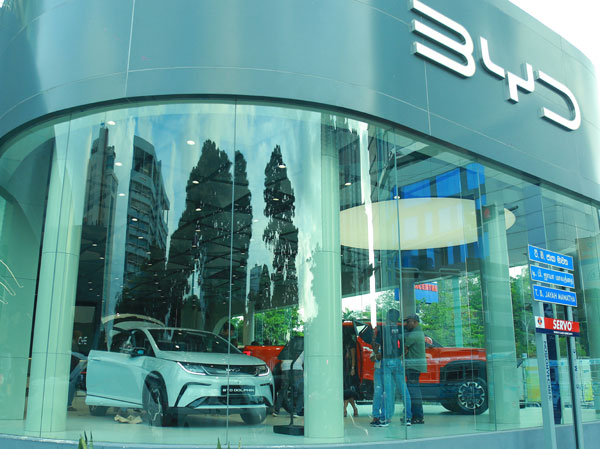
Meanwhile, Chinese new energy vehicle (NEV) manufacturer BYD Company, which is already listed in Hong Kong, continues to face legal battles with Sri Lanka Customs alongside its local distributor.
John Keells CG Auto, BYD’s local partner, sought legal recourse after a consignment of BYD electric vehicles (EVs) and plug-in hybrids was detained. On August 7, the Court of Appeal ordered the release of 991 out of 997 vehicles. Subsequently, another batch of BYD vehicles was detained, and earlier this month the court ordered the release of 506 more units.
The ongoing tussle — centered on electric motor power classifications, potential customs duties, and a demand for a level playing field — has drawn the attention of other NEV importers operating in Sri Lanka.
Surge in EV and Hybrid Registrations
Sri Lanka has seen a sharp rise in electric and hybrid vehicle sales in recent months. According to a breakdown by JB Securities, citing Department of Motor Traffic data, 5,668 EVs were registered in August — nearly three times the number recorded in February, when imports resumed after a suspension. Hybrid registrations also surged, with 1,907 units in August compared to just 27 in March.
BYD’s Market Challenges
Despite global expansion, BYD faces mounting challenges. The company has been criticized for aggressive discounting and continues to struggle with bearish sentiment on its stock. In July, BYD’s monthly sales fell for the first time this year, despite discounts of up to 30%.
According to unaudited Hong Kong filings, BYD’s battery electric vehicle sales in July fell sharply to 177,887 units — a decline of more than 40% year-on-year — while plug-in hybrid sales dropped 14.77% to 163,143 units.
Bloomberg reported in mid-September that BYD faced a US$45 billion stock sell-off amid an ongoing price war in China. In June, the company endured another sell-off, wiping more than US$20 billion off its market value in just two weeks. Over the past six months, BYD’s share price has fallen 15.68% on the Hong Kong Stock Exchange.
Still, year-to-date performance shows gains: BYD’s share price rose from HK$86 to HK$112.80 as of September 18, closing at HK$113.50 on Friday after opening at HK$112.20. Institutional investors such as Vanguard International Growth Inv Fund and Hang Seng China Enterprises ETF (holding 4.28%) remain invested, according to Morningstar data. BlackRock, Inc. holds a 6.23% stake in BYD’s H-shares, while UBS continues to recommend a “buy” rating with a target price of HK$160.
Earlier in March, BYD raised US$5.59 billion in Hong Kong via a primary share placement priced at HK$335.20 per share.
A Legacy of Innovation
Founded in 1995 as a mobile phone battery maker, BYD later acquired the state-owned Xi’an Qin Chuan Automobile. The company name, originally “ba ya di,” evolved into the acronym BYD. Over the years, BYD has become an innovation leader, developing fast-charging battery technology that promises 100 miles of range in five minutes, an advanced driver-assistance system, and its well-known 2020 “blade battery” using lithium iron phosphate.
The company’s design direction has also been shaped by Wolfgang Egger — famed for his work with Alfa Romeo, Audi, and Lamborghini. Today, BYD is the largest company in its sector in Hong Kong by market capitalization, ahead of competitors such as Li Auto, Geely Auto, Xpeng, Nio, and Yadea.
Nevertheless, the June quarter net profit fell 29.9% to 6.36 billion yuan. Bloomberg reported that BYD shares tumbled 8% after the announcement, erasing more than US$6 billion in market value.
Price War Concerns
Aggressive discounting in China’s domestic NEV market has triggered concern from regulators. The Chinese Communist Party’s People’s Daily recently criticized what it described as a “domestic rat race.”
BYD Executive Vice-President Stella Li, speaking at the Munich Motor Show, warned that “some of the original equipment makers will be pushed out” of the market if they cannot match the discounting trend. “Even 20 OEMs is too much,” she said.
Hozon, the manufacturer of the Neta brand, recently went bankrupt.
BYD has been offering steep discounts — as much as 30% for some models — along with generous trade-in subsidies. The Seagull model’s price dropped to 55,800 yuan (Rs 2.37 million) in May, while the trade-in subsidy for an electric vehicle reached up to 15,000 yuan (over Rs 637,000).
In its interim filings in Hong Kong, BYD acknowledged “intense market game, increased price competition, and frequent occurrence of excessive marketing,” calling such practices a “malpractice.”
In July, China’s Ministry of Industry and Information Technology urged NEV manufacturers to curb “irrational competition.” The China Automobile Dealers Association estimated in December that the price war led to industry losses of 177.6 billion yuan between January and November 2024.
Chery’s New Moves in Sri Lanka
Chery’s global brand lineup includes Tiggo, Arrizo, Fulwin, as well as the Omoda and Jaecoo models designed for overseas markets.
In Sri Lanka, Hayleys Mobility announced last month that it had signed an exclusive distribution partnership to market Omoda and Jaecoo — Chery’s compact SUVs developed specifically for international buyers.