Long before kennel clubs, backyard breeders, and modern animal rescue organizations existed, the ancient Maya were transporting and trading dogs across remarkable distances. New archaeological research is shedding light on the important role dogs played in Maya society, revealing they were linked to trade, ritual sacrifice, food consumption, companionship, and social status.
According to Elizabeth Paris, an archaeologist at the University of Calgary and National Geographic Explorer who specializes in the ancient Maya, dogs held a special place in their world.
“Dogs are the oldest domesticated animal worldwide,” Paris said. “The Maya valued those relationships and honestly, went through a lot of time and trouble to get special dogs and to breed special dogs.”
Dogs in Maya Society
Exactly how the Maya viewed dogs has long remained uncertain. However, new findings suggest their relationship with canines was complex and multifaceted.
Historical records from the colonial period offer some clues. Franciscan bishop Diego de Landa, known for destroying many Maya codices in the 16th century, later wrote about dogs being used in Maya rituals. He specifically described white dogs with dark spots being sacrificed during cacao-growing ceremonies.
Although colonial writings cannot always be fully trusted or directly applied to earlier Maya civilizations, archaeological evidence supports the existence of such dogs. Researchers have found depictions of white dogs with dark spots on Maya pottery and vases.
Ashley Sharpe, an archaeologist at the Smithsonian Tropical Research Institute, believes these images suggest the breed was common during that era.
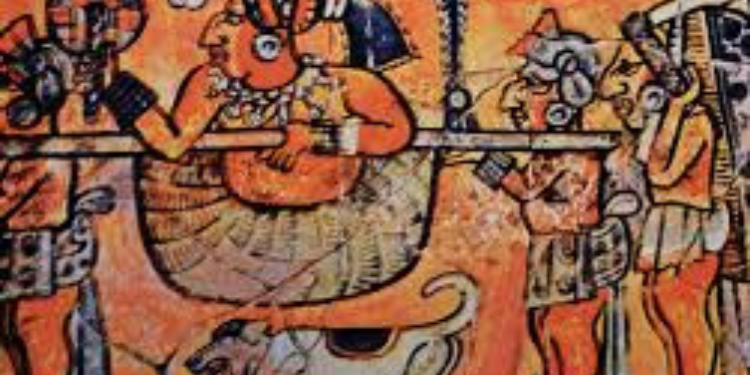
Some Maya artwork also shows dogs standing or walking beneath hammocks carrying rulers. While some scholars interpret this as part of funeral processions, Paris believes these scenes instead depict rulers traveling with dogs as companions or symbols of prestige.
Scientific Analysis Reveals Long-Distance Dog Trade
Modern scientific techniques are now helping researchers trace where these ancient dogs came from.
By analyzing isotopes in dog bones, scientists can determine where animals lived and what they ate. Chemical signatures absorbed through food and water vary by region, allowing researchers to track movement.
In 2018, Sharpe and colleagues found evidence of dog movement between two Maya cities in present-day Guatemala — Kaminaljuyu and Ceibal. Some dogs buried in lowland Ceibal originated from highland Kaminaljuyu, while others moved in the opposite direction.
“This was an indication that dogs must have been moving up and down the mountains somehow,” Sharpe said.
More recent research published in the Journal of Archaeological Science examined dog remains from two Classic Maya sites in southern Mexico’s Chiapas Highlands: Moxviquil and Tenam Puente.
Tenam Puente, once home to over 5,000 people, featured a large plaza, ball courts, ritual spaces, and a marketplace where dog remains were discovered. Moxviquil, a smaller settlement of around 1,000 residents, was surrounded by funerary caves containing both human and dog remains.
Using strontium isotope analysis, researchers determined that all four dogs found at Tenam Puente came from locations hundreds of miles away. One likely came from southern Campeche near the Guatemalan border, while three others probably came from the Becan region farther north.
The three dogs found at Moxviquil also had diverse origins. One was likely local, another may have come from the Mayapan region, and a third possibly originated near Palenque.
Paris says the findings strengthen evidence that dogs were part of a far-reaching Maya trade network.
“You have a trade of dogs over vast distances,” Paris said.
Why Did the Maya Trade Dogs?
Researchers are still debating the reasons behind the Maya dog trade.
Sharpe believes many dogs were raised primarily as food. Most dog remains found at Maya sites belong to small animals, slightly larger than modern Chihuahuas. She compares them to the well-known Colima dog figurines of western Mexico, which resemble short, stout modern corgis.
“I’m pretty sure they were little fat dogs,” Sharpe said.
Many of the dogs died between one and two years old, suggesting they were bred for consumption rather than kept long-term. Numerous bones also contain cut marks consistent with systematic butchering.
“It’s very systematic, they’re skinning them like a rabbit,” Sharpe explained.
However, not all dogs were used as food.
At Kaminaljuyu, archaeologists uncovered a pit containing dog remains dating to a period when a nearby lake — a vital water source — was drying up. Some researchers believe the Maya sacrificed the dogs in an attempt to appeal to the gods for rain.
Many skeletons had cut marks on their necks and were buried alongside broken pottery in a stone-lined area.
“That, I would say, is evidence of sacrifice—you can’t get better than that,” Sharpe said.
A Relationship More Complex Than Today
Future DNA research may reveal more about ancient Maya dog breeds and whether they are connected to modern dogs such as Mexico’s hairless Xoloitzcuintli.
For now, experts believe dogs in Maya civilization played many familiar roles still seen today — companions, hunting assistants, and status symbols — along with less familiar ones such as livestock and sacrificial offerings.
“Their relationship with dogs is more complicated than our relationship with dogs today,” Sharpe said.