
After a month when over 700,000 fans descended on Doha, Qatar will go back to being relatively empty. Real estate agents are concerned apartments will remain unfinished, hotels will have a glut of rooms, and some stadiums will never be used again.
When Qatar was drawn out of the envelope as a future host of the World Cup back in 2010, it was doubtful the majority of football fans would have been able to find it on a map.
A dozen years, $300 billion and a raft of controversy later, one of the most expensive marketing campaigns in history will culminate with the tiny Gulf state hosting a final on Sunday between Argentina and France that’s expected to be watched by half the planet.
The inevitable question is whether the extravaganza was all worth it – even for a host with a seemingly bottomless pit of money. The organizers – particularly FIFA – see the event as an outright success: a record TV audience, happy fans and a burnished brand. But however much soft power Qatar has gained from the tournament, the return to normality will be an epic comedown.
After a month when over 700,000 fans descended on Doha, Qatar will go back to being relatively empty. The fans have already started to return home, and so too will vast numbers of migrant workers. Real estate agents are concerned apartments will remain unfinished, while hotels will have a glut of rooms and some stadiums will never be used again.
Then there’s Qatar’s international standing, even as it supplies almost a quarter of the liquefied natural gas imports Europe is relying on to get through the winter. Before the focus of the World Cup turned to drama and upsets on the pitch, the country faced criticism about the rights of migrant workers and an aversion to LGBTQ pride symbols. That’s unlikely to go away.
This week, Qatar has also been the subject of non-World Cup headlines – a European Union corruption scandal involving bribery allegations.
And next month will put the spotlight back on how one of the biggest sporting events was handed to a tiny city-state in one of the world’s hottest regions as a court case gets underway. An indictment filed in the US accuses several officials of receiving payments to back Qatar’s bid. The country denies paying anyone for the hosting rights.
“There will be some long-term benefits for Qatar’s local population,” said Christina Philippou, a senior lecturer in sports finance at the University of Portsmouth in the UK. “However, if the whole purpose was to showcase Qatar to the world, in that sense I think there have been some less reputation-enhancing aspects. It’s been a very expensive ad campaign and I’m not sure it’s been an especially successful one.”
There’s no doubt Qatar made progress on workers rights after scrutiny from activists. A month before the tournament kicked off on Nov. 20, the ruling emir, Sheikh Tamim bin Hamad Al Thani, told local lawmakers some of the criticism was useful for the country’s development. But he also hit back at what he called an “unprecedented campaign,” full of “fabrications and double standards” with dubious motives.
The World Cup preparations shone a light on the Gulf region’s “kafala” sponsorship system for foreign workers, and although some of the controversy around human rights in Qatar has faded since the event began, some groups advocating for migrant workers say the pressure must continue.
“The end of the tournament must not signal the end of scrutiny,” said Isobel Archer, Gulf program manager at the Business & Human Rights Resource Centre in London. “Although FIFA and the Qatar government have repeatedly pushed the narrative that the labor reforms were the end goal, we know from workers themselves implementation is still severely lacking.”
Qatar’s long-term quest was for the tournament to modernize its image and make it a tourism and business destination on a par with regional rival Dubai. It’s not without precedence. Major sporting events have long been seen as a catalyst to transform cities.
The Barcelona 1992 Olympics were seen as the archetypal sporting success story, bringing much needed infrastructure and tourism to the then-struggling Spanish city. As the hype faded – just as it did following the Athens Olympics and the European football championships in Portugal years later – criticism over cost overruns and the exaggeration of social benefits grew.
The economic benefit of hosting the quadrennial World Cup may also be a myth, with no evident boost in the immediate aftermath of the event, according to a recent paper from the University of Surrey in the UK.
Qatar is no different. Even before the World Cup has finished, empty buildings dot its business and residential districts. Around 765,000 fans visited Qatar over the first two weeks of the tournament, according the organizers, short of the 1.2 million Qatar hoped would show up.
Many of those who made the journey weren’t disappointed, though. Shock results – Saudi Arabia beating Argentina, the early departure of Germany, Brazil’s quarter-final loss to Croatia and Morocco’s progress to the semi-finals – added to the convenience of the competition being played in one city.
“It’s great to be able to see all the different cultures and people, and it’s much more family friendly,” said Jason Daley, an American who has attended every World Cup since 2006 and runs social media accounts that provide fan information about the tournament. “Compared to the last couple of World Cups, the ease of getting through security and into the stadiums has been incredibly smooth.”
In a statement to Bloomberg News, a Qatari government official said: “Qatar has defied the sceptics who claimed that Qatar would not be able to host a successful World Cup. Some of those critics now admit that the Qatar World Cup has been the safest, most-family friendly and accessible World Cup yet for supporters around the world.”
It’s unclear how Qatar will remain that attractive to tourists. After the winners depart Qatar’s Hamad International Airport airport – replete with indoor tropical garden complex – the world’s attention will rapidly shift elsewhere.
Real Madrid football club is set to open a branded theme park next year, which will include rides, games, a museum and stores selling memorabilia. It’s a perfect post-World Cup attraction. But it will be in Dubai, not Doha.
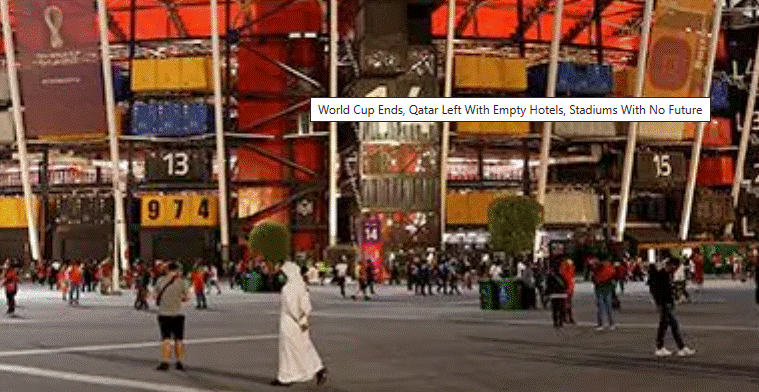
Lacking a competitive local football league, many of the stadiums will be broken up or converted. Stadium 974 – derived from Qatar’s international dialing code – was constructed out of shipping containers and will be dismantled after hosting a fashion show and concerts.
About 170,000 seats from other stadiums have been promised to developing countries. The other six stadia will be re-purposed for hotels, shopping or made smaller for local football teams, adding to an already oversupplied real estate market.
“The infrastructure, such as the metro system, would have been built regardless of the tournament being hosted,” said Ross Griffin, assistant professor at Qatar University. “But it put a convenient finishing date on everything.”
( this story has not been edited by NDTV staff and is published from a syndicated feed.)
(source: NDTV)