The political rise of TNA leader R. Sampanthan and Ranil Wickremesinghe share some similarities. Ranil became the UNP leader after the LTTE assassinated several UNP leaders. Similarly, Sampanthan, who had lost all elections since 1977, was elected to Parliament following the assassination of MP Thangathurai, which was linked to the LTTE
Sampanthan was elected to Parliament through a public vote in the 2001 General Election with the support of the LTTE. He was the first Tamil MP to campaign in LTTE-controlled areas during the 2001 General Election. In the 2004 General Election, the LTTE united the Northern and Eastern Tamil parties to form the TNA, with Sampanthan as its leader. During the 2002 ceasefire period, Ananda Sangaree, leader of the Tamil United Liberation Front, opposed the LTTE’s influence on Northern and Eastern Tamil politicians.
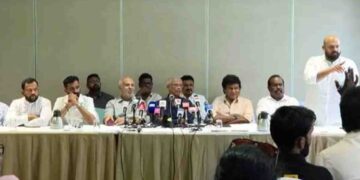
Sampanthan, however, was willing to act as the LTTE’s proxy leader, leading the LTTE to make him the leader. He frequently met with LTTE ideologue Balasingham and political wing leader Tamilselvan to receive guidance on parliamentary activities. Once, Sampanthan and a group of MPs met LTTE leader Velupillai Prabhakaran. Following this meeting, Sampanthan held a media conference stating that the TNA had decided to work in unity with the LTTE. Pottu Amman also attended this meeting. Afterwards, Sampanthan organized meetings with LTTE political wing leaders.
In the 2005 Presidential Election, some TNA MPs opposed Prabhakaran’s decision to boycott the election to defeat Ranil. They discussed this with Tamilselvan. Sampanthan, however, was willing to support the LTTE’s stance, holding media conferences to justify the election boycott. Below is his statement.
“Tamil residents in North-East are fully aware of the conduct of the two major Sinhala parties. They have been through and suffered through periods under these parties’ governance. We know and understand Tamil people’s frame of mind. We do not doubt that they are in full agreement with our thinking.
We discussed in depth and exchanged our views on the situation related to the elections and what historical significance our participation in the elections is going to be for the future of our people,” he said.
There was no doubt in any of the participants’ minds that the Presidential election would not produce any positive shift in the Southern Polity’s thinking and approach that will in any way result in any progressive advance towards resolving the Tamil question. That is why we decided that it is a futile exercise to show any interest in the elections,”
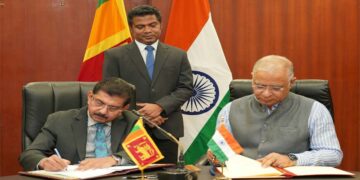
After the war, Indian national security advisor K.R. Narayanan visited Sri Lanka and met with TNA MPs. Media reports indicated that Sampanthan accused the Indian national security advisor of using the Tamil people to fulfil India’s geopolitical ambitions and then abandoning them. Although Sampanthan acted as Prabhakaran’s proxy leader, he later became friendly with India. Sampanthan, who spoke in favour of the Tamil election boycott in 2005, agreed to support Ranil’s common candidate, Fonseka, in the 2010 Presidential Election to secure Tamil votes. Later, he became a close ally of Ranil. From 2010 to 2015, Sampanthan supported Ranil as the opposition leader and worked to elect Ranil’s common candidate in the 2015 Presidential Election. Ranil became Prime Minister, and Sampanthan became the opposition leader.
Ranil conducted negotiations with the TNA during election time through Sampanthan. After Ranil became President, Sumanthiran and Rasamanickam opposed him, while Sampanthan advised continuing discussions with Ranil. Thus, Sampanthan’s loss is detrimental to TNA, Tamil people as well as to Ranil.