
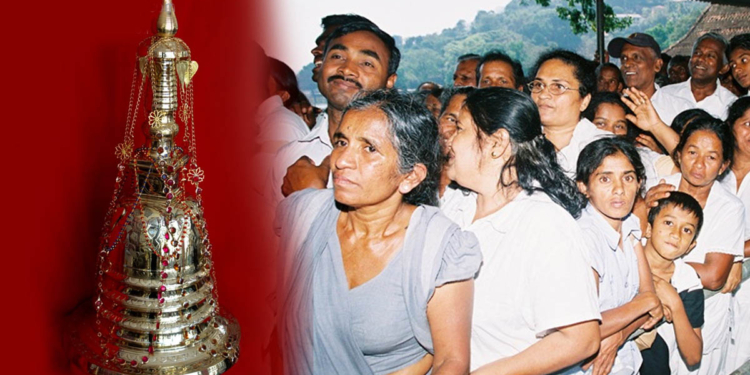
As I sit down to write this, my mind drifts back exactly 43 years, to mid-1982. At that time, I had already been a journalist for three years at the ‘Davasa’ newspaper and had recently joined the ‘Divaina’ newspaper. One unforgettable assignment during those early days was covering the 1982 Sri Dalada exhibition held at the Dalada Maligawa (Temple of the Sacred Tooth Relic) in Kandy. Such exhibitions are rare, held only once every few decades, making this a particularly memorable event in my 46-year journalism career.
I vividly recall spending two days in Kandy to report and photograph this extraordinary exhibition, which occurred shortly before the annual Esala Perahera. Back then, Mr. Nissanka Wijeratne served as the Diyawadana Nilame, the chief lay custodian of the Dalada Maligawa. A distinguished figure and a graduate of the University of Ceylon, Mr. Wijeratne held this esteemed position continuously for a decade, from 1975 to 1985.
The 1982 exhibition also held special significance due to its prominent guests. At the personal invitation of then-President J.R. Jayewardene, Prince Akihito of Japan (who later became Emperor) and the Princess attended the event as chief guests. Compared to today, crowds visiting the Dalada Maligawa were significantly smaller, yet the devotion of those who attended was profound. Journalists, including myself, received special privileges from Diyawadana Nilame Nissanka Wijeratne, allowing us rare access to closely worship and photograph the sacred Tooth Relic—a moment forever etched in my memory.
Reflecting on these past events, my thoughts now turn to the recently concluded Sri Dalada exhibition of 2025. Reports indicate that over 600,000 devotees visited during the exhibition held after a gap of 16 years, showing unprecedented enthusiasm and devotion. However, the immense crowd quickly posed significant logistical challenges. Initially disciplined, the masses soon became uncontrollable, causing the situation to escalate to an alarming level. Devotees, driven by pure devotion, remained at the venue for days. Unfortunately, these intense conditions resulted in tragedy: four devotees died, and thousands more fell seriously ill. Ultimately, authorities had to issue an urgent notice two days prior to the conclusion, pleading with devotees to refrain from further attendance.
In the aftermath, the city of Kandy faced a sanitation crisis, overwhelmed with garbage and human waste—a poignant reflection of the harsh realities faced by our country during such large gatherings. Despite these issues, the 2025 Sri Dalada exhibition concluded successfully.
Why have I begun this reflection by recalling the events of the 1982 exhibition and contrasting them with the recent one? The answer lies in the profound history of the relics of Gautama Buddha following his Mahaparinirvana. As narrated in ancient texts and various foreign historical accounts, after the Buddha’s cremation as described in the Mahaparinibbana Sutta (the 16th Sutta of the Digha Nikaya), his ashes became the focus of a historical dispute. Initially reserved solely for the Sakya clan, a conflict arose among several other clans and a king. Ultimately, the Brahmin Drona resolved this conflict by dividing the Buddha’s relics into eight portions.
These relics subsequently spread across various countries, safeguarded by kings and rulers throughout history. According to the ancient chronicles, particularly the Mahavamsa, Emperor Ashoka of India played a significant role by distributing the relics to numerous countries to be venerated, preserved in stupas, and honored through worship.
Today, sacred relics of the Buddha exist across 24 countries, including India, Thailand, China, Cambodia, Afghanistan, Bangladesh, Bhutan, Indonesia, Japan, Korea, Laos, Malaysia, Mongolia, Nepal, Myanmar, Pakistan, Russia, Tibet, Singapore, Vietnam, the United States, and our very own Sri Lanka. Among these, India is home to the largest collection of relics—unsurprising given that Buddha was born in Lumbini (Nepal), attained enlightenment in Bodh Gaya (India), and passed away in Kushinagar, also in India.
Currently, India houses 22 Buddha relics, all displayed with great reverence at the National Museum in New Delhi. Two relics were previously donated to the National Museum in Kolkata, while the remaining 20 continue to be exhibited year-round in New Delhi. Remarkably, many devotees remain unaware of the opportunity to view these relics due to strict regulations at the museum. Although formal worship with offerings such as flowers, incense, or lamps is prohibited, devotees are permitted to quietly meditate in the presence of the relics.
Notably, these sacred relics rest in an exquisite casket made entirely of 24-carat gold—a generous gift to India from the King of Thailand. Visitors to India have the rare opportunity not only to view but to spiritually reflect upon these relics in a peaceful setting, marking a deeply spiritual experience for devotees worldwide.
Thus, from my personal memories spanning over four decades to recent events, these exhibitions remind us of the enduring reverence and challenges surrounding the veneration of sacred Buddhist relics. Such moments serve both as lessons and as profound reminders of our shared heritage and devotion.
Priyantha Hettige