A South Asian nation has emerged as an unexpected mediator in global efforts to end the ongoing U.S.-Israeli war with Iran. However, at the same time, it is engaged in its most intense conflict in decades with neighboring Afghanistan—an issue that has received far less attention amid the Middle East crisis.
Pakistan has proposed its capital, Islamabad, as a potential venue for negotiations between the United States and Iran. U.S. President Donald Trump stated that “great progress” is being made toward initiating talks, although Tehran has denied that any discussions are currently taking place. Trump, who is scheduled to address the nation on Wednesday night, also told NBC News on Tuesday that Iran does not necessarily need to reach a deal for the conflict to come to an end.
Nevertheless, if negotiations do take place, Pakistan is keen to host them. The country, with a population exceeding 250 million, is aiming to strengthen its regional influence. It also faces significant risks if the war continues, particularly due to Iran’s closure of the Strait of Hormuz, which has blocked nearly all of Pakistan’s oil and gas imports.

Pakistan has already assisted the United States in delivering a 15-point ceasefire proposal to Iran, though Tehran responded with skepticism. This week, Islamabad hosted two days of discussions involving the foreign ministers of Saudi Arabia, Turkey, and Egypt—three regional powers seeking to reduce tensions in the conflict.
According to Foreign Minister Ishaq Dar, Pakistan has received “full support” from these countries to act as host, along with backing from China, which on Tuesday introduced a five-point peace initiative during Dar’s visit to Beijing.
“Pakistan will be honored to host and facilitate meaningful talks between the two sides in coming days,” Dar said earlier this week, adding that both the U.S. and Iran “have expressed their confidence in Pakistan to facilitate the talks.”

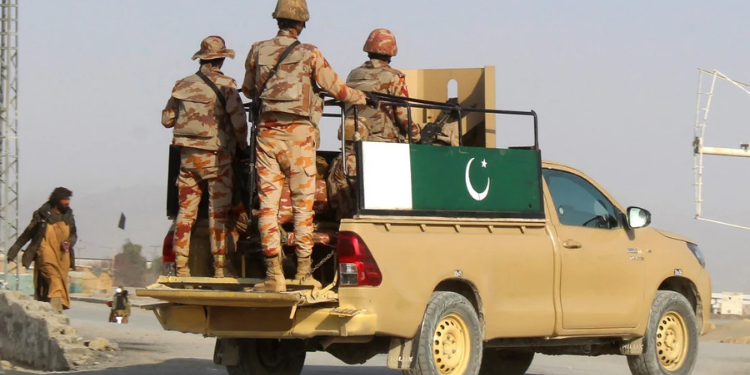
Even as diplomatic discussions on ending the Iran conflict were underway in Islamabad on Sunday, Pakistan was engaged in heavy fighting with Afghanistan, marking the second month of a conflict that has resulted in civilian casualties on both sides.
The Afghan government reported that one person was killed and more than a dozen others—mostly women and children—were injured by Pakistani shelling near the eastern city of Asadabad. Pakistani officials denied targeting civilians, stating that their actions were in response to Afghan attacks, according to Reuters.
Afghanistan is also dealing with the aftermath of an apparent Pakistani airstrike on a drug rehabilitation center in Kabul on March 16. The United Nations, which condemned the strike, reported that at least 143 people were killed. Two mass funerals have since been held, with images showing bulldozers digging 60 graves in Kabul last Thursday.
Pakistan has rejected allegations of targeting a civilian facility, stating that it “precisely targeted military installations and terrorist support infrastructure” at the site, which it described as a former NATO and U.S. military base.
However, Amnesty International noted that the site had been widely recognized as a drug rehabilitation center since 2016, arguing that “any reasonable assessment and information gathering would have concluded that the camp had a high civilian presence.” Satellite imagery from Vantor, taken three days before the strike, showed groups of people gathered in the facility’s courtyard.

Pakistan attributes the recent rise in militant attacks to Afghanistan, particularly following the U.S. withdrawal in 2021, although the Taliban deny that militants are using Afghan territory as a base.
Ali Sarwar Naqvi, a former Pakistani diplomat and executive director of the Islamabad-based Center for International Strategic Studies, stated that years of diplomatic efforts have failed to resolve the issue.
“There’s this wrong impression that we are waging a war against Afghanistan,” he said, adding that “the Afghans are the ones who have been allowing terrorist acts to be carried out against Pakistan.”
On Wednesday, Pakistan and Afghanistan resumed talks in China, which is acting as a mediator. Two government officials in Islamabad and two in Kabul confirmed to NBC News that discussions would focus on extending a ceasefire, reopening border crossings, and restoring trade and economic activity. The officials requested anonymity as they were not authorized to speak publicly.
Meanwhile, the ongoing conflict risks further destabilizing a region where extremist groups such as the Islamic State and Al Qaeda are attempting to regroup.

Regarding Iran peace efforts, analysts warn of potential challenges. Chietigj Bajpaee, a senior research fellow for South Asia at Chatham House in London, said the key issue is whether Pakistan’s ambitions can withstand its internal and regional instability.
However, he noted that successfully hosting the talks would significantly enhance Pakistan’s international standing.
“Its status with the U.S., its status in the Islamic world, and status in South Asia would go up,” Bajpaee said.
Naqvi added that Pakistan is in a “unique position” to mediate due to its strong relations with all five permanent members of the U.N. Security Council—the United States, Britain, China, France, and Russia—while also serving as a current member of the council.
“Therefore we should play our rightful role of trying to bring the combatants together,” he said.
Pakistan’s relationship with the United States has improved significantly under Trump, who met twice last year with Pakistan’s army chief, Field Marshal Asim Munir, and referred to him as his “favorite field marshal.” Pakistan has also shown support by joining Trump’s Board of Peace and nominating him for the Nobel Peace Prize.

Despite these diplomatic efforts, the Iran war remains highly unpopular within Pakistan, which has the world’s second-largest Shia Muslim population after Iran. When a U.S.-Israeli strike killed Ayatollah Ali Khamenei, Iran’s supreme leader and a central figure in Shia Islam, protests erupted, with demonstrators marching toward U.S. diplomatic missions.
Bajpaee also pointed out additional challenges, including Pakistan’s lack of formal diplomatic relations with Israel, which has pledged to continue its military actions and does not appear to be directly involved in any U.S.-Iran negotiations.
Furthermore, while Pakistan and Iran share strong cultural and religious ties, their relationship has faced tensions. Rajiv Dogra, a former Indian diplomat who served in Pakistan, highlighted past incidents, including cross-border strikes in 2024 over Baloch separatists operating in both countries.
He also referenced Pakistan’s struggles to protect its minority Shia population from attacks by Sunni militants.
“All this is noted in Tehran and noted with displeasure,” Dogra said.
During a phone call on Saturday with Pakistani Prime Minister Shehbaz Sharif, Iranian President Masoud Pezeshkian praised Pakistan’s peace initiatives but emphasized “the need to build trust,” according to a Pakistani statement.
Nevertheless, Iran has recently described Pakistan as a friendly nation. According to Pakistan, Iran has permitted 20 additional Pakistani-flagged ships to pass through the Strait of Hormuz, following the successful transit of 10 vessels last week.

Pakistan has historically played a key role in U.S. diplomatic efforts in the region.
In 1971, Henry Kissinger secretly traveled to China via Pakistan ahead of President Richard Nixon’s landmark visit to Beijing. Pakistan also assisted in facilitating the Soviet withdrawal from Afghanistan in the 1980s, as well as the U.S.-Taliban agreement that ended the war in Afghanistan during Trump’s first term.
“We have done a number of times this kind of work to establish peace and stability in the region,” Naqvi said. “That is our objective.”