
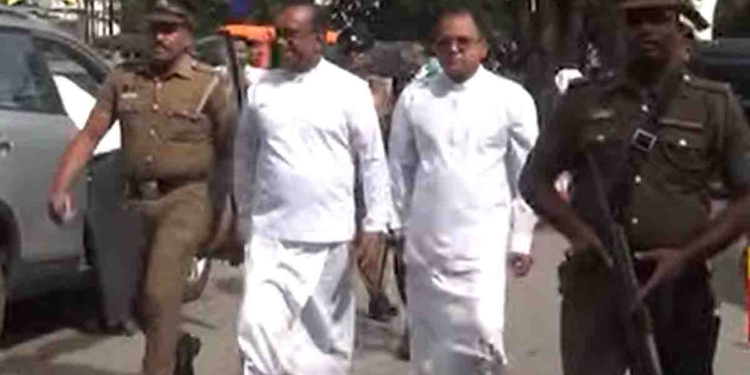
The appeal petitions filed by former Minister Mahindananda Aluthgamage and former Minister Nalin Fernando against their 20-year rigorous imprisonment sentences, imposed by a three-judge bench of the Colombo High Court on a corruption charge, were heard for the second day yesterday (10) before the Supreme Court.
The hearing was conducted before a five-judge bench of the Supreme Court, headed by Chief Justice Preethi Padman Surasena and comprising Supreme Court Judges Shiran Gunaratne, Arjuna Obeysekara, Achala Wengappuli, and Sampath Abeykoon.
During the proceedings, President’s Counsel Ali Sabri and Romesh de Silva, representing the defendant appellants, presented several crucial points to the court.
Ali Sabri highlighted that the goods in question had been imported in accordance with a decision by the Sathosa Procurement Committee during the original trial. He argued that the Bribery Commission had deliberately failed to present key facts and call essential witnesses related to that procedure, creating a significant missing link in the case. He stressed that the allegations could not be sustained without proving this.
The defense lawyers also confirmed that there was no manipulation of evidence. They argued that the investigation had been politically motivated from the outset, targeting the 2nd accused-appellant, a minister at the time, and the 1st accused-appellant, the chairman of Sathosa, based on political interests.
Romesh de Silva argued that it was illegal to convict Mahindananda Aluthgamage on the charge of “conspiracy” after he had been acquitted on the charge of “aiding” in the indictment filed by the Bribery Commission. He further asserted that filing charges of “conspiracy” under the Penal Code via the Bribery Act was illegal and therefore null and void.
De Silva emphasized that it had not been proven that the government suffered any loss due to the import of the sports goods in question. Since Sathosa is a private institution, any loss incurred by it could not legally be considered a loss to the government. He also pointed out that the goods were never received by the Sports Ministry and had instead been taken to a location in Mabola, Kelaniya, by the warehouse custodian.
The defense also criticized the prosecution for failing to call seven essential witnesses, including those from the procurement committee. They further condemned the practice of forming opinions about the trial on social media, describing it as highly inappropriate.