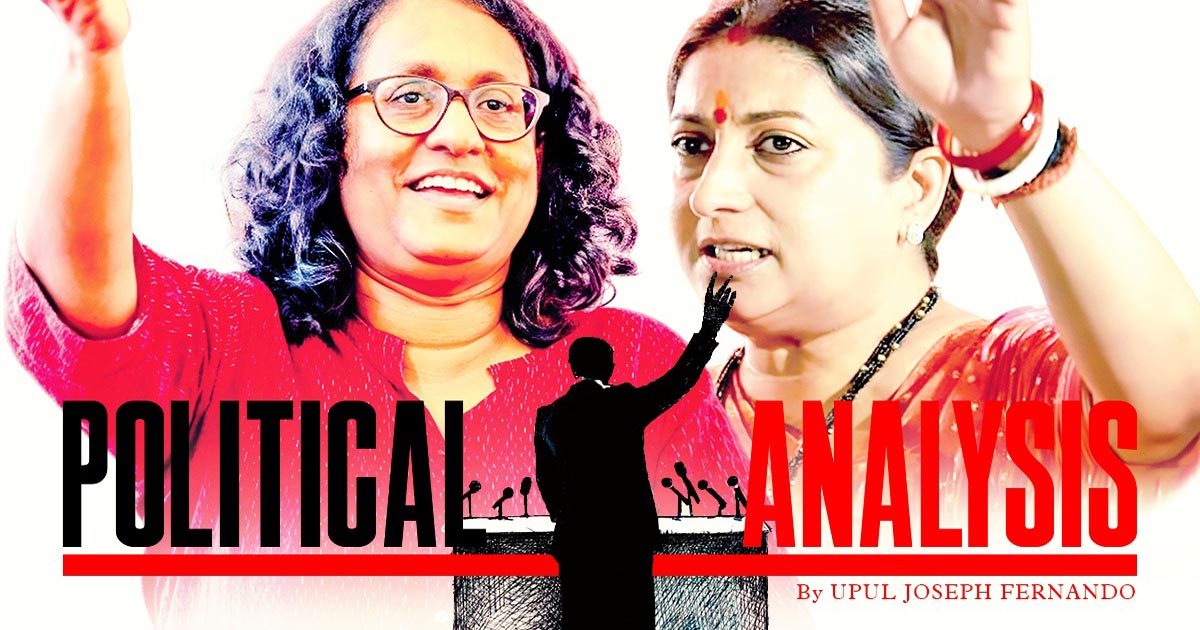
Smriti Irani is a well-known figure not only in India but also in Sri Lanka. She rose to prominence in Sri Lanka through the teledrama Mahagedara, where she portrayed the character “Tulsi.” From the very beginning, Tulsi’s depiction as a warm and welcoming woman endeared her to Sri Lankan audiences. The role simultaneously made her immensely popular in India, where the name Tulsi Virani became familiar in nearly every household across both countries.
The Bharatiya Janata Party (BJP) recognized her political potential largely because of the image she had cultivated as Tulsi Virani — that of a middle-class Indian wife and mother. She joined the BJP in 2003 and quickly rose to senior positions within the party. Prime Minister Narendra Modi then entrusted her with a formidable political challenge: contesting the Amethi constituency, long considered the stronghold of the Gandhi family. Just as Attanagalla was the Bandaranaikes’ bastion and Hambantota the Rajapaksas’ fortress, Amethi had been the Gandhis’ domain. For decades, the Gandhis entered Parliament through Amethi, retaining the seat even when they lost power nationally.
Modi’s objective in assigning Irani to Amethi was clear: dismantle the Gandhis’ political fortress if possible. In the 2014 general election, however, she failed to defeat Rahul Gandhi, who retained the seat. Following this, Modi appointed her as India’s Minister of Education.
As Education Minister, Irani attempted to run the ministry in an authoritarian manner. She faced strong opposition from teachers and students after trying to alter degree programmes at Delhi University and later reinstate previously changed courses. In protest against her arbitrary administration, the director of a technical institution resigned, as did a prominent nuclear scientist. Her attempt to replace German with Sanskrit in university curricula met widespread resistance, and she further provoked criticism by banning academic discussions and seminars at universities.
Meanwhile, the opposition accused her of submitting fraudulent educational qualifications when contesting elections. Educationists and professionals argued that such misrepresentation made her unfit to serve as Education Minister. The opposition pursued the matter in court, and protests erupted nationwide. During these demonstrations, Irani claimed the accusations stemmed from gender bias, arguing that a male-dominated opposition could not tolerate a woman in her position. The BJP mobilized its women’s wing in her defence, and she sought to deflect criticism by playing the “women’s card”.
The court eventually ruled that her educational qualifications were indeed false. Amid the resulting embarrassment, she was removed from the Education Ministry and appointed Minister of Textiles.
Despite these setbacks, Irani did not retreat from the challenge Modi had given her. In the 2019 general election, she contested Amethi once again, vowing to unseat the Gandhis. This time, she defeated Rahul Gandhi, stripping the “crown” from the Gandhis’ heir and shattering their long-held dominance. The nation watched in astonishment as this “iron woman” achieved what had once seemed impossible. Political analysts even predicted she could succeed Modi as the BJP’s next leader. She was subsequently appointed Minister of Women and Child Development.
During this period, Irani endured physical and verbal attacks from opposition supporters — she was pelted with footwear, booed, and stoned on multiple occasions. She used these incidents to garner public sympathy. After her victory in Amethi, the opposition grew wary of her. The BJP’s women’s committee launched a major campaign portraying criticism of Irani as an attack on women’s dignity, though the opposition continued its struggle against her.
Yet, despite her popularity as both an actress and politician, Irani faltered as a minister. She failed at the Ministry of Education and again at the Ministry of Women and Child Development. Over time, she lost public support in Amethi. What had once been a major asset to the BJP became a liability, a “white elephant”. In the 2024 general election, Congress candidate Kishor Lal defeated her by 167,196 votes, stunning the nation.
The same Smriti Irani, once predicted to be the BJP’s leader after Modi, could not withstand the pain of defeat. She withdrew from politics and returned to acting in teledramas.
Her story inevitably comes to mind when observing the controversy surrounding Sri Lanka’s Education Minister Harini Amarasuriya and her attempted reforms. Even before introducing reforms, she began, like Irani, by banning university discussions and seminars, including a conference at the University of Peradeniya.
Colombo has historically been a UNP stronghold, producing leaders such as J.R. Jayewardene, Premadasa, Lalith Athulathmudali, and Ranil Wickremesinghe. No leader from anti-UNP parties had ever challenged this dominance. Yet, in the 2024 general election, Harini shattered the UNP’s Colombo fortress by securing a record number of preferential votes. Just as Modi entrusted Irani with the Education Ministry, President Anura entrusted Harini with the same portfolio.
At the time Harini assumed office, Sri Lanka’s leading businessman, Dhammika Perera, was spearheading efforts to digitize school education through DP Education, offering free online learning to children. During the COVID period, when the Gotabaya government struggled to sustain education, it was Perera who launched DP Education to provide free online classes. By 2029, he had also introduced programmes aimed at fostering children’s digital creativity.
As Education Minister, Harini neither engaged with this online education revolution nor initiated programmes to advance digital learning in Sri Lanka. Instead, without consulting education experts or holding parliamentary discussions, she attempted to unilaterally overhaul the education system. This proved to be her downfall. When the opposition took to the streets against her reforms, she too attempted to play the “women’s card”, as Irani had done. This strategy failed, and eventually the government conceded to opposition protests.
Harini, once an asset to the JVP during the 2024 presidential and general elections, has now become a liability to the party — just as Smriti Irani became to the BJP.
“So does that mean Harini will face the same fate as Smriti Irani in the next election?” It is far too early to say.