
Backlash Erupts Over Lalkantha’s ‘Mihintale Barbarian’ Remarks
Government Stands Firm on Education Reforms Amid Mounting Opposition
Sajith Pushes for Timely Two-Party Unity at a Critical Juncture
Sri Lanka Lets a Major Indian Opportunity Slip Away
Why Didn’t Wang Meet Anura?
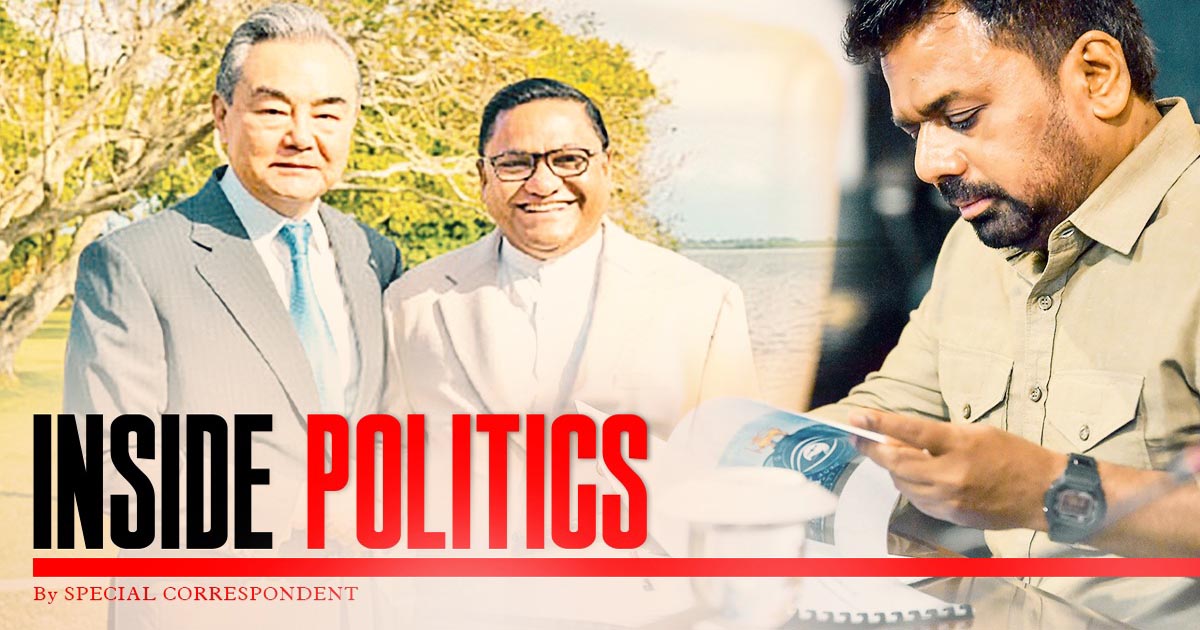
Last week, Chinese Foreign Minister Wang Yi visited Sri Lanka, spending only a few hours in the country. As previously revealed in the “Inside Politics” column, Wang Yi was scheduled to stop in Sri Lanka as a transit point on his return journey to China after completing his tour of Southern Africa. Accordingly, President Anura Kumara Dissanayake, Prime Minister Harini Amarasuriya, and Foreign Minister Vijitha Herath were all preparing to meet and hold discussions with him.
Similarly, Wang Yi had visited Sri Lanka in 2016 during the Yahapalana government. That visit too was a transit stop following his annual South Africa tour. On that occasion, he met then-President Maithripala Sirisena and Prime Minister Ranil Wickremesinghe in Colombo for discussions. Later, in 2022, Wang Yi once again traveled to Southern Africa and stopped in Sri Lanka, where he met President Gotabaya Rajapaksa and Prime Minister Mahinda Rajapaksa.
During Ranil Wickremesinghe’s presidency, two foreign heads of state also stopped in Katunayake as transit points. One was French President Emmanuel Macron, and the other was South African President Cyril Ramaphosa. On both occasions, President Wickremesinghe went to the Katunayake hotel where they were staying to meet them. Notably, Ramaphosa’s birthday coincided with his visit, and Ranil, along with several ministers, joined in cutting a birthday cake and extending greetings. Photographs of this event were widely published in the media. Thus, both the French and South African presidents briefly set foot in Sri Lanka only for a few hours, but the meetings were considered significant.
This time, reports indicated that Chinese Foreign Minister Wang Yi would again stop in Sri Lanka for a few hours as a transit point, and the President was expected to meet him. Initially, it was reported that the President would go to Katunayake to hold discussions with Wang Yi. However, another perspective suggested that, according to protocol, a President does not go to meet a foreign minister; instead, the minister should come to Colombo to meet the President. Yet, given Sri Lanka’s current crises, some advised the President to set aside protocol and go to wherever Wang Yi was staying in order to hold discussions with him.
Was the Meeting Stopped by Someone?
Despite the circumstances, when Wang Yi arrived in Sri Lanka, no meeting took place between him and the President—a notable development. Although this was not publicly discussed, diplomatic circles exchanged various explanations. Questions arose: Why didn’t Wang Yi meet Anura and Harini? From which side was the meeting prevented? Was it abruptly cancelled, or did someone deliberately stop it? These speculations became a topic of discussion among diplomats.
However, by last week, media attention was largely diverted to other issues—such as the controversy over the Grade 6 English module question and Minister Lalkantha’s remarks of the “Mihintale Barbarian.” As a result, the matter of the cancelled meeting between Wang Yi and the President received little coverage. The only images published showed Foreign Minister Vijitha Herath meeting Wang Yi.
Why Was the Hotel Hidden?
Another unusual detail emerged. Whether by oversight or deliberate choice, neither the Chinese Embassy in Colombo nor Sri Lanka’s Foreign Ministry mentioned the location of the meeting between Vijitha Herath and Wang Yi in their official statements. Both sides only confirmed that a meeting had taken place, during which Herath requested Chinese assistance for Sri Lanka’s recovery from recent storm damage.
Official photographs released to the media suggested that the meeting occurred at a hotel near a lagoon. This confirmed that Wang Yi had landed at Katunayake and then traveled to that area. Yet, all parties carefully avoided naming the hotel, ensuring that the venue remained undisclosed.
Official Statement
The official communiqué read:
“Chinese State Councilor and Foreign Minister Wang Yi, during a brief stopover in Sri Lanka on his return from an overseas visit, held discussions with Sri Lankan Foreign Minister Vijitha Herath.”
Wang Yi emphasized that China and Sri Lanka share a long-standing friendship based on mutual respect, equality, and benefit, and that China attaches great importance to preserving this relationship. He noted China’s understanding of Sri Lanka’s current economic and developmental challenges and reaffirmed China’s support for the development path chosen by the Sri Lankan government and people.
He further stated that China is ready to continue providing all possible assistance to promote Sri Lanka’s stability, development, and prosperity. Both sides exchanged views on deepening cooperation in trade, investment, infrastructure, agriculture, tourism, and improving livelihoods. They also focused on enhancing high-quality and practical cooperation under the Belt and Road framework.
Wang Yi added that in today’s complex and unstable international environment, developing countries like China and Sri Lanka must work together to safeguard multilateralism, uphold the goals and principles of the United Nations, and resist the notion of “might is right.”
Foreign Minister Vijitha Herath expressed that the Sri Lankan people highly value the long-standing friendship with China and conveyed gratitude for China’s continuous support in Sri Lanka’s economic recovery and development efforts. He reaffirmed Sri Lanka’s unwavering support for the One-China policy.
Both sides agreed to further strengthen China–Sri Lanka relations, enhance high-level exchanges, and expand practical cooperation.
The Hidden Hotel Revealed
It was eventually discovered that the hotel where Foreign Minister Vijitha Herath met Chinese Foreign Minister Wang Yi had been deliberately kept secret. Following an investigation by the ‘insidepolitics’ column last week, it was revealed that Wang Yi had stayed for several hours at the luxury Jetwing Lagoon Hotel in Negombo, awaiting his next flight.
Previously, the Jetwing Lagoon fell under the Pamunugama police division, but after recent administrative changes, it now belongs to the Dungalpitiya division. According to inquiries, Vijitha Herath went to this hotel to meet Wang Yi and hold discussions.
This raised the next question: why were the scheduled meetings between Wang Yi and the President, as well as the Prime Minister, cancelled? Was it because the Chinese side refused to hold such a meeting in Colombo? This issue has now become the subject of serious debate.
Expectations vs. Reality
Sri Lankan authorities had high hopes for Wang Yi’s visit. They believed he would announce China’s commitment to rebuilding areas devastated by the recent cyclone. In fact, just before his arrival, the President launched the “Rebuilding Sri Lanka” website, expecting that one or more major projects listed there would be taken up by the Chinese government.
Yet, during his brief stopover, Wang Yi made no official statement about such commitments. The official communiqué only noted that Vijitha Herath requested assistance for recovery from cyclone damage, but Wang Yi did not give a concrete response. No project was formally pledged by China.
Why Did China Step Back?
This lack of commitment is striking, given the historically close ties between the current Malima administration and China. During the President’s earlier visit to Beijing, Sri Lanka’s Chinese ambassador had assured him that President Xi Jinping was ready to grant any request.
Moreover, JVP General Secretary Tilvin Silva had recently undertaken a lengthy visit to China, where discussions focused on strengthening ties between the two countries, between their leaders, between the Communist Party of China and the JVP, and between the peoples of both nations. Similarly, Minister Bimal Ratnayake also visited China to study provincial administration and rural industries. On each occasion, Chinese officials emphasized their readiness to assist Sri Lanka in any way.
This led many in Sri Lanka to believe that the government had chosen to distance itself from the U.S. and Western powers, aligning its future path more closely with China.
However, recent developments suggest that some powerful factor has disrupted this friendship. According to unofficial information uncovered by inside politics, during discussions held on December 25 with Wang Junsheng—a member of the 20th Central Committee of the Communist Party of China and Party Secretary of the Xinjiang Autonomous Region—Sri Lankan officials expected a major Chinese grant. Yet, nothing materialized.
Where Is the Chinese Agreement?
After the meeting between the President and senior government leaders, the Chinese envoy traveled to Pelawatte to meet JVP General Secretary Tilvin Silva. According to diplomatic circles, the main issue raised during this meeting was China’s dissatisfaction over Sri Lanka’s refusal to allow Chinese research vessels into its waters.
During the President’s earlier visit to China, he had reportedly given verbal consent for such vessels to enter Sri Lankan waters and promised to formalize this through an agreement (an SOP). However, nearly a year has passed since that verbal commitment, and the Malima government has yet to publish the agreement. China is said to be displeased by this delay.
Under former President Gotabaya Rajapaksa, Chinese research vessels entered Sri Lankan waters without restriction, though India and the U.S. strongly opposed it, claiming the ships were spying on India. In response to this opposition, Ranil Wickremesinghe’s government imposed a one-year ban on Chinese research vessels. China viewed this as a serious insult to its national pride, and during Ranil’s tenure, Sri Lanka received no aid from China.
When Anura Kumara Dissanayake came to power, China believed the issue had been resolved and accepted verbal assurances. Yet, the government’s failure to formalize the agreement has left China increasingly frustrated, leading to speculation that Beijing has now taken a firm stance toward Sri Lanka.
The Indian Agreement Exposed
This tension became clearer during the Pelawatte meeting between Tilvin Silva and the Chinese envoy. Reports suggest that when Tilvin attempted to explain the situation, the envoy produced a document from his file—allegedly a copy of a special security agreement signed between Sri Lanka and India.
Although such an agreement was signed recently, the government has not disclosed it publicly. The opposition has repeatedly demanded that these agreements be presented in Parliament, but the government has remained silent.
According to diplomatic chatter, the envoy showed Tilvin the document and remarked: “You have given so much to India. But what have you given us?” While the authenticity of this account cannot be fully verified, it has gained significant weight in diplomatic circles.
Are the Chinese Still Easily Fooled?
Many believe that Wang Yi’s visit should have been a major event, but the unresolved issue of research vessels overshadowed it. Just days before his arrival, Foreign Minister Vijitha Herath stated that the agreement on Chinese research vessels could be finalized within two months. Yet, sources indicate the draft has been ready for nearly a year, withheld only because making it public might provoke other countries.
Herath’s promise of a two-month timeline may have been intended to secure Chinese aid during Wang Yi’s visit. However, the government seems to have overlooked an important reality: today’s Chinese are not the “easily deceived” ones of the past.
In earlier times, Sri Lankans joked about gullible people as “ponytail Chinese.” But modern China is far more assertive and pragmatic. Wang Yi’s visit was proof of this. Despite Sri Lanka’s hopes for major financial assistance to rebuild after floods and cyclones, the Chinese Foreign Minister made no official announcement of aid. Not even a hint of serious attention to such projects was visible.
India’s Request That Fell Flat
While tensions with China were unfolding, a separate episode involving India also came to light. This concerns the Buddha Relics Exhibition that had been planned last year.
In January, Indian Prime Minister Narendra Modi organized a grand exhibition in New Delhi titled “The Light and the Lotus: Relic of the Awakened One”, held at the Rai Pithora Cultural Complex. The relics, discovered in Piprahwa (Kapilavastu region), are preserved at the National Museum in Delhi and the Indian Museum in Kolkata. Alongside these sacred relics, a priceless collection of pearls and gems—recently recovered from auction—was also displayed. Remarkably, this was the first time in 127 years that the gem collection was exhibited in India.
According to information uncovered, India had initially chosen Sri Lanka as the venue for this exhibition. Hosting it in Sri Lanka would have drawn not only vast numbers of local devotees but also international Buddhist pilgrims and Indian tourists. However, the Malima government at the time missed this opportunity. Instead, it scheduled a hurried Tooth Relic Exhibition in Kandy, timed to coincide with LG elections.
The Kandy exhibition left the city overwhelmed, with garbage piling up and infrastructure strained. Many criticized it as a politically motivated event held at the wrong time, which even worsened the impact of floods and landslides that followed the cyclone.
India’s Vesak Proposal
India did not entirely abandon the idea. The Sri Lankan government later requested that the Buddha Relics Exhibition be held during Vesak, possibly in Nuwara Eliya, where the state Vesak festival was planned. India agreed and sent a high-level delegation, including a cabinet minister, to assess feasibility.
However, the delegation’s report was unfavorable. They noted that Nuwara Eliya, despite being a tourist paradise, posed logistical challenges. They also pointed to the problems caused by the earlier Kandy exhibition and concluded that Sri Lanka lacked the experienced teams needed to manage such a large-scale event.
Additionally, the Indian delegation was reportedly disappointed by the lukewarm reception they received. Instead of being welcomed by senior Sri Lankan officials, they were met only by mid-level representatives. In contrast, during President J.R. Jayewardene’s era, a similar relic exhibition had been fully supported by the Ministry of Buddhist Affairs, with top leaders like Prime Minister Ranasinghe Premadasa and Minister E.L.B. Hurulle directly involved.
Ultimately, India informed Sri Lanka that the Vesak exhibition could not be held there. Thus, a rare opportunity for Sri Lanka to host a historic religious and cultural event was lost due to missteps and poor preparation.
The Historic Photograph
Meanwhile, domestic politics shifted focus elsewhere. The controversy over the Grade 6 English module and Minister Lalkantha’s “Mihintale Bushman” remark dominated headlines. Yet, one political development did capture attention: the growing rapprochement between the Samagi Jana Balawegaya (SJB) and the United National Party (UNP).
A photograph released after a meeting at the Taj Samudra Hotel in Colombo—featuring SJB leader Sajith Premadasa with UNP leaders Ruwan Wijewardene, Akila Viraj Kariyawasam, and Naveen Dissanayake—went viral. It has become a symbol of hope among grassroots supporters of both parties.
By last week, the photo had been viewed over 680,000 times online, and the number continues to rise. Party organizers report that supporters at the village level are now expressing strong optimism about unity between the two parties. With young leaders visibly involved, many believe that this time, a merger is inevitable.
Sajith–Ruwan–Sagala Meeting
Opposition Leader Sajith Premadasa celebrated his 59th birthday on January 12. True to his tradition, Sajith did not mark the day with parties or personal festivities, but instead dedicated it to religious and social welfare activities. That morning, he visited the Gangaramaya Temple in Colombo, a place historically central to UNP politics since the era of former President Ranasinghe Premadasa.
Just as his father had done, Sajith chose Gangaramaya for his birthday observances. Organizers informed senior UNP youth leaders about the event, and their presence turned what was meant to be a simple religious ceremony into a nationally significant occasion. Among those who attended were UNP Deputy Leader Ruwan Wijewardene, National Organizer Sagala Ratnayake, Deputy Leader Ravi Karunanayake, and a large group of UNP municipal councillors from Colombo.
Notably, many UNP councillors and grassroots organizers joined without formal invitations, underscoring the symbolic importance of the event. As a result, the ceremony became more than just a religious observance—it was seen as another major step toward unity between the Samagi Jana Balawegaya (SJB) and the United National Party (UNP). Photographs of the event quickly gained prominence, echoing the publicity of the earlier Taj Samudra Hotel meeting between SJB and UNP leaders.
Party Reactions and Strategic Concerns
At last week’s UNP Working Committee meeting, attention focused on the ongoing SJB–UNP discussions. The UNP issued a statement proposing a meeting between the working committees of both parties. This raised suspicions among some that the proposal might be aimed at creating friction and slowing down the growing momentum toward unity.
Sajith, however, was well aware of the discussions and the underlying motives. At the SJB Working Committee meeting, he updated members on the progress of talks with UNP youth leaders and delivered a strong message of reassurance.
Sajith’s Special Statement
Sajith emphasized:
“We have begun discussions to unite the SJB and the UNP. But this is not something that can be rushed or forced. We have already laid the foundation, but we must continue detailed talks to ensure fairness to both sides. Neither our members nor UNP members should feel disadvantaged. This must be done in a way that satisfies both parties and their supporters. We cannot repeat the old mistakes of committees pulling in different directions. If anyone thinks of playing games like before, this time there will be no room for that.”
He further explained:
“I first met Ruwan, Akila, and Naveen at the Taj Samudra Hotel, and the discussion was very positive. Afterwards, I met Sagala Ratnayake, and that too was very constructive. These meetings have created great enthusiasm among both SJB and UNP supporters. But we need more time. If anyone feels I should step aside, I am ready to let others continue. But as long as I lead, I will move forward step by step. Don’t rush to make public comments that could harm the excitement among our supporters. If the media asks, simply say the talks are progressing positively—that is the truth. I will bring these discussions to a successful conclusion, but it cannot be done overnight. There is no election right now; we must time this unity for the peak moment.”
During this statement, the SJB Working Committee members listened in complete silence, reflecting the gravity of Sajith’s words.
This translation captures the political nuance and the symbolic weight of Sajith’s birthday observances and subsequent statements.
Did Eran Tip the Bucket?
Following Sajith Premadasa’s statement at the SJB Working Committee, a controversy arose due to remarks made by member Rumi Marshuk. He claimed that fellow committee member Eran Wickramaratne had recently given an interview to the Daily Mirror, in which his comments about leadership indirectly undermined Sajith’s authority.
Rumi alleged:
“In that interview, when asked about leaders, Eran said Sajith is still an untested leader, lacking experience, and suggested that in times of crisis, experienced leaders are needed. That is wrong. Making such statements about our party leader from within the party is unacceptable.”
Rumi looked to Sajith for a response. Sajith, unaware of Eran’s interview, replied calmly:
“I haven’t seen that. But if he said it, I take it positively. After all, the country’s problems were created by tested leaders. I am the only untested leader left—so let’s test me too.”
Sajith’s lighthearted response diffused tension, though Rumi reiterated his disapproval of Eran’s remarks. Notably, Eran himself was absent from the meeting and did not respond directly.
Afterwards, SJB leaders addressed the media carefully, following Sajith’s instructions to speak positively about ongoing SJB–UNP unity talks. They emphasized that discussions were progressing constructively and that a merger was inevitable. This boosted enthusiasm among supporters, with UNP Deputy Leader Naveen Dissanayake even declaring in Kandy that he was ready to contest as Chief Minister of the Central Province if Sajith wished.
Akila at the Opposition Leader’s Office
Meanwhile, Sajith initiated an important dialogue at his office on genuine education reforms—contrasting with the controversial reforms currently under fire. The discussion involved professors, lecturers, principals, parents, and MPs from several opposition parties.
Significantly, UNP Deputy Leader Akila Viraj Kariyawasam, who served as Education Minister during the Yahapalana government, also joined. At a time when current Education Minister Harini Amarasuriya was facing heavy criticism on social media, some commentators noted that Akila had managed the sector without major crises and had introduced reforms. They suggested Harini could learn from his tenure. Akila contributed several key ideas during the meeting.
Has Harini Been Isolated?
By last week, protests under the slogan “Harini Go Home” had spread nationwide. The most striking development was that, apart from two or three Malima MPs, no one from the JVP stepped forward to defend her.
On Saturday, Sajith led a major protest in Matugama, outside the statue of C.W.W. Kannangara, the father of free education, directly targeting the Prime Minister. On the same day, Malima MP Nilanti Kottahachchi organized another protest in Matugama in support of Harini. Yet, no significant JVP representation was visible—an unusual and telling absence.
Did the Religious Leaders Intervene?
The controversy began when Ven. Ulapane Sumangala Thero first revealed that the name of a homosexual website had appeared in the Grade 6 English module. He immediately informed the Mahanayake Theros of Malwathu and Asgiri Chapters. Soon after, opposition politicians and other influential figures also briefed the Mahanayake Theros, fearing that the issue could escalate into a serious national crisis.
By last week, speculation grew that the government had received a strong message from the Mahanayake Theros, urging it to withdraw the education reform immediately. In addition, reports suggest that Cardinal Malcolm Ranjith, who has consistently opposed the promotion of homosexuality, also sent a powerful message to the government.
As a result, the government decided to postpone the reintroduction of the Grade 6 English module until 2027, after a thorough review.
Political Awareness of the Intervention
Opposition Leader Sajith Premadasa and several other opposition leaders had already learned of the impending message from the Mahanayake Theros. At the time, Sajith was engaged in discussions to establish a common opposition platform on education reforms. Even though the government withdrew the module, Sajith continued to push forward with plans for this platform.
Meanwhile, some politicians who received the message staged fasts and satyagrahas, reflecting the depth of public anger.
A Major Setback for the Government
Observers point out that both the President, Prime Minister, and senior ministers such as Lalkantha had strongly declared they would not withdraw the reforms. Yet, faced with public protests, the government was forced to retreat and suspend part of the reforms.
This reversal is seen as a significant setback for a government that commands a two-thirds majority in Parliament with 159 MPs.
This highlights how the intervention of religious leaders, combined with public protests, pressured the government into retreating on its education reforms.