
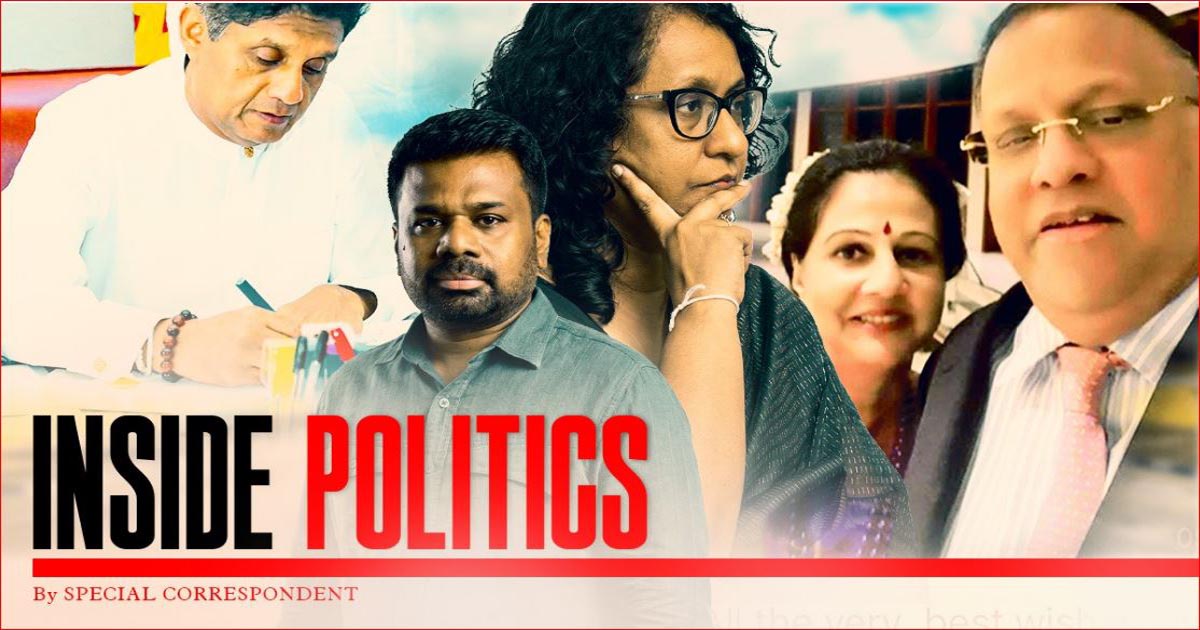
Stalemate over civil society appointments to Constitutional Council
SJB–UNP opposition reduced to a handful within UNP ranks
Ranil’s cautionary strategy once again defies the majority
Experts warn of a looming economic crisis again
Uvidu’s web platform puts Arjuna Mahendran back in the spotlight
What Awaits Harini
The controversy that began last week over the inclusion of a link to an obscene homosexual website in the Grade 6 English module has intensified this week, spreading across different fronts. Last week, we revealed that strong pressure was being exerted from Pelawatte on the President to immediately remove Prime Minister Harini Amarasuriya from office and appoint Bimal Ratnayake as her successor, so that the issue would not escalate further.
This is not the first crisis involving the Prime Minister. Previously, following setbacks in the provincial council elections, Pelawatte proposed that the government’s “engine” should be reshuffled and ministerial responsibilities reassigned. Bimal Ratnayake, as Chief Whip, publicly voiced this proposal at a state media briefing. However, the President dismissed it, while close allies Sunil Handunnetti and Nalinda Jayatissa opposed Bimal’s statement, arguing that neither a cabinet reshuffle nor the removal of the Prime Minister was necessary at that moment.
Even now, despite Pelawatte’s renewed push and Bimal’s name being put forward again for the premiership, the President has stood firm on his original position: The Prime Minister should not be changed at this time. If a change were to be made, given the prevailing geopolitical situation, the President’s preferred choice would be Vijitha rather than Bimal. We reported this for the first time last week through Mawrata newspaper. Following our revelation, both mainstream and social media picked up the story, and notably, the government has not denied it.
Serious matter
Against this backdrop, the issue surrounding Harini Amarasuriya has taken on multiple dimensions, with the opposition now seizing it as a serious matter.
The first to expose the existence of such a link in the English module was Ven. Ulapane Sumangala Thero, representing teachers’ unions. He informed the Asgiriya Mahanayake Thero, whose reaction was unexpectedly severe. The Mahanayake publicly declared: “They are destroying the country… this is terrifying… such things must not be allowed.”
As media coverage spread, the matter was taken up seriously by the Sangha, teachers’ unions, professional associations, and parents’ groups. The opposition, too, has strongly pursued it. In particular, the Samagi Jana Balawegaya (SJB) convened a special parliamentary group meeting via Zoom last Monday to discuss the issue. The main proposal put forward was that, since the government had already assumed responsibility, a motion of no confidence should be brought against the Prime Minister. All SJB MPs present unanimously endorsed this proposal.
Accordingly, after consensus was reached, opposition party leaders met on Tuesday when Parliament reconvened, and the final decision was entrusted to Opposition Leader Sajith Premadasa.
Opposition’s Next Moves
During the discussions, another proposal was raised: while preparing the no‑confidence motion, the opposition should also launch a strong protest against the Prime Minister and the government, using this issue as the basis. At that point, MP S.M. Marikkar suggested that all opposition MPs should gather in front of the Ministry of Education and stage a demonstration. This proposal too received unanimous support, and a date was set for the protest. Although different opinions were expressed, Opposition Leader Sajith Premadasa ultimately endorsed the plan.
Additionally, Kalutara MP Jagath Withanage presented another proposal. He argued that since a statue of C.W.W. Kannangara—the father of free education—stands in his Matugama electorate, a protest should be held in front of the statue to highlight the government’s destruction of free education. This proposal was also unanimously accepted, with the protest scheduled for Saturday.
While the opposition was deciding on strong action against Harini, a parallel dispute emerged concerning the Constitutional Council. The Prime Minister herself was involved in these talks. The terms of the three civil representatives on the Council are set to expire this month, requiring new appointments. According to the Constitution, these appointments must be made with the joint approval of the Prime Minister and the Opposition Leader.
In the previous government, then‑Prime Minister Dinesh Gunawardena and Sajith Premadasa agreed on three names acceptable to all, leading to the appointment of Pratap Ramanujam, Dr. Anula Wijesundara, and Dr. Dinesha Samararatne without controversy. Dinesh proposed one name, Sajith another, and the third was agreed upon jointly.
This time, however, Sajith has taken a firmer stance: he insists that the three civil representatives must be independent figures, respected nationwide and unaffiliated with any political party. His position stems from the fact that the Auditor General’s post has remained vacant for eight months, and the four names submitted by the President were rejected by the Council. There is speculation that the government intends to alter the Council’s composition to push through appointments.
The Malima government had assumed Sajith would cooperate as he did previously with Dinesh. But given that the President’s four nominees were rejected, and the government subsequently launched public attacks against the current civil representatives, Sajith is now approaching any government‑backed names with heightened caution.
Constitutional Council Dispute
Sajith Premadasa, seeking clarity on how civil representatives should be appointed to the Constitutional Council, entrusted a group of lawyers with expertise in constitutional law to study the matter and advise him. Last week, they informed Sajith that the government cannot appoint these members unilaterally; the Opposition Leader’s consent is also required. They even pointed out the relevant constitutional provisions.
According to the Constitution, it is not stipulated that the Prime Minister nominates one name, the Opposition Leader another, and the third by mutual agreement. Instead, it clearly states that all three civil representatives must be appointed with the concurrence of both the Prime Minister and the Opposition Leader. The lawyers further explained that if a consensus cannot be reached, the current civil representatives should continue in office until such an agreement is achieved.
Against this backdrop, Harini and Sajith held their first meeting on the matter last Wednesday in Parliament. Before discussions began, the government side made an unusual proposal: that the Speaker should also participate as a mediator. Sajith immediately rejected this, stating that the Constitution provides no such role for the Speaker, and that appointments must proceed strictly according to constitutional provisions.
Shortly afterwards, another significant development occurred. SJB MP Dr. Harsha de Silva declared in the chamber that an Auditor General must be appointed without delay. He revealed that the President had held a lengthy phone conversation with him on the matter, and as Chairman of the Finance Committee, he, too, believed the appointment should be expedited.
Harsha’s remarks sparked discussion among SJB MPs present. One MP suggested that a new arrangement might be emerging between Harsha and the President, noting that Harsha’s words seemed to echo the President’s agenda. He expressed suspicion that the President might be using Harsha to advance his plans. The MP shared this concern with three other SJB colleagues, and together they immediately informed Sajith, who was in his Opposition Leader’s office at the time.
They warned Sajith that the President appeared to be maneuvering around the Auditor General’s appointment by drawing Harsha into his strategy. Sajith, however, showed no sign of alarm. Calmly, he responded that although some had previously claimed he had a “deal” with the President, he had never entered into any such arrangement.
Presidential Support for Harini
Sajith Premadasa, addressing four of his MPs, firmly rejected claims that he was striking deals with the President. He stressed: “I will never enter into deals with the President. Nor will I act outside the Constitution. Everything I do is strictly according to constitutional provisions. Whoever the President deals with, I will continue to act within the law. Don’t be afraid of that.” Sajith further explained that although the President had submitted three names for the Auditor General’s post, none had been approved by the majority of the Constitutional Council, as more qualified candidates were already within the department. He emphasized that his nominations would always be respected professionals, independent of party affiliations, just as he had done previously.
Following this, Sajith met Prime Minister Harini Amarasuriya on Wednesday to discuss the appointments. Reports indicate that Sajith did not agree to Harini’s proposed names, instead suggesting several figures acceptable to all. The meeting ended without consensus, though both agreed to reconvene on Thursday afternoon.
However, Thursday’s talks also failed to produce agreement. Harini stood by her earlier nominations, while Sajith maintained his position. Unlike the first meeting, no new date was set for further discussions. Until a consensus is reached, the current civil representatives will continue to serve on the Constitutional Council.
Meanwhile, confidential reports revealed that despite mounting pressure from various quarters to remove Harini, the President has decided not to change the premiership. In a high‑level meeting last week with senior ministers, it was resolved to reject all allegations and defend the Prime Minister. The matter would be handed over to the Criminal Investigation Department for inquiry, with future action based on its findings.
It was also agreed that Harini, together with her close allies Vijitha Herath and Nalinda Jayatissa, should hold a media briefing to defend her position and make a special statement in Parliament. Furthermore, the leadership decided Harini should meet the Mahanayake Theros of Malwathu and Asgiriya to inform them of the situation. Accordingly, Harini joined Vijitha and Nalinda at a press conference on Tuesday, delivered her statement in Parliament on Wednesday, and travelled to Kandy on Thursday to brief the chief prelates.
A Close Ally of Ranil Meets Sajith
While the government continues to project unity and stability to the country, last week saw several notable developments regarding the growing consensus between the Samagi Jana Balawegaya (SJB) and the United National Party (UNP). The nation first witnessed signs of this progress when Mawurata website published a photograph showing Sajith Premadasa alongside three of the UNP’s most popular young representatives—Naveen Dissanayake, Akila Viraj Kariyawasam, and Ruwan Wijewardene.
That meeting, held at the Colombo Club in the Taj Samudra Hotel, was revealed to have laid a strong foundation for SJB–UNP cooperation. The disclosure drew significant reactions not only from SJB supporters but also from UNP loyalists. Building on that, our ‘inside politics’ column is now ready to reveal another special encounter that took place at the same venue last Monday. This meeting, known only to a handful until today, was between Opposition Leader Sajith Premadasa and Sagala Ratnayake—one of Ranil Wickremesinghe’s closest confidants.
Last week, we reported that on New Year’s Day, Ranil and Sagala had conveyed greetings to Sajith via the mobile phone of Colombo SJB municipal councillor Tharanga Athuraliya, with Sagala also requesting a personal meeting. We further revealed that Sagala had previously sent messages through various channels expressing his desire to meet Sajith. In response, Sajith informed Sagala that such a discussion could be arranged at the Colombo Club on Monday.
Both Sajith and Sagala ensured the meeting was conducted in utmost secrecy, known only to Ranil and a few others. Sajith, however, did notify three individuals—Naveen, Ruwan, and Akila—who had joined him in the earlier discussion at the same venue. When told of the upcoming meeting with Sagala, all three encouraged Sajith, saying it was a positive step forward. According to ‘inside politics’, the Sajith–Sagala meeting lasted several hours. Sajith spoke candidly, stressing that his involvement in efforts to unite the two parties was driven by sincerity and transparency. He reminded Sagala that millions of supporters longed to see such unity, not just party representatives.
In an emotional exchange, Sajith reflected on his past:
Throughout Sajith’s heartfelt words, Sagala mostly listened in silence, occasionally acknowledging certain points with agreement. Finally, Sagala noted that both sides must reach a common understanding for unity and that there is now significant interest and expectation among supporters. Sajith, in turn, expressed his 100% agreement.
Sajith–Sagala Talks Successful; Ranil’s Unclear
During the recent discussions, Sajith Premadasa emphasized that uniting the SJB and UNP was essential. He insisted that Ranil Wickremesinghe should remain clearly in an advisory role, while leadership should be handed over to the capable younger generation now emerging in both parties. Sajith stressed that the people of the country were demanding such a change. Whether the two parties ultimately merge into one or form an alliance could be decided later, he said, but first, both sides must agree on a common program. Sagala accepted this point, adding that Sajith and Ranil should meet as soon as possible. Sajith agreed in principle but maintained that the timing was not right. Sagala agreed, and thus both the Sajith–Sagala meeting and the earlier Sajith–Naveen–Akila–Ruwan meeting concluded successfully.
Now, however, attention turns to Ranil’s reaction. Will Ranil remain silent? Is he fully supportive of these talks—or will he, as usual, play games? History shows that Ranil has never truly stood for uniting the SJB and UNP. Instead, his preference has often been to bring the UNP together with the SLPP. We previously reported how Ranil presented this proposal at UNP working committee meetings, only to face opposition from members. SLPP leaders too rejected the idea, with Namal Rajapaksa publicly stating that what should happen instead was a UNP–SJB unity, which he himself would bless.
Therefore, it appears Ranil is not genuinely enthusiastic about merging the SJB and UNP. Yet this time, with party representatives and grassroots supporters overwhelmingly satisfied in favour, Ranil finds himself pushed into a corner where he cannot openly oppose the unity project. Indeed, last week we revealed that after the Colombo Club photo was published, Ranil summoned Naveen, Akila, and Ruwan to express his displeasure. He was not happy about their meeting with Sajith either. From the discussions Ranil held separately with each of them, it became clear that his stance on unity remains different from theirs.
UNP WC Meeting: Tensions and Decisions on Unity
Last week, several developments from the UNP side appeared to obstruct the momentum of unity talks with the SJB. One striking incident was media reports claiming that Naveen Dissanayake—who had recently sat at the discussion table with Sajith Premadasa—was suddenly appointed as a Deputy Leader of the UNP. The announcement came without any constitutional basis, and even Naveen himself was unaware until the media published it. No official statement was issued by the UNP, nor did Naveen receive any formal letter of appointment.
Against this backdrop, the UNP Working Committee met last Wednesday afternoon at Sirikotha. Many expected Ranil Wickremesinghe to formally congratulate Naveen on his supposed new position, but instead Ranil opened the meeting by discussing party reorganization. He explained that district responsibilities were being reassigned, noting that Akila Viraj Kariyawasam would now handle only Kurunegala, while Puttalam would be given to someone else later. He then moved on to appoint new officials to key committees such as Finance, Discipline, and Membership Promotion.
Only afterwards did Ranil address politics. He acknowledged that Naveen, Akila, and Ruwan had informed him of their meeting with Sajith, and said he had given them permission. He requested that the Working Committee be briefed on what transpired. Naveen spoke first, stressing that after 20 years in Parliament he was convinced the UNP could not win alone, and that unity with the SJB was essential. He said Sajith too was committed to this path, provided it was pursued sincerely and without “games.” Akila echoed Naveen’s points, while Ruwan was absent from the meeting.
Unexpectedly, Ajith Mannapperuma intervened, suggesting Ranil should also meet SJB figures like Kabir Hashim, Harsha de Silva, and Eran Wickramaratne. Naveen countered by noting Ranil already spoke frequently with Mayantha. Akila then sharply rebuked Mannapperuma, warning him not to drag personal issues into what he described as “a battle between life and death” for the party and the people. Even senior UNPers stood against Mannapperuma, emphasizing that unity with the SJB was now essential. Manusha Nanayakkara added that grassroots mobilization required the two parties to unite. Sagala Ratnayake too supported this, revealing he had recently met Sajith and believed unity was the way forward. Mannapperuma fell silent.
Ranil then spoke, aligning himself with the pro-unity line but adding his usual caveat: that the UNP should not only unite with the SJB but also with other opposition parties, including the SLPP and leaders like Jeevan Thondaman. He argued that Sajith had missed an opportunity by not attending the Nugegoda rally, which Namal Rajapaksa had capitalized on. Ranil proposed that once 80% of unity issues were resolved, he and Sajith could meet to finalize the remaining 20%. Akila, however, objected strongly to involving the SLPP, warning that such a move would collapse the entire effort, citing the backlash after the Nugegoda rally. He suggested issuing a statement that avoided mentioning the SLPP by name, but allowed for talks with other opposition parties. Everyone agreed.
Subsequently, the UNP issued an official statement (dated January 7, 2026) confirming that:
1. A joint national program committee would be formed to coordinate activities of UNP and SJB members in local councils.
2. Three joint programs would be presented by the Working Committee.
3. A committee would be appointed, with approval from both leaders, to explain these matters to other parties and hold discussions.
4. After agreement on the program, Ranil and Sajith would meet.
5. The two Working Committees would then meet jointly.
6. Other allied parties and coalitions would also be informed.
United National Party
2026.01.07
What is explicit by this is except for one or two individuals, almost all members of the UNP Executive Committee have given their approval to the SJB–UNP alliance. In contrast, only a handful have expressed dissenting views—among them Ajith Mannapperuma, who was expelled from the SJB after entering Parliament through the Gampaha seat vacated by Ranjan Ramanayake and striking a deal with Ranil; and another defeated figure who, having jumped between several parties and held ministerial positions, now remains without bail. Altogether, there are only about two or three such individuals. Records of the secret discussions they held in various places, as well as details of the plans they made to disrupt unity, are preserved under the ‘State Secrets’ category. We are not disclosing these at present, as we too are closely observing the developments regarding the alliance between the SJB and the UNP.
Arjun and his Reappearance
When the Malima government came to power, one of its key promises to the nation was to apprehend former Central Bank Governor Arjun Mahendran—considered the mastermind behind the infamous bond scam—and bring him back to Sri Lanka. Yet, more than a year has passed since the government assumed office, and not even the slightest sign of such an arrest has materialized. As a result, the people of Sri Lanka appear to have gradually forgotten both Arjun Mahendran and the Central Bank scandal itself.
Unexpectedly, however, Arjun Mahendran resurfaced through the Facebook page of Uvindu Kurukulasuriya, a journalist currently residing in London. Due to their friendship, Arjun engaged in a video call with Uvindu, which—with Arjun’s consent—was later published on Uvindu’s Facebook page. Uvindu stated that the video carried a message from Arjun intended for the President. Thus, for the first time under Anura’s administration, Arjun Mahendran appeared publicly without fear—something he had avoided even during Ranil’s presidency. This was the first indication that Arjun no longer intended to remain in hiding.
Subsequently, last week, Arjun Mahendran once again appeared in public, this time by releasing a New Year’s greeting accompanied by a photograph with his wife—the first such image to be made public. This too was shared via Uvindu’s Facebook page. The fact that Arjun now feels confident enough to publish photographs with his wife, even while a government that once vowed to extradite him remains in power, suggests that he has re-entered the public sphere without fear or hesitation. Many speculate whether this newfound openness stems from the fading of his fear of arrest, or perhaps from the outcome of some undisclosed arrangement. The unfolding events will eventually reveal the full story behind these images.
India’s Message
A few weeks ago, Indian External Affairs Minister S. Jaishankar paid an official visit to Sri Lanka, meeting with the President, senior government leaders, and opposition leader Sajith Premadasa. The official discussions were widely reported in the media. However, what has not been revealed until now is a significant development connected to Jaishankar’s visit.
During the meeting, senior officials from both sides were present, but towards the end, all others were asked to leave, leaving only the President and Jaishankar in a private, face-to-face discussion lasting about half an hour. It is reported that Jaishankar conveyed a special message from Indian Prime Minister Narendra Modi. This message included India’s commitment to provide Sri Lanka with an unexpected relief package worth USD 450 million. The President expressed his gratitude to Jaishankar for this pledge.
Before Jaishankar departed Sri Lanka, a high-level Chinese envoy also arrived. This was Wang Junsheng, a member of the 20th Central Committee of the Chinese Communist Party and Secretary of the Party Committee of the Xizang Autonomous Region. At the time, Sri Lanka was reeling from the devastation caused by Cyclone Ditva. Wang informed the President that China was prepared to extend assistance for a major project, the details of which would be disclosed later.
In the coming days, Chinese Foreign Minister Wang Yi is scheduled to arrive in Sri Lanka during a transit stop on his official tour to South Africa. Reports indicate that the President, Prime Minister Harini Amarasuriya, and Foreign Minister Vijitha Herath will be at the airport to receive him. It is expected that during this meeting, China will officially announce the project it intends to undertake in Sri Lanka.
Rebuilding Sri Lanka
In response to the destruction caused by the cyclone, the government has already initiated a special program for reconstruction. Under the banner “Rebuild Sri Lanka,” a national fund was launched, with appeals made to the public for contributions. Additionally, foreign ambassadors were invited and formally requested to assist. The opposition, meanwhile, repeatedly urged the government to convene an international donor conference to secure the necessary funds. At one point, the government itself hinted at plans to organize such a conference.
However, according to information now emerging, the government has abandoned the idea of holding an international donor conference. Experts had warned that if such a conference were to fail, it could severely damage the government’s future prospects. Instead, the government has decided to introduce a new website that will list all the damages—covering highways, railways, bridges, houses, schools, and public buildings—along with the estimated costs of reconstruction.
Reportedly, all preparations for this website have been completed, and it is scheduled to be unveiled by the President next Tuesday. In Parliament, the President had earlier stated that a comprehensive document detailing the damages and reconstruction costs would be presented to the nation, and that any donor—whether an individual, country, or institution—could take responsibility for specific projects. Once completed, the donors’ names would be displayed on plaques at the reconstructed sites.Thus, following the launch of the website next Tuesday, anyone will be able to select and sponsor projects for rebuilding Sri Lanka.
A Crisis Looms
In recent weeks, several political figures have issued warnings of a possible economic crisis emerging once again. UNP’s Harin Fernando predicted that by April the economy would plunge into turmoil. Rajitha Senaratne suggested such a crisis could surface by the end of this year. Wimal Weerawansa, speaking at a press briefing last week, also cautioned that the country faces renewed economic risks. While the political motives behind these forecasts remain unclear, this edition of State Secrets aims to report on the practical signs of a potentially unstable economic environment.
Although these warnings may signal an impending crisis, it is impossible to say with certainty whether it will materialize in April, at year’s end, or in 2027 or 2028.
Following the recent calamity, the government moved to approve a supplementary budget of Rs. 500 billion to rebuild the country—despite opposition from the International Monetary Fund (IMF). The IMF advised against rushing such measures, noting that by January or February it could help the government secure the necessary funds. The Fund also questioned how the Rs. 500 billion would be sourced and spent, but the government failed to provide clear answers.
As a result, the IMF suspended the staff-level agreement that had enabled the release of the fifth tranche of its loan package, postponing it until February. Thus, the progress made under the agreement has abruptly stalled.
To continue discussions, IMF Managing Director Kristalina Georgieva and a high-level delegation are scheduled to visit Sri Lanka later this month. If the government cannot present a concrete plan for raising the Rs. 500 billion, a precarious situation will be unavoidable. Analysts warn that in such a scenario, by March or April the IMF may declare Sri Lanka’s debt sustainability unstable, raising the likelihood of long-term difficulties in servicing foreign debt. Should the IMF make such a statement, it would mark the first stage of a new crisis.
This could trigger a downgrade by international rating agencies, similar to what occurred during Gotabaya Rajapaksa’s tenure, pushing Sri Lanka back to the lowest tiers of global credit rankings. The next step would be the country’s inability to secure any international loans, setting in motion a prolonged economic decline. Importantly, such a development would not mean an overnight collapse of the economy or government, but rather the beginning of a long-term downward process.
Yet, the government has so far offered no clear plan or response. It is possible that it has an alternative strategy to navigate the crisis, and may be preparing to implement it if the IMF takes a firm stance. In that case, the results would only become evident over the next two to three months.