Thousands of people across Mexico rallied on Saturday to protest escalating crime, corruption, and impunity, in demonstrations organised primarily by members of Generation Z.
The protests drew participants from various age groups, including older activists from opposition parties and supporters of the slain Michoacan Mayor Carlos Manzo, who was shot dead earlier this month during a public Day of the Dead event.
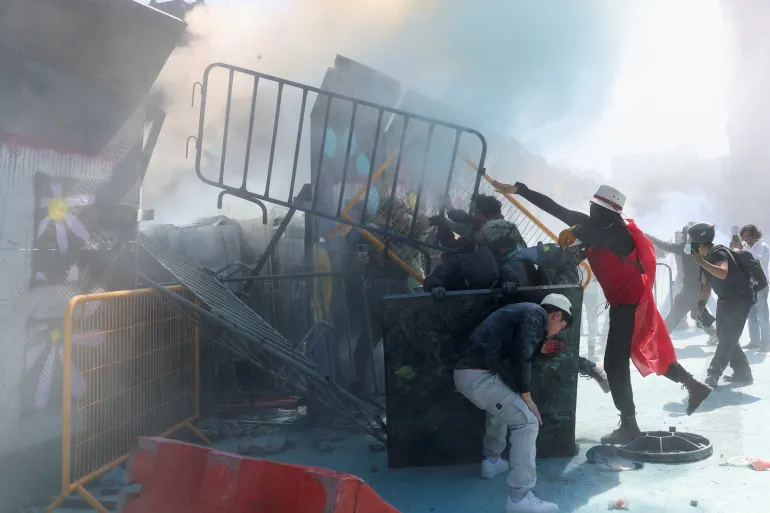
In Mexico City, a small group of hooded demonstrators tore down fences surrounding the National Palace, where President Claudia Sheinbaum resides. According to media reports, the incident triggered clashes with riot police, who deployed tear gas.
Mexico City Public Safety Secretary Pablo Vázquez said during a news conference that 100 police officers were injured, including 40 who required hospital treatment. He added that 20 civilians were also injured.
Vázquez told local outlet Milenio that authorities arrested 20 people and referred another 20 for administrative offences.
According to El Universal, security forces fired tear gas and threw stones at demonstrators who entered the National Palace perimeter. The outlet reported that security personnel “physically assaulted young people demonstrating in the Zócalo with their shields and stones,” leaving several injured and treated by marching doctors and ERUM (Emergency Rescue and Medical Emergencies Squadron) personnel.
The outlet further stated that police officers, after “chasing and beating protesters on the Zócalo plaza” for several minutes, “forced people to leave the area and dispersed the last remaining protesters.”
Protest Movement Described as ‘Inorganic’
The demonstrations were organised by a group calling itself “Generation Z Mexico,” which circulated a social media manifesto describing itself as non-partisan and representing youth disillusioned with violence, corruption, and abuses of power.
However, earlier in the week, some Gen Z social media influencers said they no longer supported Saturday’s protests. Meanwhile, prominent figures, including former President Vicente Fox and billionaire Ricardo Salinas Pliego, publicly expressed their support.
President Sheinbaum has accused right-wing parties of attempting to infiltrate the youth-led movement and of using social media bots to boost turnout.
Across several Asian and African nations this year, Gen Z groups have led protests against inequality, corruption, and democratic backsliding. The largest took place in Nepal in September after a social media ban, ultimately prompting former Prime Minister KP Sharma Oli’s resignation.
Major protests in Madagascar that same month, initially driven by severe water and electricity shortages, exposed deeper governance failures and corruption. Weeks of unrest led to the dissolution of the government and forced President Andry Rajoelina to flee the country, prompting a change in leadership.
AJ+ reporter Monica Cruz, based in Mexico City, said it was likely that opposition groups were behind the demonstrations in the Mexican capital.
“We are having a hard time believing that this is an organic protest, especially from young people. We don’t want to say that Gen Z is a monolith. There are young people across the political spectrum,” she said.
“But there’s not a lot of young people out there on the streets, and we think that may be a sign that this did not originate from them. For example, during protests against the genocide in Palestine, we saw thousands of young people marching.”
Anger Over Crime and the Manzo Assassination
Many protesters in Mexico City said they were motivated by growing insecurity and persistent impunity.
“We need more security,” said 29-year-old business consultant Andres Massa, who carried the pirate skull flag that has become a global symbol of Gen Z protests, in comments to The Associated Press.
Claudia Cruz, a 43-year-old physician, said she attended to demand more funding for the public health system and better safety conditions, noting that doctors “are also exposed to the insecurity gripping the country, where you can be murdered and nothing happens.”
President Sheinbaum, who assumed office in October 2024 and maintains approval ratings above 70 percent, has faced criticism over her handling of security following several high-profile murders, including that of Manzo.
Carlos Manzo, mayor of Uruapan in Michoacan, was assassinated on November 1 after leading a campaign against drug-trafficking gangs in his municipality.
His supporters also held demonstrations across towns in Michoacan on Saturday, with some travelling to Mexico City to join the march.
“The state is dying,” said 65-year-old real estate agent Rosa Maria Avila, who travelled from Patzcuaro in Michoacan. “He was killed because he was a man who sent officers into the mountains to fight delinquents. He had the guts to confront them,” she added.