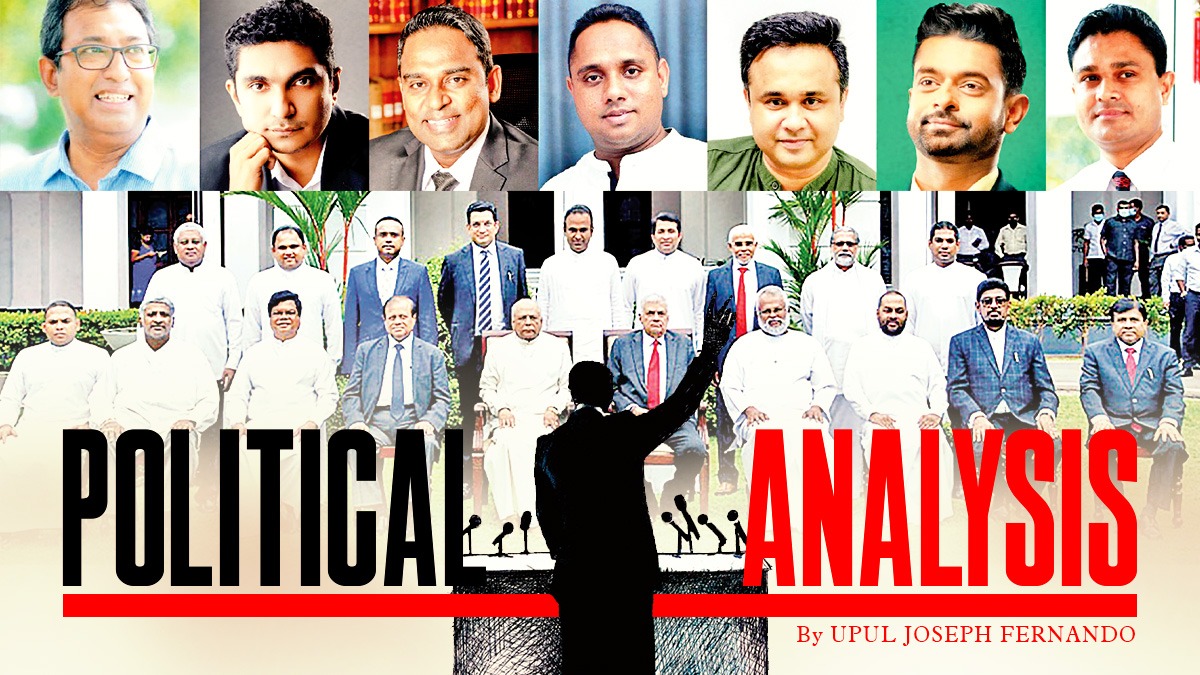
During the recent UNP anniversary, the sight of the politicians seated in the front row brings to mind the article published on April 6, 2024, in the “Political analysis” column titled:
“Sri Lanka’s Second Cabinet on the Brink”
Below is an excerpt from that article:
“Dahanayake first announced his resignation from the Sri Lanka Freedom Party (SLFP). The SLFP did not accept his resignation and instead expelled him from the party. In retaliation, he removed the Bandaranaike-aligned SLFP ministers and formed a cabinet of five members.
His new party was named the Lanka Democratic Party. He contested the March 1960 general election under this party. To the astonishment of the entire country, both he and his party suffered a complete defeat in the election. No one from his party was elected to Parliament.
This was the first cabinet in Sri Lanka’s political history to be defeated along with the Prime Minister. The SLFP ministers whom he had dismissed contested under the SLFP and were elected.
Just like Dahanayake, Ranil—who became Prime Minister and later President—also has a cabinet. But the ministers in this cabinet have no party. They don’t even know under which party they will contest the next general election. Some of these ministers, including the President, are members of the national list. They themselves don’t know how they will find a national list to return to Parliament next time.
Dinesh Gunawardena has a party—the United People’s Front. The last time this party contested an election independently was in the 1994 general election. In that election, Dinesh and Bandula contested under the symbol of the wheel. The United People’s Front suffered a complete defeat. Both Dinesh and Bandula lost their deposits. The party, which had previously campaigned using Sinhala-Buddhist nationalism and accused Chandrika of being pro-Tamil, was defeated again.
In the 2000 general election, it joined an alliance under Chandrika’s leadership and won seats in Parliament. Today, the United People’s Front exists only in name. If Dinesh and the party contest again, it will be a repeat of the 1994 defeat.
Everyone else is hanging on without support. Some say Ranil should be the presidential candidate for the SLPP. Others don’t even speak a word about the presidential or general elections. This cabinet was appointed by Gotabaya out of fear of the Aragalaya (protest movement). Gotabaya’s previous cabinet was full of SLPP flags. That cabinet faced intense opposition from the Aragalaya. At that time, Susil Premajayantha, angry at not receiving a ministerial post from Gotabaya, went to Delkanda market and criticized Gotabaya over rising prices.
Wijeyadasa Rajapakshe, also denied a ministerial post, attacked Gotabaya’s government. Kanchana Wijesekera was aligned with Namal, and Prasanna was with Basil. Gotabaya, fearing the Aragalaya, dissolved the SLPP-flagged cabinet and formed a new one with those who had criticized him, hoping to escape the protest and save his presidency. Meanwhile, Kanchana was taken in due to Namal’s influence, and Prasanna due to Basil’s.
When Gotabaya resigned, this cabinet was left adrift. It had no leader, no party—an orphaned, helpless cabinet. Ranil agreed to keep it because he himself had only one MP from his party. This cabinet has done nothing over the past two years except raise its hands like signal poles. Initially, they thought Ranil had a brilliant strategy and that they too would benefit. They expected that after Ranil revived the UNP by swallowing the SJB, they would join the UNP alliance. But now they realize that going with Ranil has left them with no path forward. If Ranil contests the presidential election and loses, all of them will lose their dream of entering Parliament. If Ranil doesn’t contest, finding a party to enter Parliament will be harder than finding a black cat in a coal cellar.
“Does that mean what happened to Dahanayake’s cabinet will happen to this cabinet too…?”
The prediction made by the “Political Analysis” column on April 6, 2024, turned out to be exactly right. The first cabinet in Sri Lanka to lose without securing deposits was Dahanayake’s cabinet, following the March 1960 general election. The second cabinet to suffer the same fate was Ranil’s cabinet from 2022 to 2024.
Most members of that cabinet lost without securing deposits. Others, fearing defeat, didn’t even contest the election. These ministers, who once loudly claimed they accepted the challenge during the country’s bankruptcy, have been nowhere to be found in recent times. Suddenly, they appeared at the recent UNP anniversary, now hoping to enter Parliament through the Samagi Jana Balawegaya (SJB) election list via the UNP.
“Don’t ask for nominations. Let’s give Sajith the chance to win. Let him win and then we’ll try to form a national government…”
These ministers, who once risked their political careers to defeat Sajith and elect Anura, never said this to Ranil during their desperate battle. They believed that Sajith’s SJB would be swallowed by Ranil, who would then win and make them immortal ministers.
“Sajith ran away when the country was in crisis. We were the ones who accepted the challenge…”
That’s what these ministers said back then. Today, fearing the challenge of facing an election, they are clinging to the SJB’s coattails.
“Can we win votes by forming an alliance with this group…?”
People voted for the SJB as the main opposition because, like the JVP, it had no corrupt members. Neither the JVP nor the SJB has ever governed Sri Lanka. Although Anura, Vijitha, Lal Kantha, and Bimal held ministerial positions, and Sajith and other senior SJB members also served as ministers, none of them governed.
Even though they previously served under Ranil’s leadership, the public knows they were not part of Ranil’s corrupt 2022–2024 government. That’s why people entrusted Sajith and the SJB with the role of main opposition.
Now, the SJB must use that public mandate to rebrand itself as a new party and a new force, moving forward with a fresh team.
The JVP did the same. Anura, who received only 3% of the votes and lost the presidential election, became the JVP leader in 2014. Since then, in provincial and general elections, the JVP faced repeated defeats.
Anura first entered Parliament via the national list in 2010. He is not a popular leader. But he rebranded the party, introduced a new team, and contested the election. He won. He showed change by placing Harini and the new team at the forefront.
That’s exactly what the SJB must do now. The SJB has a strong team capable of speaking to today’s floating voters and youth.
- First is Harsha de Silva, a popular figure among the new generation and a leader who can attract floating voters. If the SJB markets him well, he can draw in new votes.
- Second is Prasad Siriwardena, who emerged in the last election. He is a skilled speaker and a popular figure among the youth, similar to JVP MPs. He can bring a significant youth vote to the SJB.
- Also, Puttalam District MP Chitral Fernando, newly elected and articulate, is a fresh young face who can help win youth votes.
- Suranga Ratnayake, elected for the first time from Anuradhapura, is a vocal young MP in Parliament. He, too, can attract youth votes.
- Fifth is Varuna Deeptha Rajapaksha, a former JVP MP who knows JVP history well and is a popular figure on social media. Just as one uses a tree to cut another tree, his contribution can be immense. He speaks the language of youth and has a unique style. He is a strong machine to cut into JVP votes.
- Sixth is Charith Abeysinghe, an actor who, like JVP’s Jagath Manuwarna, understands politics well. He has strong youth appeal and is popular on social media. The SJB can use him to attract youth votes.
- Also, Dr. Chamal Sanjeewa is a popular figure among professionals. He made a name for himself by speaking out against the pharmaceutical mafia. He, too, can bring significant momentum to the SJB.
In addition to these, the SJB has many other capable individuals. But they are familiar old faces. The JVP won not by placing Vijitha Herath, Bimal, Lal Kantha, or Sunil Handunnetti at the front, but by showcasing new faces. However, the main ministerial positions went to the old faces.
If the SJB wants to win with its old faces, it must make sacrifices. A new team must be brought to the forefront.
Ranil’s cabinet is corrupt. When they face corruption allegations today, they look to the SJB for cover. Should the SJB carry their burden?
If the SJB moves forward with Ranil’s defeated, corrupt cabinet, it won’t even retain its position as the opposition in the next election.