The World Bank has cautioned that Pakistan’s current economic growth model is failing to reduce poverty, with income gains stalling and poverty reaching its highest level in eight years in 2024.
In its report “Reclaiming Momentum Towards Prosperity: Pakistan’s Poverty, Equity and Resilience Assessment”, the Bank revealed that the aspiring middle class — which makes up 42.7% of the population — is “struggling to achieve full economic security.”
“The aspiring middle class is facing significant non-monetary deprivations, such as limited access to safe sanitation, clean drinking water, affordable energy and housing,” the report stated, pointing to “poor public service delivery in Pakistan.”
Youth Disengagement
The report highlighted a worrying trend: 37% of Pakistan’s youth, aged 15–24, are neither employed nor engaged in education or training. This, it said, stems from demographic pressures and a misalignment between labour demand and available skills.
“Pakistan’s growth model that supported initial poverty reduction has proven insufficient to sustain progress, and poverty is on the rise since 2021–22,” the report noted.
When asked whether the World Bank and International Monetary Fund (IMF) were responsible for supporting Pakistan’s weak growth model, Tobias Haque, Senior Economist at the World Bank, stressed that “there has not been a single economic growth model imposed by either the World Bank or the IMF.”
Reversal of Gains
“Pakistan’s once promising poverty reduction trajectory has come to a troubling halt, reversing years of hard-fought gains,” the report added.
Bolormaa Amgaabazar, the World Bank’s Country Director for Pakistan, said the institution sought to understand why poverty rates have not fallen as in the past, admitting that “the economy was not doing great in recent years.”
The report projects that poverty has climbed back to 25.3% in fiscal year 2023–24 — the highest level in eight years. This marks a 7% rise in just three years.
Two different poverty measurements were provided: according to the official national poverty line, 25.3% of the population is poor, while under the international poverty line, the rate soars to 44.7%.
Poverty Trends and Shocks
Christina Wieser, World Bank poverty expert and lead author of the report, noted that poverty fell by 3% annually between 2001 and 2015, but slowed to just 1% per year between 2015 and 2018.
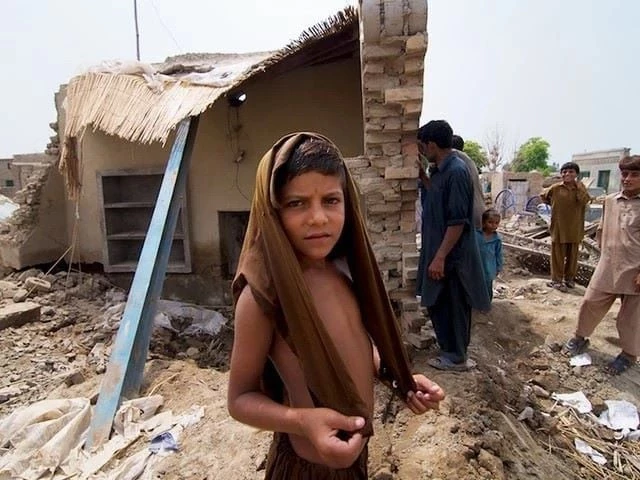
Post-2018, macroeconomic deterioration and multiple shocks triggered a reversal. The devastating 2022 floods alone caused a 5.1% increase in poverty, pushing an additional 13 million people below the poverty line. Inflationary pressures in 2022–23, driven by energy price hikes, further eroded household incomes.
Wieser cautioned that “the vulnerability is incredibly high, especially in rural areas and in the agriculture sector,” making it too early to fully assess the impact of more recent floods.
Growth and Inequality
Over the past two decades, Pakistan’s economic growth has remained low, volatile, and consumption-driven. Real GDP per capita has grown only 2% annually — half the regional average.
The report warned that “perverse institutional incentives and elite capture” hinder Pakistan’s productive capacity and divert investment, limiting equitable distribution of growth benefits.
Geographic and Provincial Disparities
Rural poverty stands at 28.2%, compared with 10.9% in urban areas. Provincial disparities are stark:
Balochistan: 42.7% poverty rate (highest)
Punjab: 16.3% (lowest) but home to 40% of the poor due to its large population
Sindh: 24.1%
Khyber Pakhtunkhwa: 29.5%
Seven of Pakistan’s 10 poorest districts are in Balochistan. However, Punjab contains three of the five districts with the largest absolute numbers of poor — Muzaffargarh, Rahim Yar Khan, and Dera Ghazi Khan — each with more than one million people living in poverty.
Poverty ranges from just 3.9% in Islamabad to a staggering 76.9% in Tharparkar.
Urbanisation Understated
The report found that Pakistan’s official urbanisation figure of 39% is significantly understated. Using geospatial methods, the Bank estimates the true figure at 60–80%, and up to 88% when towns are included.
Unplanned urbanisation, the report said, has resulted in “sterile agglomeration” — dense settlements without improvements in productivity or living standards.
Income Inequality and Consumption Patterns
While difficult to quantify due to underreporting by the wealthy, income inequality is evident. Wealthier families consume more than four times that of the poorest households. Using Federal Board of Revenue (FBR) data, the Bank assessed that inequality is far greater than reflected in household surveys.
Labour Market and Social Protection
Pakistan’s labour market is dominated by informal, low-paying jobs, with 85% of employment classified as informal. Urban men largely work in low-wage construction, transport, or trade, while rural men shift from stagnant farming to low-productivity off-farm work.
Women and youth are largely excluded from the labour force. Female labour force participation stands at just 25.4%.
The Bank said most households remain clustered at low welfare levels, leaving them highly vulnerable to shocks. Historically, Pakistan’s fiscal system has not supported poverty and inequality reduction.
Path Forward
The World Bank recommended structural reforms to ensure macro-fiscal stability and promote private sector-led development. “It will be critical to protect Pakistan’s hard-won poverty gains while accelerating reforms that expand jobs and opportunities — especially for women and young people,” said Amgaabazar.
Between 2001 and 2015, non-agricultural income drove 57% of poverty reduction, compared to 18% from agriculture labour and just 2% from social transfers. Remittances, while beneficial, reach only a small and unevenly distributed portion of the population.