The Supreme Court has ruled that the Officer-in-Charge (OIC) of Hasalaka Police violated the fundamental rights of a woman by arresting and detaining her in 2019 for allegedly wearing a dress featuring a “Dharma Chakra.”
Delivering the verdict, Supreme Court Justice Yasantha Kodagoda, with the concurrence of Justices Kumuduni Wickramasinghe and Shiran Gunaratne, concluded the hearing of a fundamental rights petition filed by Abdul Rahim Masahina, a resident of Kolongoda.
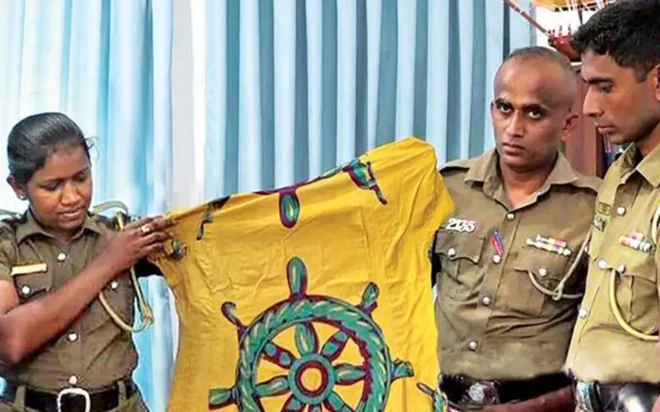
Misidentified Symbol: ‘Not a Dharma Chakra but a Rudder of a Ship’
The petitioner was arrested on May 17, 2019, within the Hasalaka Police Division, on the claim that the garment she wore displayed the Dharma Chakra—a sacred Buddhist symbol. However, Attorney Pulasthi Hewamanne, representing the petitioner, informed the court that the symbol was, in fact, a rudder of a ship, not a Dharma Chakra.
The Supreme Court ruled that the arrest and detention violated her rights under the law, particularly in the context of Article 3(1) of the International Covenant on Civil and Political Rights (ICCPR). The bench noted that the police acted without reasonable cause.
Compensation and Further Directives
The court ordered Inspector Chandana Nishantha, the then-OIC of Hasalaka Police, to personally pay Rs. 30,000 as compensation to the petitioner.
Importantly, the judgment emphasized that this compensation must not be paid from Police Department funds or the Police Collective Fund. The Inspector General of Police (IGP) was directed to submit a certificate to the court confirming that no such public or institutional funds were used.
Further, the Supreme Court instructed the IGP to issue a circular—subject to the approval of the Attorney General—providing clear guidelines for police officers regarding arrests made under the ICCPR. The purpose of this circular is to prevent similar incidents in the future through better understanding and interpretation of the relevant legal provisions.
Background
The case originated when Abdul Rahim Masahina was taken into custody for wearing a dress allegedly bearing the Dharma Chakra, which police believed was disrespectful. She subsequently filed a petition at the Supreme Court, claiming her fundamental rights had been violated due to the wrongful arrest and detention without justifiable grounds.
After considering all submissions, the three-judge bench found in favor of the petitioner, setting a significant legal precedent on wrongful arrest and religious misinterpretation.