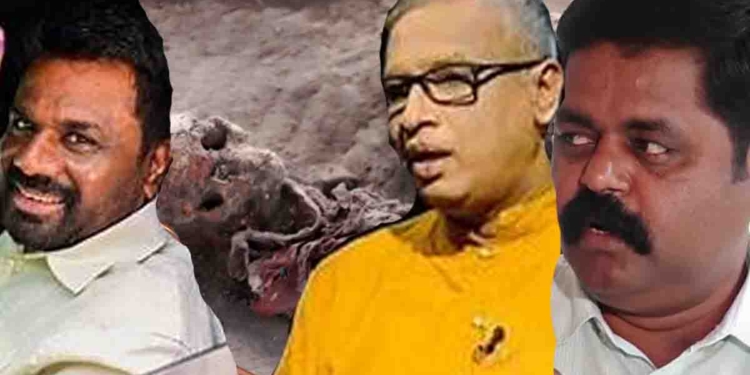
The Ilangai Tamil Arasu Kachchi (ITAK), the leading Tamil political party in Sri Lanka’s North, has called on President Anura Kumara Dissanayake to merge the judicial proceedings concerning the Chemmani mass graves—both the remains discovered in 1999 and those currently being unearthed in 2025.
In a formal letter addressed to President Dissanayake, dated July 11 and signed by ITAK leaders C.V.K. Sivagnanam and M.A. Sumanthiran, the party emphasized that the 15 bodies recovered in 1999 from the Chemmani area appear to be directly connected to the ongoing discoveries. They stressed that genuine accountability would not be possible unless the case filed in the Colombo Magistrate’s Court is merged with the present investigations.
As of June 10, 2025, a total of 65 human skeletons—including those of young children—have been recovered from the Chemmani Sitthupathi mass grave, which has officially been designated a crime scene. Excavations began in mid-May.
The grave gained national attention after former Sri Lanka Army soldier Somaratne Rajapaksa, who was convicted and sentenced to death—along with four others—for the rape and murder of schoolgirl Krishanthi Coomaraswamy on September 7, 1996, revealed in a courtroom statement that 300–400 bodies were buried in mass graves in the Chemmani area. This revelation was made only after he was sentenced, and had not emerged during initial police investigations.
Of the 15 bodies recovered during the 1999 excavation, only two were positively identified as young men who disappeared in 1996. No investigations have been conducted into the remaining 13.
In their letter, ITAK leaders urged the President to consolidate the judicial processes under both the Colombo and Jaffna Magistrates’ Courts without delay. They further called for the involvement of independent, internationally recognized forensic experts to oversee the entire investigation process, stating that this is essential to uphold judicial integrity and ensure public confidence.
“The only way to end the pain and suffering of families whose loved ones have disappeared is through comprehensive, robust investigations conducted by independent experts with forensic expertise capable of uncovering the truth,” said UN High Commissioner for Human Rights Volker Turk in a video statement recorded near the Chemmani Siddupathi mass grave in Jaffna. The United Nations has reiterated its demand for international involvement in all mass grave investigations across the island, emphasizing impartiality and adherence to global standards.
“The investigations must be conducted thoroughly and impartially in accordance with international standards,” the UN office in Sri Lanka posted on social media. “A number of mass graves have been discovered across the country.”
ITAK has also requested the President to make public all interim and final forensic reports, including DNA profiles and identification results. They have emphasized that the victims’ families, civil society representatives, and international observers should have timely access to this information.
The party further pointed out that no Sri Lankan government has made any credible effort to repatriate the remains exhumed in 1999, which are believed to be currently stored in Glasgow. ITAK urged the President to bring these remains back to Sri Lanka so that proper examinations can be conducted, allowing for their dignified return to the families.
Additionally, ITAK has requested increased government funding to ensure that current excavations proceed in line with international forensic standards. They noted that hundreds of families continue to inquire about the fate of their missing relatives, underscoring the urgent need for state accountability.
“Without truth-finding and accountability, reconciliation remains a sham,” the letter stated. “Immediate steps must be taken to prosecute those responsible for these heinous crimes. This is essential for the healing of the nation.”
Excavations at the newly uncovered Chemmani mass grave complex—which is now the fourth-largest such site in Sri Lanka—were temporarily paused on July 10 to allow excavation crews to rest.
Attorney-at-law Ranitha Gnanarajah, who is overseeing the excavation process, informed journalists that Magistrate A.A. Anandaraja had ordered the forensic medical team to submit a report on a bundle of bones wrapped in polythene that was discovered that same day.