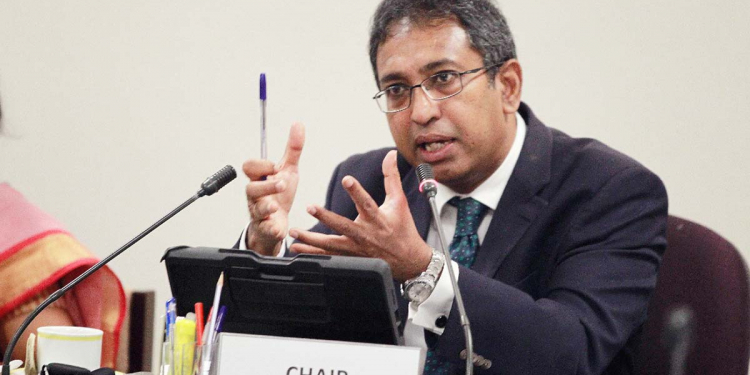
MP Dr. Harsha de Silva participated in a media briefing held at the Samagi Jana Balawegaya headquarters.
Further expressing his views, he said:
“President Anura Dissanayake, in a meeting with IMF Deputy Managing Director Dr. Gita Gopinath, stated that Sri Lanka would enter into an agreement with the IMF for the last time and that he would ensure this happens. However, Sri Lanka must implement the economic reforms it has committed to. Otherwise, the country will fall back, as Dr. Gopinath also pointed out to President Dissanayake.
The funds Sri Lanka expects to receive under the IMF program will not come solely from the IMF but also from institutions like the World Bank, the Asian Development Bank, and JICA. These institutions collectively support the budget financing. However, money from the IMF cannot be used for energy or transmission expenses. IMF funds are not allocated for such areas. Instead, budgetary support comes through the World Bank, the Asian Development Bank, and JICA.
Further, the World Bank, the Asian Development Bank, and JICA have jointly sent a letter to the Minister of Power highlighting four main concerns about repealing the Electricity Act approved for 2024.
Among those key points, they stress that all institutions related to electricity generation, distribution, and production should remain under government ownership. Additionally, hydropower plants such as Victoria, Randenigala, and Rantambe produce power at lower costs. There are also coal-fired plants like Norochcholai, as well as solar and wind plants. These are all state-owned. However, under the Electricity Act approved in 2024, these institutions were broken into segments. All power generation bodies were split into segments, but it was not clearly stated whether the government would retain ownership of the other plants apart from Mahaweli-owned power stations. According to the Act, shares of other power plants could be obtained through the stock market if necessary.
The letter also mentioned transmission lines and highlighted that investments are needed to maintain and develop Sri Lanka’s transmission grid. It further stated that 50% of the transmission grid should remain under government ownership, while private investment could be sought for the rest. Previously, 100% of the power distribution institutions were owned by the Ceylon Electricity Board (CEB), but under the new amendments, all power stations — including Mahaweli, Norochcholai, diesel, wind, and solar plants — should be consolidated into a single institution under government ownership. Transmission institutions too should remain 100% government-owned, according to these amendments. The institutions were merged under one entity named LECO, which was then designated as part of the CEB.
The World Bank, the Asian Development Bank, and JICA have questioned why LECO is being incorporated with the distribution institutions. Also, under existing law, one power distribution company cannot take over another. But the law is being changed to allow the CEB to take over LECO, which would completely eliminate competition.
The letter also touched on electricity tariff revisions. According to it, electricity tariffs should be revised every six months. Although the government planned to increase tariffs by 18%, the Public Utilities Commission only allowed a 15% increase. However, decisions regarding tariff increases can only be taken by the Public Utilities Commission. The government did not agree to reduce tariffs by 20% when the Commission showed that a 20% reduction was possible. Furthermore, there was mention of introducing a turnover tax on electricity in consultation with the Finance Ministry. Meanwhile, the government is working to remove the Public Utilities Commission, which is the sole body protecting consumers, even though the World Bank, the Asian Development Bank, and JICA have opposed such moves.
The National People’s Power (NPP) earlier promised to cut electricity bills by a third before coming to power, but now electricity bills have risen significantly. Powers that previously belonged to the people are being stripped away under the current administration.
Additionally, the Minister of Power has not yet responded to the letter sent by the World Bank, the Asian Development Bank, and JICA. Instead, it was replied to by Mr. Pubudu Niroshan, the Director General of the Power Sector Reforms Secretariat in Sri Lanka, who then shared his response with the media. However, Pubudu Niroshan’s letter did not even mention the names of the World Bank or JICA, though it was sent to the Asian Development Bank.
In his reply, Pubudu Niroshan said there was no issue with the first concern raised in their letter and that government ownership of all electricity generation, distribution, and production institutions would be maintained but that these could be “unbundled” if needed. As members of the legislature, we do not know what the government is trying to do, but Pubudu Niroshan seems to know. How can we trust what Pubudu Niroshan is saying? As parliamentarians, we cannot accept a letter written by him to the Minister. Therefore, the best solution would be to appoint Pubudu Niroshan himself as the Minister of Power so we could then discuss these matters with him directly. A person outside of Parliament does not have the authority to respond to the World Bank or JICA on behalf of the government. Only the Minister can officially state the government’s position.
Pubudu Niroshan also said there was no issue with taking over LECO under the CEB. He did not mention anything about the removal of the Public Utilities Commission’s authority. He also stated that the four points raised in the joint letter by the World Bank, the Asian Development Bank, and JICA were irrelevant.
Matters about the Electricity Act should be discussed in Parliament. A person outside Parliament cannot make decisions or statements about it. The amendment is being brought by Minister Kumar Jayakody, so he should be the one to respond to these questions. But it appears Pubudu Niroshan is preparing to establish his own authority in the future.
Even if President Anura Dissanayake does not wish to continue with an IMF program, the country will still have to carry out the initiated economic reforms. However, decisions about these economic reforms are not being taken by the Minister but rather by someone appointed from elsewhere. So even though there is a Minister, another group is really driving the country’s economic reforms. If these reforms are not carried out, the country will face major problems.
Furthermore, hydropower plants like Randenigala, Rantambe, Kotmale, and Victoria are all one unit and their ownership should never change. But there is no need to maintain Norochcholai, thermal plants, or wind plants with state tax money. That is the basic economic vision. Under the new amendment, assets reserved for Mahaweli are now also being applied to Norochcholai, thermal, and wind plants. However, what we need is foreign investment. Even the President has acknowledged the need for foreign investment. If so, the framework for that should be established. Just talking about a social market economy will not make it happen. Former President Ranil Wickremesinghe stabilized the economy, but now what is needed is not just stability, but actual growth in the economy.”