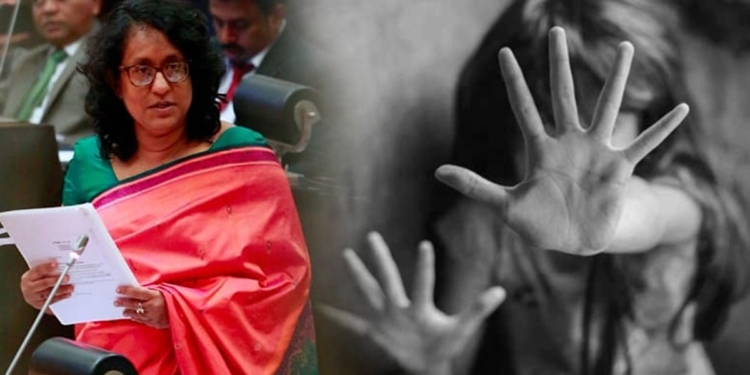
Recently, the Prime Minister of Sri Lanka, who is also the Minister of Education, had a special discussion which was widely shared on social media. During this discussion, it was mentioned that there has been an increase in the abuse faced by school children. It was Dr. Harini Amarasuriya, the Minister of Higher Education and Vocational Training and Prime Minister, who highlighted this. We learned that she stated this at a meeting held by the Ministry of Education on the 27th, intended to inform school principals in the Colombo District.
This is a very frightening and serious issue. The reason is that we send our children to school with trust. Even when we do not trust any other institution in the world, we trust the institution called school. That’s because principals and teachers are recruited with special training, discipline, and as special individuals. We inherently believe that these people will protect children and that they care about children with a special affection.
In the past, Sri Lankan children learned at the teacher’s house, sometimes even as boarders. They would do household chores, help around the house, and learn in that environment. There was also a time when learning happened in temples, but because it was not suitable to send girls to the temple, girls’ education was discontinued, and only boys learned.
Education is very important to people. We’ve heard that education is like wings that help you fly. For people like us from poor families, education helped us move forward in life. But if after sending children to school, which is entrusted with such a noble duty, incidents of abuse are reported from within the school, we are left wondering, ‘Whom can we even tell of this sorrow?’
When such incidents are reported daily and when problems arise in schools with names and details, and when even the political stage discusses these matters, when children end their lives by jumping from buildings out of pain and fear caused by abuse, we have to ask ourselves again and again: What era are we living in? Where are we now?
These discussions surface whenever a child dies, is abused, or faces an issue, just like talking about rambutans in the rambutan season or durians in the durian season. For a week or two, people talk, and then it fades away. Maybe it’s better not to talk at all.
Sri Lanka is recognized as a country with high educational standards, or at least one that aspires to them. If such incidents continue to happen, are seen, and are felt, it’s time to act and take control.
Often, when abuse happens within schools, both parents and children try to hide it, sometimes not even reporting to the police. We saw a similar response recently in the case of a girl who died by suicide; she was removed from her school and placed in another, and all of this happened in secrecy. We understand the importance of maintaining a child’s dignity, and while our media often neglects the dignity of universities or teacher training colleges, they do care somewhat about schools, which is a good thing. The child’s dignity matters.
It is the duty of authorities to ensure that revealing details about a child and the incident does not mentally harm or push them to self-harm. However, those who are at fault must be given the highest possible punishment. Whether it is a girl or a boy, if any child is abused or faces issues in school, the relevant teacher, office assistant, or any staff member involved should receive proper legal action and punishment. There are enough rules and laws for that. If any political or powerful party tries to intervene or cover up, legal action should be taken against them as well.
Therefore, what Harini Amarasuriya said is not a trivial matter. It’s a very serious issue. We are not blaming the Prime Minister; she only revealed the reality in the country. Now that this has been exposed, it is time to act immediately. If not, it’s like letting an illness fester without medicine—the disease could become fatal. We must remember that there is nothing in our country more precious than the school system.