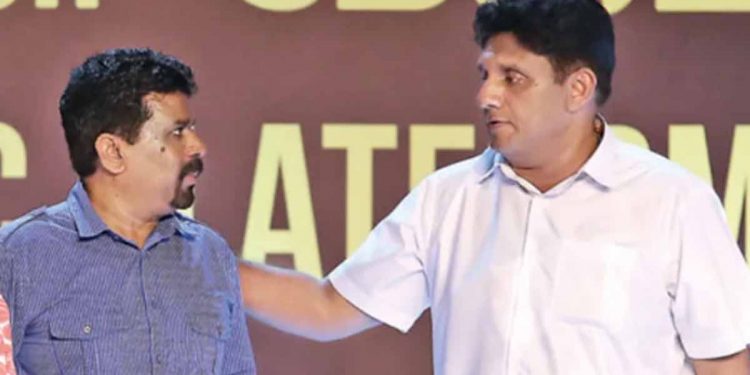
Opposition Leader Sajith Premadasa accused the current government of continuously deceiving the public, emphasizing that despite the exposure of the mastermind behind the Easter attacks, only the Presidential Commission’s report was handed over to the Criminal Investigation Department (CID). He further stated that the government, which lied to the public at the time of the Easter attacks, continues its deceitful approach even today.
Premadasa made these statements while addressing a public meeting held today in Lunugamvehera in the Tissamaharama electorate.
He criticized the government, led by the Janatha Vimukthi Peramuna (JVP) and symbolized by the compass, for introducing a new political ideology based on lies and deception. He claimed the JVP-led government had misled people with false promises during both presidential and general elections, eventually turning into an administration that continuously deceives citizens.
Referring to the government’s broken promises on economic relief, Premadasa highlighted that although it pledged to reduce electricity bills by 33%, it failed to implement this reduction for six months after assuming power. Following public outrage, the Public Utilities Commission intervened, reducing electricity tariffs by 20%, not the government nor the President. Premadasa demanded that the government should still fulfill its remaining promise of a 13% reduction.
He pointed out a similar scenario regarding fuel prices, stating that although the government initially blamed high prices on taxes, corruption, fraud, and commission fees—and promised relief by addressing these issues—the prices remain high. Premadasa added that farmers, fishermen, and entrepreneurs have not received promised fuel subsidies, and despite assurances of abolishing the price formula, no such change was implemented. He asserted that even if taxes and commission fees were eliminated, the fuel price should match port rates, proving the government’s dishonesty.
Premadasa accused the government of repeatedly lying about several other critical matters. He reminded the public that promises to renegotiate the IMF agreement, provide employment for unemployed graduates, increase fertilizer subsidies, compensate farmers affected by human-elephant conflicts and floods, and reduce the prices of essential commodities remain unfulfilled. Additionally, he stressed that the recent price increases of rice and coconut milk powder, along with shortages of essential goods such as salt, exposed the government’s empty promises.
“Are you prepared to be deceived by this government’s lies for the third time?” he questioned, urging citizens to reject a government that consistently resorts to lies, theft, fraud, and deception. He stated that the government was presenting old lies repackaged as new promises, making false claims about budgetary concessions that do not exist.
Furthermore, Premadasa criticized President Ranil Wickremesinghe, alleging that the President had not thoroughly read or understood the Local Government Act. He accused the government of fraudulently violating electoral laws by openly declaring that financial allocations to local government institutions would only be granted if these bodies aligned with the government’s compass symbol. He stressed that the President’s lack of understanding of the Local Government Act constituted a serious breach of democratic norms.
Premadasa warned that the current government’s incompetence could lead Sri Lanka into further economic crisis and potential bankruptcy. He explained that beginning in 2028, Sri Lanka must repay substantial foreign debts, which requires significant economic growth and increased state revenue. He cautioned that unless the country achieves an economic growth rate exceeding 5% from 2025 to 2028, it would be unable to repay these debts and could face an unprecedented financial collapse.
To avoid this scenario, Premadasa advocated for expanding industrialization, developing tourism, and diversifying export markets. He accused the current administration of lacking any concrete economic plan and claimed that former President Gotabaya Rajapaksa had exacerbated the economic situation by shifting the repayment of debt originally scheduled for 2033 to 2028.
“This government has no strategy, and unless immediate action is taken to foster growth, bankruptcy in 2028 is inevitable,” Premadasa concluded.