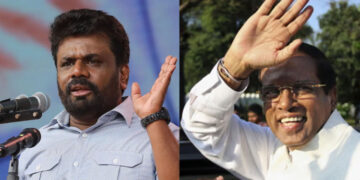


The Election Commission has officially sent a letter to the Secretary to the President, requesting that President Anura Kumara Dissanayake be advised to refrain from making political statements that may contravene election laws.
According to internal sources within the Commission, the letter was issued in response to complaints lodged by several election observation organizations. These organizations raised concerns regarding recent remarks made by the President on political platforms.
The complaints allege that President Dissanayake, in his capacity as the leader of the ruling National People’s Power (NPP) party, made statements suggesting that government funds would not be allocated to institutions lacking political power at the local government level. Observers argue that such remarks constitute a direct violation of election laws.
Specifically, they point to Sections 82C and 82D of the Local Government Elections Act—provisions that prohibit improper influence and the offering of benefits or promises to sway voters or institutions. The observation bodies emphasize that the President, unlike an ordinary Member of Parliament, holds executive authority over the disbursement of public funds, thereby making such statements particularly consequential and potentially illegal at a national scale.
The Election Commission has further indicated in its communication that, due to the constitutional protections granted under Article 35(1) of the Constitution, no legal action—civil or criminal—can be initiated against a sitting President for acts performed in either a personal or official capacity.
Article 35(1) of the Constitution states:|
“No civil or criminal proceedings shall be instituted or continued against any person while holding the office of the President of the Republic of Sri Lanka for acts done or omitted by him in his personal or official capacity.”
The Commission’s letter serves as a formal reminder of the importance of upholding the integrity of the electoral process and adhering to the legal boundaries set forth in the constitution and electoral legislation.