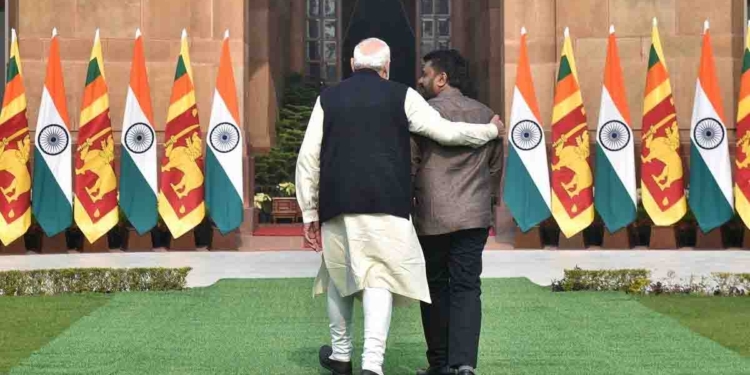
Indian Prime Minister Narendra Modi has just departed Sri Lanka, concluding a two-day official visit. Modi is now headed to Tamil Nadu, where he is scheduled to inaugurate a railway bridge in the Ramanathapuram district. Prior to his departure, during his visit to Anuradhapura, the Prime Minister posted a message on his X account expressing his gratitude to President Anura Kumara Dissanayake and the Sri Lankan government for their warm hospitality. In his message, Modi affirmed that the visit had reaffirmed the deep cultural, spiritual, and civilizational ties between India and Sri Lanka, and that it would undoubtedly strengthen bilateral relations.
State Secrets provided further insights into the context of Modi’s Sri Lankan trip. It noted that his three-day visit comes at a time when tensions have escalated after former U.S. President Donald Trump imposed tariffs on Sri Lanka. Although some portray the visit as entirely positive, there are underlying issues. Prior to Modi’s arrival, the prominent Indian businessman Gautam Adani—widely regarded as Modi’s close associate—clashed with the Sri Lankan government and subsequently departed the country amid a major government operation targeting him both in parliament and beyond. Complaints regarding this matter had also been communicated to Indian authorities through various channels.
Originally, Modi had planned to visit Sampur to inaugurate a renewable energy project upon arriving in Sri Lanka. However, due to the ongoing conflict involving Adani, a last-minute directive from India required Modi to launch the project digitally from Colombo instead. This decision was influenced by historical precedents; years earlier, when former Indian Prime Minister Manmohan Singh sought to launch the Sampur power plant, strong opposition from the JVP, notably led by figures such as Wimal and Lalkantha, led to widespread protests and even a formal complaint to the Human Rights Commission. Concerns were raised that an in-person inauguration alongside protesters might lead to international ridicule, prompting the digital approach.
An unexpected development also occurred concerning the Colombo Port West Jetty, whose construction was financially supported by Adani. Initial plans called for Modi and Adani to jointly inaugurate the facility. However, Modi has since decided to suspend the opening, reportedly influenced by certain issues raised by Sri Lankan authorities.
These events have cast a shadow over the image Sri Lanka is trying to project. At a time when the country faces economic challenges and seeks to attract foreign investment by emphasizing its profitable investment environment, the abrupt departure of Adani and Modi’s decision to forego inaugurating a southern development project do not bode well. Instead, the Sri Lankan government has proposed that Modi visit significant religious sites, such as the Sri Maha Bodhi and the Ruwanmali Seya, to pay homage.
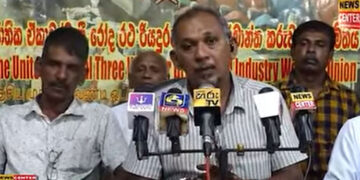
Adding to the controversies, Indian media reported last Thursday that a security agreement was set to be signed during Modi’s visit. This prompted the hard-line Frontline Socialist Party—a breakaway faction from the JVP—to hold a press conference, demanding that the government immediately release details of the agreement and clarify which Sri Lankan group was involved in its preparation. To date, the government has not provided a comprehensive response.
In a related development, the Sri Lankan President convened a special committee on Thursday evening to investigate the tariffs imposed by Trump. The committee included several key figures, such as the Treasury Secretary, the Central Bank Governor, and prominent garment industry leaders, and even reached out to Opposition Leader Sajith for a meeting to discuss the matter.
Looking ahead, after his visit to Sri Lanka, Prime Minister Modi is set to inaugurate another major project on the Indian side—the Pamban Bridge. This bridge, which is the final section of the railway link between India and Sri Lanka, was built in Rameshwaram. Historically, a train service once operated between Talaimannar and India until the bridge was destroyed by a cyclone in 1964. Although previous talks during the Yahapalana government under Prime Minister Ranil Wickremesinghe to rebuild the bridge were stalled due to opposition, India’s The Hindu newspaper reported last week that Modi is scheduled to inaugurate the Pamban Bridge on April 6. The report also mentioned that the remaining sections of the railway line are planned for future construction.