
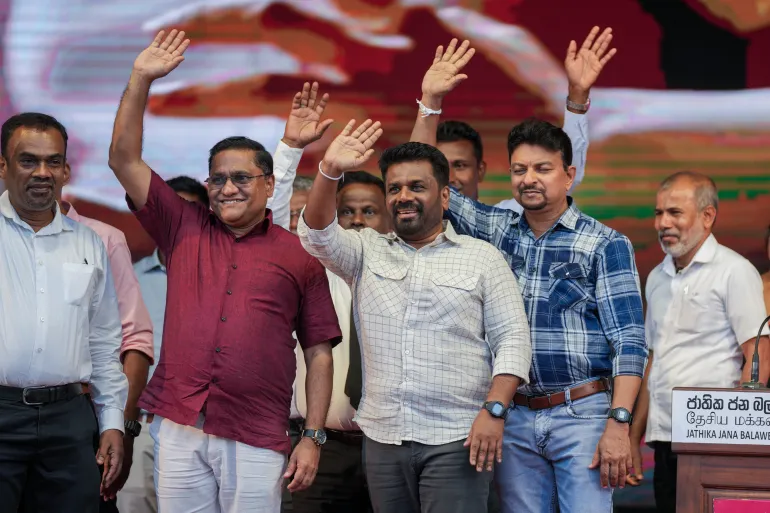
Sri Lankan President Anura Kumara Dissanayake’s leftist coalition has achieved a decisive victory in snap parliamentary elections, granting the Marxist-oriented leader a strong mandate to ease severe austerity measures in the economically troubled nation.
By Friday, with most ballots counted, Dissanayake’s National People’s Power (NPP) had a substantial lead over the opposition Samagi Jana Balawegaya (SJB), securing 62 percent of the vote and a majority of parliamentary seats, according to partial results from the country’s election commission.
As of 11:30 a.m. local time, the NPP had won 137 seats in the 225-member parliament and was leading in 21 out of 22 electoral districts, positioning it for an overwhelming parliamentary majority.
The SJB, led by Sajith Premadasa—the son of former President Ranasinghe Premadasa—had obtained 35 seats. The Ilankai Tamil Arasu Kachchi, representing the Tamil ethnic minority, held six seats, while the New Democratic Front and Sri Lanka Podujana Peramuna held three seats and two seats, respectively.
Voter turnout in Thursday’s election reached approximately 65 percent, lower than the nearly 80 percent turnout seen in September’s presidential election.
Dissanayake won the presidential election in September, riding a wave of public dissatisfaction with austerity measures implemented by his predecessor, Ranil Wickremesinghe, as part of a bailout agreement with the International Monetary Fund (IMF).
With only three seats in the outgoing parliament, Dissanayake, leader of the Janatha Vimukthi Peramuna (JVP), called for early legislative elections to seek a renewed mandate.
Before the vote, Dissanayake projected confidence, telling local media he anticipated a “strong majority” in parliament. “We believe this is a pivotal election that will mark a turning point in Sri Lanka,” he said after voting in the capital.
“There has been a shift in Sri Lanka’s political culture since September, which we must continue,” Dissanayake added.
Dissanayake, whose JVP led a violent uprising against the government in the 1970s and 1980s, has vowed to combat corruption and explore “alternative means” to boost Sri Lanka’s economy without placing additional strain on the poor.
While he criticized the IMF agreement during his presidential campaign, Dissanayake has since acknowledged the importance of its objectives, stressing the need to protect struggling Sri Lankans.
Sri Lanka has been grappling with its worst economic crisis since gaining independence in 1948, due to years of economic mismanagement, the COVID-19 pandemic, and the 2019 Easter bombings.
In 2022, then-President Gotabaya Rajapaksa was compelled to resign after mass protests erupted over soaring inflation and shortages of fuel and food. His successor, Wickremesinghe, managed to stabilize the economy but faced widespread discontent over revenue-raising efforts, including hikes in electricity tariffs and income taxes.