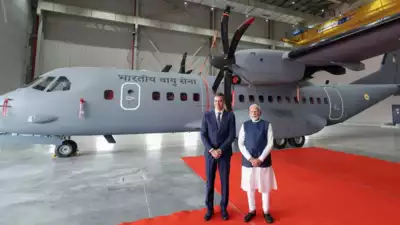
NEW DELHI: On Monday, Prime Minister Narendra Modi, alongside Spanish counterpart Pedro Sánchez, inaugurated India’s first private military aircraft manufacturing facility in Vadodara, marking a pivotal advancement in the nation’s defense manufacturing. This facility represents a major stride toward self-reliance in defense, aligning with the government’s ‘Make in India’ initiative by emphasizing local production.
The facility, which will specialize in the assembly of Airbus C-295 aircraft, aims to bolster the Indian Air Force’s (IAF) operational capabilities while fostering indigenous production. Operations are scheduled to begin by November this year, with the first domestically produced C-295 expected to roll out by September 2026.
The C-295 Deal: Significance and Scope
Valued at ₹21,935 crore (around $2.5 billion), the C-295 deal involves procuring 56 aircraft to replace the IAF’s aging Avro-748 fleet. This acquisition is strategically important for several reasons:
- Building an Aerospace Ecosystem
The C-295 manufacturing facility is designed to establish a comprehensive aerospace ecosystem in India, covering the entire lifecycle of aircraft production. From assembly and testing to maintenance, this integrated approach will enable India to produce, maintain, and upgrade advanced military aircraft, enhancing the IAF’s operational readiness. - Enhanced Air Transport Capabilities
The C-295 is a versatile tactical transport aircraft capable of supporting diverse missions, including troop and cargo transport, medical evacuation, and maritime patrol. Its ability to operate from short, unpaved runways makes it particularly effective in various operational environments. - Boost to Indigenous Production
Under the terms of the agreement, 16 aircraft will be delivered directly from Spain within 48 months, while the remaining 40 will be manufactured in India by Tata Advanced Systems Limited (TASL) at the new Vadodara facility. This groundbreaking project marks the first time a private entity will manufacture an entire military aircraft in India. A 30% offset requirement ensures that Airbus will reinvest in the Indian economy by sourcing from local suppliers, strengthening Indian industry and encouraging further international engagement. - Job Creation and Industry Support
This venture is expected to generate approximately 15,000 skilled jobs and an additional 10,000 indirect jobs over the next decade. It will involve collaboration with over 125 domestic Micro, Small & Medium Enterprises (MSMEs), significantly bolstering India’s aerospace supply chain.
‘Make in India, Make for the World’
As a cornerstone of the ‘Make in India’ program, the C-295 project not only advances India’s defense capabilities but also fuels economic growth through job creation and technological exchange.
- Technology Transfer
Airbus will provide TASL with essential manufacturing technology for C-295 components, incorporating indigenous systems like radar warning and missile approach warning systems developed by Indian firms such as Bharat Electronics Limited and Bharat Dynamics Limited. - Maintenance Hub Potential
Plans for establishing Maintenance, Repair, and Overhaul (MRO) facilities as part of this deal position India as a regional MRO hub, potentially supporting fleets from neighboring countries.
During the inauguration, PM Modi highlighted the facility’s role in bolstering India’s defense and self-reliance goals, calling it a “boost to our mission of Make in India, Make for the World.” He described this facility as ushering in a new era for India’s defense sector, where private involvement is essential for innovation and efficiency. Modi noted that the aircraft produced here will be available for export in the future, expressing optimism that this aerospace ecosystem may eventually enable India to manufacture civil aircraft as well.
Reflecting on the country’s aviation growth, Modi envisioned India as a hub for aviation and MRO, emphasizing how the facility aligns with the government’s strategic goals to strengthen national security through indigenous production. He underscored that projects like this are instrumental to achieving Atmanirbhar Bharat (self-reliant India), demonstrating the government’s dedication to empowering local industries and advancing technology within the country.