
The European Union Election Observation Mission (EU EOM) has accused former President Ranil Wickremesinghe of creating an uneven playing field during the campaign for the upcoming presidential election. In a preliminary statement regarding the 2024 Presidential Election, the EU EOM highlighted that various government initiatives—such as salary increases for public sector workers, social welfare programs, an interest-free student loan plan, and financial aid for small businesses—were positively framed by state media and aligned with the incumbent’s re-election efforts.
The mission noted that the distinction between governance and campaigning became increasingly blurred due to the involvement of state and local officials in the incumbent’s rallies, compounded by the lack of elected provincial and local councils.
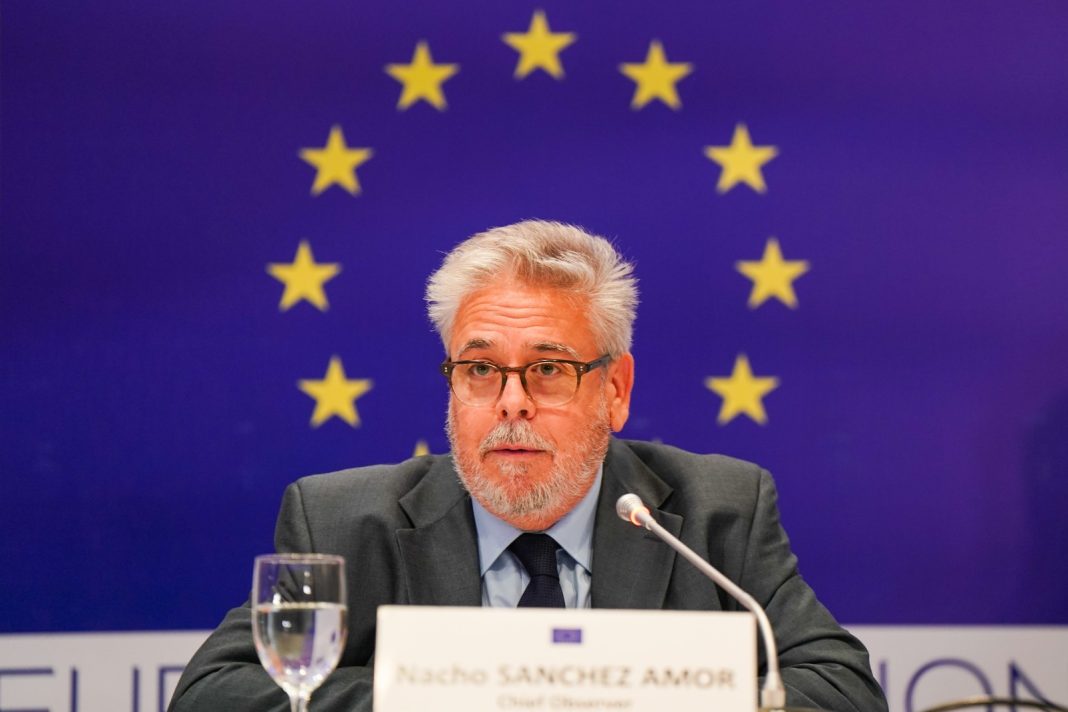
Nacho Sánchez Amor, a Member of the European Parliament and Chief Observer for the EU EOM in Sri Lanka, presented the preliminary findings for the presidential election held on September 21. He emphasized that this election marked a crucial step for Sri Lanka, being the first electoral event following the significant economic and political crises of 2022. Sánchez Amor commended the Election Commission for its independent and resolute conduct, which ensured transparency at every stage of the election process. He noted that voters were provided with genuine political choices, and the campaign atmosphere remained largely peaceful and vibrant.
However, he pointed out that the advantages of incumbency skewed the electoral landscape, with certain misleading digital campaigns aimed at confusing voters. Despite these challenges, the election day proceeded in an orderly manner, with well-trained polling staff facilitating the voting process effectively.
The initial ballot count was organized and maintained the integrity of the election process, though the counting locations occasionally became crowded. The presence of citizen observers and party agents in polling stations, counting centers, and during the results tabulation contributed to the overall transparency of the election.
The Election Commission of Sri Lanka (ECSL) demonstrated a commitment to transparency, gaining the trust of stakeholders while monitoring the campaign closely, even with limited enforcement powers. The ECSL publicly denounced the misuse of state resources and addressed various campaign violations.
While the legal framework laid a strong foundation for democratic elections, recent reforms have enhanced privacy protections and regulated campaign financing. However, new laws pose potential risks to political freedom.
The campaign was competitive, with fundamental freedoms broadly respected. Media coverage was vibrant but lacked substantial non-partisan analysis that could have aided voters in making informed decisions. National fact-checkers and civil society organizations played a crucial role by highlighting misinformation, tracking electoral rule violations, and drawing attention to the misuse of incumbency.
Sánchez Amor concluded that while the election framework is supportive of democratic practices, there is room for improvement, particularly in enhancing transparency in political financing and advancing women’s participation in public and political spheres.
The EU EOM has been in Sri Lanka since August 14, deploying over 70 international observers across all nine provinces. The mission will continue to monitor the post-election environment and will release a final report with recommendations for future elections in the coming months.