Sri Lanka’s state-owned enterprises ratcheted up losses amounting to 18 times the annual pay-as-you-earn taxes collected from wage earners since privatisation was halted, a think tank has said.
When state enterprises ran losses they were covered by loans taken from domestic banks as well as from capital markets.
“From 2005 to 2021, roughly over 15 years, state enterprises have accumulated losses of 1.8 trillion rupees,” said Dhananath Fernando, Chief Executive of Advocata Institute told reporters in Colombo.
“To put this in context, the government hopes to collect 100 billion rupees in for a full year. That means if PAYE tax payers paid their dues for 18 years, then the losses of SOEs could be just covered.”
“They have taken large volumes of loans.”
Though entities like the CEB have taken loans for infrastructure, CPC and Sri Lankan Airlines have taken loans simply to cover losses.
From 2005, privatisation was halted and several previously privatised firms including Sri Lankan Airlines and Shell Gas were taken back to the state. Sri Lankan Airlines in particular then ran up large losses.
“The subsequent losses Sri Lankan made after it was taken over by the government was well-known,” Ravi Ratnasabapathy, a consultant said.
“How were these losses financed When you are making cash losses, you are spending more money than you are earning. A private company cannot do it. The only option is to borrow. Who is lending to these state entities? It is the Bank of Ceylon and People’s Bank.”
State banks were also made to buy Sri Lankan Airlines when it was taken back from Emirates, he said.
The loans are to be taken over by the government prior to privatization. Sri Lanka now has to raise taxes to make debt sustainable.
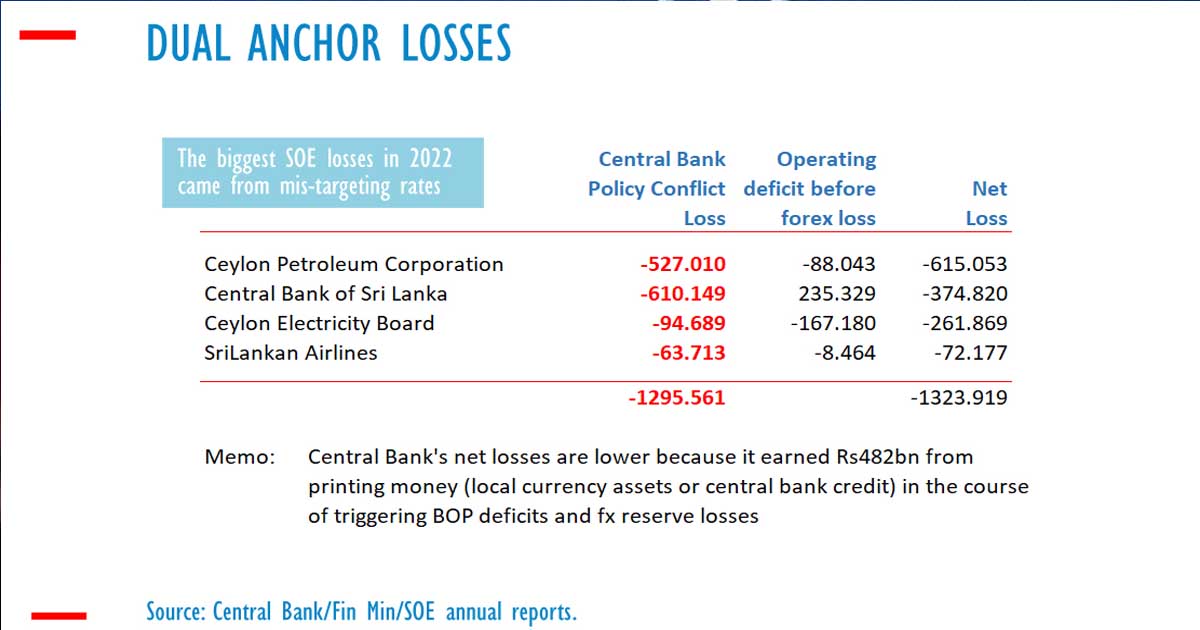
However a large part of SOE losses also come when the currency falls as the central bank prints money to target a fixed policy rate, due to dollar loans in their books, regardless of pricing, other analysts have shown.
Some of the SOE loans, like in the CEB were taken to finance infrastructure not losses. But they also generate losses, when the central bank prints money and depreciates the currency.
The CPC has accumulated large dollar loans in recent years as it was barred from buying dollars when the central bank cut rates with printed money and triggered forex shortages.
The CPC imports oil on suppliers’ credit and its letters of credit, without paying immediately in years when the central bank prints money to cut rates, triggering forex shortages. The LCs were then settled by loans from state commercial banks.
In 2018 when fuel was market priced by then Finance Minister Mangala Samaraweera cutting operational losses, the CPC ran an 80 billion rupee forex loss because the rupee fell from 152 to 182 to the US dollar due to rate cuts enforced by money printing.
In 2022, Ceylon Petroleum Corporation lost 615 million US dollars of which 527 million came from forex losses from the collapse of the rupee as the rupee collapsed from 200 to 360 to the US dollar.
After debt topped 100 per cent of GDP, Sri Lanka experienced the first economic contraction in post-independence history, as money was printed during a civil war to mis-target rates, legal limits were brought to control the deficit and also Treasury guaranteed debt.
A Fiscal Management Responsibility Act was passed in parliament in 2003, limiting Treasury guarantee-backed borrowings to 4.5 per cent of GDP.
“The Government of Sri Lanka regularly circumvents these legislative limits through Parliament and SOEs have benefited from these loose restraints,” Thowfeek said.
“The FMRA originally set out a limit of 4.5 per cent of GDP on the amount of government guarantees that can be incurred on SOE liabilities. This limit has been raised three times already and in 2021 this limit was further extended to 15 percent, more than twice the original level.”
“The government also routinely provides letters of comfort or treasury guarantees for SOEs.”
Ravi Rathnasabapathy, independent consultant said if loans given by state banks to SOEs were properly provided for when they were not paid back, they would also have made losses capital deficiencies.
Source : Economynext