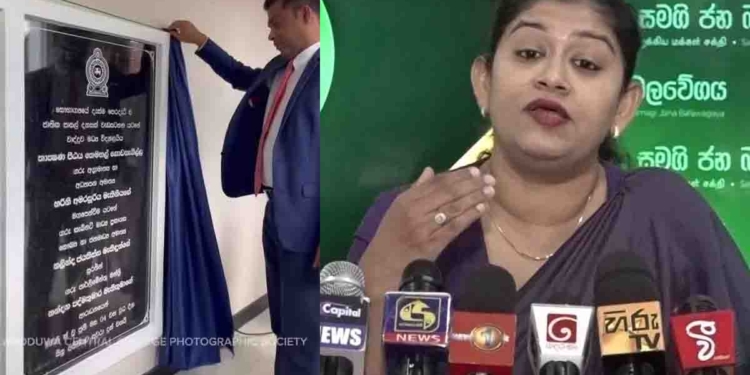
Attorney Lihini Fernando, a municipal councilor of the Moratuwa Municipal Council, participated in a media briefing held today (9th) at the main office of the Samagi Jana Balawegaya (SJB).
Further expressing her views, she stated:
“On the occasion of the recent Poya Day, 388 prisoners were granted a presidential pardon. According to the constitution, the President has the authority to grant general amnesty to prisoners. However, it has come to light that in addition to the official list of 388 prisoners, a person named W.H. Thilakarathna has also been released. Reports indicate that this individual’s name was not included in the official list of those to be pardoned. Furthermore, it has been reported that an officer from the Anuradhapura prison has also been taken into custody regarding this incident.
There is a specific procedure that must be followed when granting pardons to prisoners. The Commissioner General of Prisons provides a list of inmates eligible for release. Based on this, prisoners are released on special occasions. Priority is given to those unable to pay bail and elderly inmates when granting the presidential pardon. Once the list of inmates to be released is prepared by the Prisons Commissioner General, it is sent to the Ministry of Justice, and then from there to the Presidential Secretariat.
The Ministry of Justice scrutinizes the list of prisoners to be released. Only then does the President sign off on the list.
Therefore, questions arise as to how a prisoner whose name was not on the official list was released. We also have concerns as to whether any power is acting above the executive authority of the President. How could a prisoner receive a pardon without the President’s signature? Did the Justice Minister properly review the list submitted by the Prisons Commissioner General? Was the general amnesty misused to illegally release prisoners?
President Anura Dissanayake has stated that he would never betray the public trust in any way. But is this incident a violation of public trust by the President, or does it reflect an administrative weakness of the government? The National People’s Power (NPP) stated that all procedures would be done correctly if they come into power. How do such mistakes happen under a government that made such promises? What becomes clear from incidents like this is the administrative and governance weaknesses of the current government. The NPP claims to have competent, skilled, and capable people in their ranks. If such a group is in government, did a force greater than the executive power act in releasing this prisoner? We would like to ask the government this question.
Furthermore, the Indian Prime Minister recently visited Sri Lanka. During the visit, seven agreements were signed between Sri Lanka and India. These agreements were discussed in Parliament, with many MPs requesting the government to present the details to the country. However, the President and the government have maintained silence on this matter. Even though details were requested under the Right to Information Act, the government has not disclosed the contents. These agreements mainly cover the sectors of energy, digitalization, defense, health, and multilateral support in the Eastern Province. They include initiatives such as establishing high-voltage interconnections for the import and export of electricity, digital transformation at the public level, developing Trincomalee as an energy hub, cooperation in defense, and support in the health and pharmaceutical sectors.
We question why the government is not disclosing the details of these agreements to the public. When the previous government entered into any agreements, the then opposition—now the current government—protested and organized strikes throughout the country. Why is the current government now following a different approach? We request the government to reveal the contents of these agreements to the country.
Additionally, the Minister of Health recently unveiled a commemorative plaque. Previously, the NPP stated that there was no need for such plaques. They said that the public should own the developments made with their tax money, and there was no need to inscribe the names of ministers on them. But now, government ministers are affixing their names to these projects funded by public taxes. The NPP promised to end the 76-year curse when coming to power. Yet the current government continues with old practices. These actions by the government that was brought to power by the people have become an insult to those very people.”