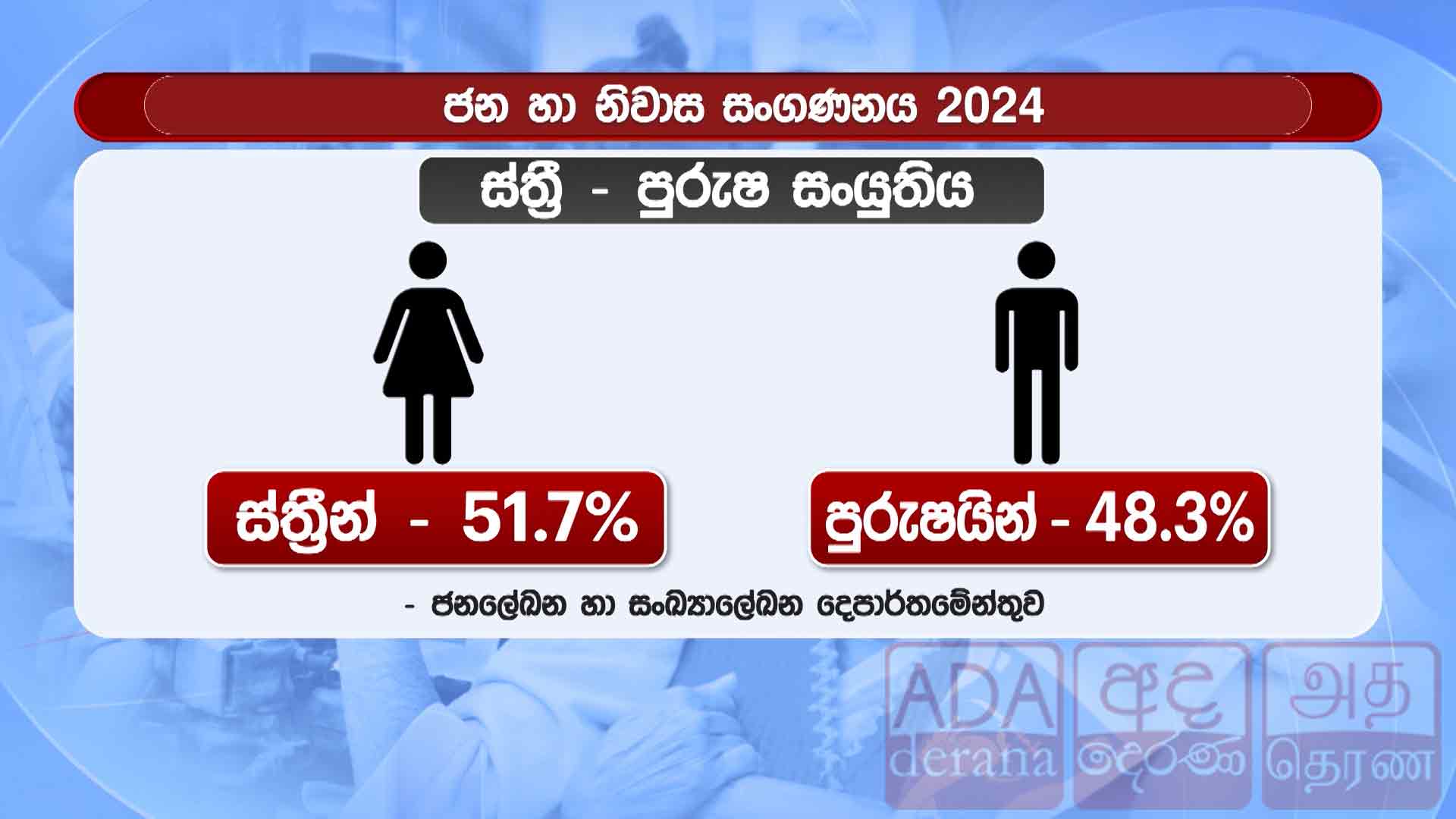

According to the 2024 census data released by the Department of Census and Statistics, Sri Lanka’s sex ratio has been reported as 93.3.
The sex ratio refers to the number of males per every 100 females.
It is an important demographic indicator, as it influences social and economic sectors as well as long-term population stability.
Accordingly, when the sex ratio exceeds 100, it indicates that the male population is higher than the female population, and when it falls below 100, it indicates that the female population is higher than the male population.
In the 2012 census, the reported sex ratio was 93.8, while in the 2024 census, it is 93.3.
This shows a decrease of 0.5 percentage points between 2012 and 2024.
However, when the sex ratio is analyzed by age group in the latest census, it appears that in the age categories between 0 and 19 years, the sex ratio values are above 100.
Nevertheless, for all age groups above 40 years, the sex ratio shows a gradual decline with increasing age.
In particular, among those aged 70 years and above, the lowest sex ratio is recorded — 69.8.
In this census, the highest sex ratio is reported from the Monaragala District at 97.9, followed by Mannar District with 97.3.
Meanwhile, the lowest sex ratio is reported from the Batticaloa District in the Eastern Province, which stands at 88.0.