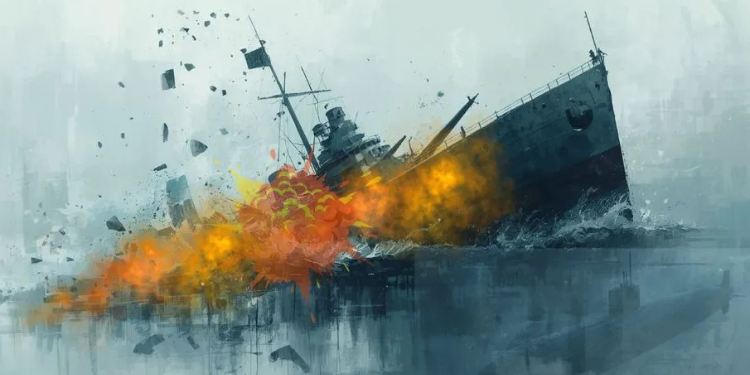
Significant debate and discussion continue regarding the sinking of the Islamic Republic of Iran’s naval vessel IRIS Dena. Numerous analysts, former naval officers, strategic affairs experts, diplomats, and social media commentators have offered differing perspectives on the incident.
Reason for the Spotlight
IRIS Dena had participated in the International Fleet Review (IFR) and Milan 2026, hosted by the Indian Navy off Visakhapatnam from 15 to 25 February 2026.
After completing its participation, the vessel departed Visakhapatnam on 25 February 2026.
On 04 March 2026, the ship was reportedly torpedoed by a United States Navy submarine, USS Charlotte (SSN 766), at a position approximately 19 nautical miles south of Galle, Sri Lanka.
About IRIS Dena
According to Jane’s Fighting Ships 2023–2024, IRIS Dena is classified as a Jamaran (Mowj)-class FFGH (Guided Missile Frigate Helicopter).
The vessel was commissioned on 14 June 2021.
Its specifications are as follows:
- Length: 94.5 meters
- Breadth: 11.1 meters
- Height: 4.3 meters
- Full load displacement: 1,372 tons
Weapons
The ship’s armament included:
- Four Noor (C-802A) anti-ship missiles with a range of approximately 180 km
- Four SM-1 surface-to-air missiles with a range of 38 km
- One 76 mm naval gun with a range of 16 km
- One 40 mm / 30 mm gun with a range of 4 km
- Six 324 mm torpedo tubes
Sensors
The vessel’s sensor suite included:
- Plessey AWS-1 air/surface search radar
- Racal Decca 1226 surface search radar
- Contraves Sea Hunter fire control radar
- Two Furuno navigation radars
There are no confirmed reports indicating whether the ship was equipped with a sonar system.
Situation Prior to Departure from Iran
IRIS Dena was based at Bandar Abbas, Iran. The ship arrived off Visakhapatnam on 17 February 2026.
The distance between Bandar Abbas and Visakhapatnam is approximately 2,728 nautical miles. A transit of this distance would normally require eight to ten days. Therefore, the ship would likely have departed Bandar Abbas between 07 and 09 February 2026.
At that time, the United States had begun a significant military buildup in the CENTCOM Area of Responsibility (AOR) starting in mid-January 2026. Consequently, tensions between the United States and Iran were already escalating when the vessel left Iran.
Under such circumstances, it is unlikely that Iran would have deployed the ship without armament or with only minimal weapons. Professional naval forces typically would not send a vessel into such an environment without appropriate combat capability.
Developments After Departure from Visakhapatnam
IRIS Dena departed Visakhapatnam on 25 February 2026 after completing its participation in the IFR and Milan 2026 events.
Three days later, on 28 February 2026, the United States and Israel launched strikes against Iran as part of Operation Epic Fury.
It is highly unlikely that IRIS Dena would have been unaware of these developments.
Despite this escalation, the ship remained at sea. There are currently no credible reports detailing communications between Iranian authorities and the ship’s commanding officer, or the reasons why the vessel continued operating at sea until 04 March 2026, when it was struck by a torpedo fired from a US Navy nuclear attack submarine (SSN).
Other Iranian Ships at IFR and Milan 2026
IRIS Dena was not the only Iranian naval vessel participating in the International Fleet Review.
The Iranian flotilla also included:
- Hengam-class landing ship Lavan (displacement 2,581 tons)
- Bandar Abbas-class replenishment ship Bushehr (displacement 4,673 tons)
Following the escalation:
- Lavan requested permission to enter Kochi, India, on 28 February 2026, which was granted on 01 March 2026. The ship entered Kochi on 04 March 2026 and has remained there since.
- Bushehr requested permission from Sri Lanka to enter Colombo on 04 March 2026. Permission was granted on 05 March 2026, and the vessel was later moved to Trincomalee by Sri Lankan authorities.
Notably, IRIS Dena was the smallest vessel in the group, with a displacement of 1,372 tons, compared to Lavan’s 2,581 tons and Bushehr’s 4,673 tons.
It therefore appears unusual that while the two larger Iranian ships sought refuge in India and Sri Lanka respectively, the smallest vessel remained at sea.
The US Submarine Strike
The US Navy submarine strike on IRIS Dena on 04 March 2026, reportedly involving a Mk 48 torpedo, sparked extensive debate.
The release of periscope photographs and videos of the attack has further intensified discussions surrounding the incident. These debates include legal, humanitarian, diplomatic, and strategic considerations.
Was the Strike Illegal?
The legality of the strike has been widely debated. However, by 04 March 2026, the United States and Iran were already engaged in active combat, making them belligerents in an armed conflict.
Under such circumstances, if one belligerent encounters a naval unit belonging to the other, it is operationally logical to attempt to neutralize that unit. This appears to be what occurred in this instance.
Location of the Attack
The strike occurred approximately 19 nautical miles south of Galle, Sri Lanka.
This location does not appear to create a legal complication, as it lies outside Sri Lanka’s territorial waters.
Expansion of the War Zone
Some commentators have suggested that the strike expanded the conflict zone across the Indian Ocean Region (IOR).
However, this may be an exaggeration. The likelihood of the United States and Iran engaging in active naval combat across distant parts of the Indian Ocean in the near future appears minimal.
Planned Strike or Target of Opportunity?
It remains unclear whether the strike was a pre-planned operation or whether IRIS Dena was simply a target of opportunity.
Both possibilities remain plausible. It is also highly likely that the United States was tracking the movements of the three Iranian vessels, which would not be unusual in such circumstances.
Rescue of Survivors
Another question raised is whether the attacking submarine should have surfaced to rescue survivors.
In practice, submarines operating in combat environments generally do not surface after an attack, as doing so would expose them to significant operational risks.
Diplomatic and Strategic Considerations
Some observers have argued that the United States should have considered the diplomatic optics, particularly because IRIS Dena had just participated in a major naval event hosted by India.
Others have suggested that the US should have informed India beforehand.
However, in wartime conditions, it is unrealistic to expect a country to disclose operational combat plans to another state. Furthermore, because the strike was carried out by a nuclear-powered submarine, it is unlikely that the United States would have revealed the presence of such a vessel operating in the Indian Ocean.
Additionally, if India had been informed in advance, it might have been viewed as complicit in the strike, potentially placing it in the position of a participant in the conflict between the United States and Iran.
Hypothetical Scenarios
Several hypothetical scenarios help illustrate how perceptions might differ:
Scenario 1:
If the strike had occurred in the northern Arabian Sea, would reactions in India have been the same, or would distance and time have moderated the response?
Scenario 2:
If IRIS Dena had not participated in the International Fleet Review, but was operating in the region for another mission, would the strike have been viewed differently?
Scenario 3:
If the vessel had been returning from a visit to another country in India’s neighborhood and was attacked in the same manner and location, would current criticism directed at India still arise?
Commentary
Considerable attention has focused on the fact that IRIS Dena had recently participated in the International Fleet Review at Visakhapatnam. Phrases such as “guest of India,” “India’s backyard,” and concerns over “bad optics” have appeared frequently in discussions.
Some narratives also emphasize that the crew had engaged in friendly interactions and that the vessel was allegedly not armed.
Such narratives appear to attempt to indirectly associate India with responsibility for the incident, while overlooking the fundamental reality that the United States and Iran were already engaged in active conflict.
While it is natural for observers to respond emotionally to such events, warships are designed and expected to operate in dangerous environments.
Analyses driven primarily by sentiment may not provide a realistic understanding of naval operations.
Some commentators have also suggested that the Indian Navy should have been aware of the presence of the US submarine, implying constant monitoring of all activity across the Indian Ocean Region.
However, such expectations overlook the vast scale and complexity of the maritime domain, where monitoring every movement continuously is extremely challenging.
Lessons from the Incident
Several strategic lessons emerge from the incident.
The most significant is the importance of continuous assessment of the strategic environment, both around one’s own country and in areas where national naval vessels may operate.
Situational awareness must be maintained 24 hours a day, 365 days a year to avoid strategic surprise.
For naval forces, there is effectively no purely ceremonial mission. Even during diplomatic visits or ceremonial engagements, warships must remain prepared for potential conflict.
Another key lesson involves the influence of social media narratives, which must be monitored carefully. False or misleading narratives should be countered promptly by trained professionals.
Finally, conflicts occurring anywhere in the world must be observed closely, with adequate manpower and resources dedicated to assessing their potential implications.
Distance from a conflict zone should never lead to complacency.