

“Colombo Municipal Council is ours. Green flags have always flown over the Colombo Municipal Council. Are we supposed to sit back blind and deaf while this is handed over to the leftists…?”
These were the angry, trembling words of Sir John Kotelawala, then Prime Minister and leader of the UNP, spoken in 1955.
Sir John’s fury arose because even while a UNP government was in power, the UNP’s own heartland—Colombo Municipal Council, which the UNP had always won—had fallen into the hands of the leftists. And the person who became Mayor of Colombo was not just any leftist; he was double-doctor N. M. Perera—regarded as a brilliant intellectual and a standard-bearer of left-wing politics. At that time, for Sir John, J. R., and Dudley, N. M. was a formidable thorn. By then, Dudley Senanayake had stepped down from the premiership and withdrawn from politics.
“We have a city councillor who has discussed a plan with our Municipal Council group to retake control of the Colombo Municipal Council. Would you be willing to speak with him?”
UNP General Secretary Amarasuriya said this to Sir John in an attempt to calm him down.
“Bring whoever it is. If you all can’t get this done, we’ll hand the job over to him…”
Sir John replied.
“Who is this man?”
Sir John asked.
“A person named Premadasa…”
The UNP General Secretary answered.
“I’ll talk to him. We’ll somehow get rid of N. M…”
Sir John growled.
By this time, Ranasinghe Premadasa had been elected to the Municipal Council from St. Sebastian’s Ward through A. E. Gunasinghe’s Labour Party, and was serving as a city councillor. Premadasa, who came from a modest family in Kehelwatte, understood that although the doors of A. E. Gunasinghe’s Labour Party had opened for him; entering the elite headquarters of the Colombo 7 aristocracy—Sirikotha—would not be easy.
Premadasa devised this master plan precisely for that purpose. But he did not do it merely for flattery. He was still a young man, and he aimed to secure the position of Deputy Mayor.
“He’s a fellow from Kehelwatte. Can we trust a chap like that?”
Asked the leader who coordinated the UNP within the Municipal Council.
“I don’t know the young man personally. But our councillors say he is capable…”
replied the General Secretary.
“Bring a motion of no confidence through the UNP. I’ll handle the rest…”
said Premadasa—the first young councillor from Kehelwatte to set foot in the aristocratic bastion of Sirikotha in Colombo 7. The UNP listened to what this non-elite lad from Kehelwatte said, and brought in a motion of no confidence.
N. M. challenged the motion in court. The court ruling was scheduled for the same day the motion was to be debated. Until the judgment came, N. M. tried to stall the no-confidence motion. He allowed three giants of the socialist movement—Osmund Jayaratne, Bernard Soysa, and J. E. de S. de Silva—to speak for hours during the debate. But the plan did not work.
To the shock of double-doctor N. M., the symbolic champion of left-wing politics, Premadasa managed something extraordinary: Anthony Marshall, elected from Kotahena under the Communist Party, and another member crossed over from the government to the opposition and supported the no-confidence motion. The motion passed by two votes. In that moment, the UNP once again raised the Green Flag over the Colombo Municipal Council. Deputy Mayor J. Rudra was removed, and Premadasa became Deputy Mayor.
“He’s talented. Bring him into the UNP…”
said Sir John, upon hearing that the green flag once again flew over the Colombo Municipal Council. J. R. nodded silently.
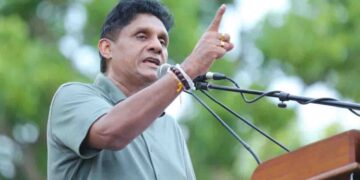
Decades later, it was Sir John’s former Deputy Mayor Premadasa’s son, Sajith Premadasa, who attempted another dramatic maneuver to reclaim a Colombo Municipal Council that had gone to the JVP after the defeat of N. M. in 1955. This time, he united Ranil’s UNP, Namal Rajapaksa’s Podujana Peramuna, Nimal Siripala’s SLFP, Dilith Jayaweera’s Sarvajana Balaya, and Champika Ranawaka’s Janaraja Peramuna. Several independent groups also joined. The operation was led by Mujibur Rahuman.
After the recent local election, no party secured a majority to form control over the Colombo Municipal Council. At that time, Sajith entrusted Mujibur with the task of taking power in the council. However, the JVP government courted independent councillors with privileges and hospitality, hosted them at five-star hotels, fed them biryani, and used the authority of a pro-JVP Municipal Commissioner to somehow establish control of the council. President Anura personally intervened. Before Anura’s maneuvers, Sajith and Mujibur had no answer.
The loss of the Colombo Municipal Council in 1954 foreshadowed the great wave of 1956. By the time that wave arrived, it was already fully formed. Sir John and the UNP could not withstand it. The leftists’ first victory in Colombo and several other councils in 1956 served as a warning sign of what was to come.
Sajith’s Samagi Jana Balawegaya faced the 2025 local election in the aftermath of the massive 2024 JVP tsunami. When the UNP stood aside separately, defending the council against that wave became extremely difficult.
However, just as the arrival of the 1956 wave had once prompted Premadasa to reclaim Colombo for the UNP, this time Sajith—son of the man who first restored the Colombo Municipal Council to the UNP—brought down the JVP-led budget, turning the council green again. But this time, the green was mixed with Ranil’s shade of green, Namal Rajapaksa’s red, Nimal Siripala and Dilith Jayaweera’s blue, and Champika Ranawaka’s party colours.
“The young man from Kehelwatte is capable. Bring him into the UNP…”
Sir John once said.
“Sajith has played the game well. Now let’s unite the UNP and the SJB and hand leadership to Sajith…”
It isn’t easy to imagine Ranil saying such a thing.