
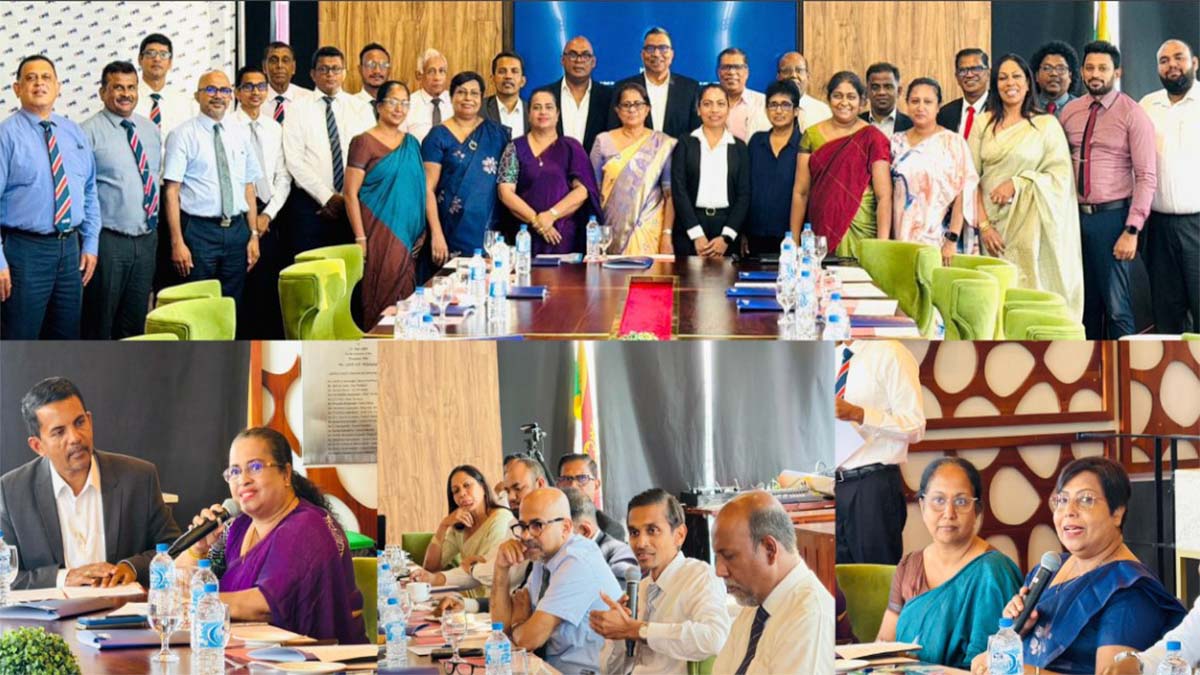
The Chartered Institute of Personnel Management, Sri Lanka (CIPM) recently hosted a roundtable discussion bringing together 30 key stakeholders from government institutions, academia, vocational training providers, and corporate bodies to jointly examine the skills-gap landscape in Sri Lanka. The growing mismatch between industry requirements and workforce competencies has emerged as a critical challenge to Sri Lanka’s economic growth and competitiveness. Technological advancements, migration of skilled professionals, changing Labour market dynamics, and gaps in education and vocational training have intensified skill shortages across multiple sectors. Industries including IT, tourism & hospitality, construction, manufacturing, healthcare, and engineering continue to report difficulties in recruiting skilled personnel, whilst youth unemployment and underemployment remain concerns, indicating a disconnect between education outcomes and market expectations.
Dr. Heather Fernando, Chairperson, Standing Committee – National HR Data Hub with Research and Development Capabilities, CIPM, outlined the purpose of the dialogue. The dialogue, facilitated by Dr. Samantha Rathnayake, Senior Lecturer, Postgraduate Institute of Management, was preceded by a presentation on Labour Market Intelligence by Manuja Karunaratne, Principal Information Officer, National Science Foundation, covering sector-specific workforce challenges, emerging skill requirements, practical strategies, and policy implications to strengthen industry-academia partnerships and workforce development initiatives. Dr. Neil Bogahalanda, Vice President, CIPM, emphasised the urgent need for strategic and systemic interventions to address the prevailing skills gap, highlighting that aligning workforce competencies with evolving industry demands is essential to strengthen national productivity, enhance employability, and sustain the country’s long-term economic growth and competitiveness.
Dr. Dilrukshi Herath, Deputy Director, National Vocational Qualification, Tertiary & Vocational Education Commission, stated that they are fully focused on developing skills for different industries, whilst Mrs N. R. Ranawake, Commissioner of Labour, Labour Standards Division, noted that some changes are at the discussion level for Labour reforms and amendments. Neil Abeysekera, CEO – Institution of Engineers, Sri Lanka, highlighted that addressing the skills gap alone is insufficient without a parallel transformation in societal attitudes and perceptions toward certain job roles and professions, emphasising the importance of fostering a culture where skilled workers, vocational and technical professions are accorded equal dignity, recognition, and social respect, similar to many developed nations. Prof. Udaya Mohan from Kelaniya University emphasised the need to employ unemployed graduates on freelance basis and to align the Labour on gig-economy approaches and requested the officers from the Department of Labour to look to a wider scope of workforce engagement factors for higher productivity. Prof. Mangaleshwaran stated that the development of soft skills among young graduates has become an essential prerequisite for employability and professional success in the contemporary Labour market, adding that the university system has strategically incorporated industry exposure through structured internship programmes, thereby strengthening their readiness for industry engagement.
The outcome of the dialogue was to focus on future Labour market dynamics and emerging occupations, technical and vocational education reforms, digital and soft skills development, retention of skilled talent amidst migration pressures, public-private partnerships for capacity building, industry-driven curriculum development, and reskilling and upskilling initiatives for economic resilience. Mrs. J. M. K. N. Jayasooriya, Assistant Commissioner of Labour, Planning, Research, Training & Publication Division, stated that dialogues should continue to strengthen understanding of Labour market dynamics and better align Sri Lanka’s human capital development with the identified needs of both private and public sector institutions. Dr. Roshan Niwunhella emphasized the need for a comprehensive transformation of university curricula to ensure that young graduates are better prepared to adapt to the rapidly evolving business environment, highlighting that higher education institutions must move beyond traditional teaching approaches and align academic programs with current industry expectations, technological advancements, and emerging Labour market dynamics. He further noted that universities should focus not only on academic knowledge but also on developing practical competencies, innovation, critical thinking, adaptability, communication, and problem-solving skills among students.
Ken Vijayakumar, Immediate Past President, U.A.C. Obeyesekere, CEO, and G. Weeratunga, CEO/Director of Professional & Academic Affairs of CIPM, and K. I. Nimesha Rashikalana of the Labour Department contributed their valuable expertise and insights to the discussion. It was agreed that CIPM should continue this dialogue to generate actionable recommendations supporting sustainable human capital development and enhance competitiveness through capability building. Dr. Samitha Perera, Past President, CIPM, summed up the dialogue at its conclusion.