Sri Lanka is facing a severe dengue epidemic due to prevailing rainy weather conditions and public negligence, the National Dengue Control Unit (NDCU) has warned.
Raising concerns over the escalating situation, NDCU Director Dr. Kapila Kannangara stated that the number of reported dengue cases had surpassed 40,000 as of this weekend. The country is currently recording between 650 and 700 new dengue cases each day.
A total of 22 dengue-related deaths have been reported so far this year, including five children under the age of 15.
In response to the worsening outbreak, the government has declared a special five-day Dengue Control Week, which will commence tomorrow and continue until Friday.
According to health authorities, public places will be inspected during the first three days of the programme. On June 18, dengue prevention activities will be conducted in all schools and educational institutions, while inspections and dengue control measures will be carried out in all government institutions on June 19.
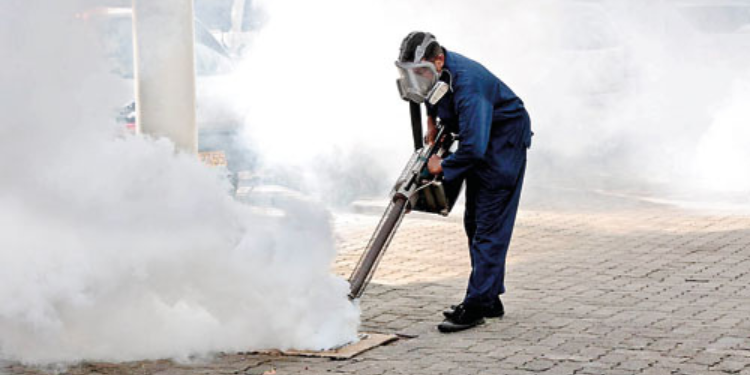
Earlier this week, the National Dengue Control Unit of the Health Ministry launched a special three-day national dengue mosquito control programme across 72 Medical Officer of Health (MOH) divisions in 14 districts.
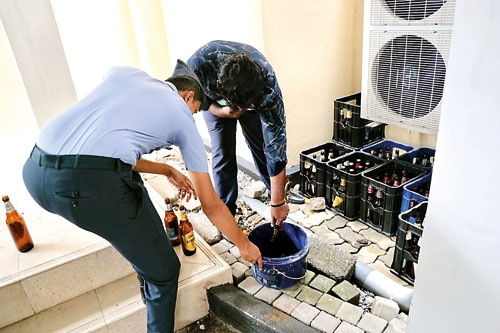
Following the conclusion of the programme on June 10, the National Dengue Control Unit released a report outlining its overall progress.
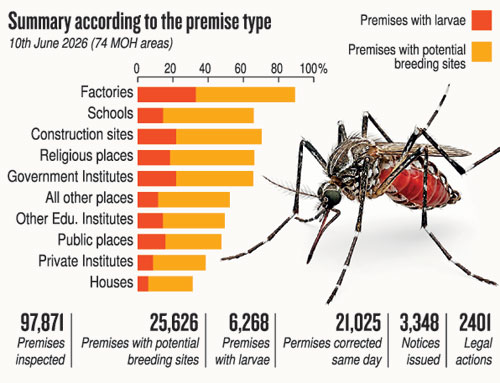
The report revealed that 97,871 premises were inspected during the three-day operation. Of these, 25,626 premises (26.2%) were identified as high-risk locations with the potential to breed dengue mosquitoes, while 6,268 premises (6.4%) were confirmed to contain dengue mosquito larvae.
Factories and construction sites were identified as the locations with the highest percentages of dengue mosquito larvae. Larvae were detected in 32.9% of inspected factory premises and 21.8% of inspected construction sites.
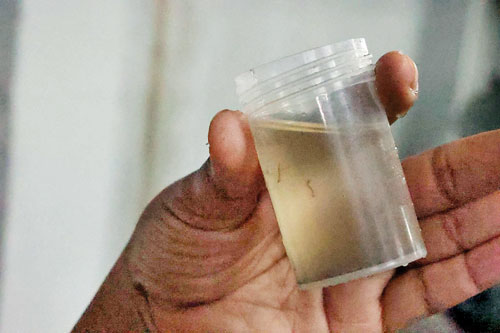
According to the report, 5,250 of the 89,417 houses inspected were found to contain mosquito larvae.
Authorities also cleaned 21,025 premises that had been identified as mosquito-breeding sites during inspections. Additionally, 3,348 red notices warning of legal action were issued over the three-day period.
Legal action has been initiated against 2,401 property owners who failed to comply with public health regulations.
The programme was conducted with the support of the police, armed forces, government institutions, MOH offices, non-governmental organisations, community-based organisations, village committees, Public Health Inspectors (PHIs), dengue assistants, and other health sector personnel.
The National Dengue Control Unit has urged the public not to rely solely on special mosquito-control campaigns, but to take continuous responsibility for maintaining clean surroundings and eliminating mosquito breeding sites at all times.