

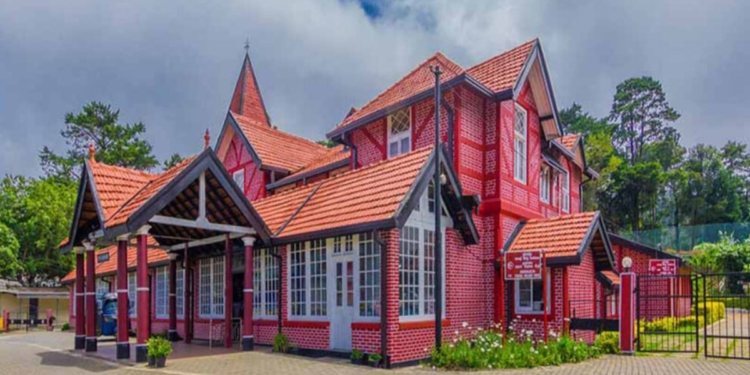
The first post offices in Sri Lanka were established during the British colonial period on 23 September 1798. The earliest post offices were set up in coastal areas including Colombo, Galle, Jaffna, Trincomalee, and Mannar. Among them, the Galle Post Office is located inside the Galle Fort, which is now in a state of deterioration and decay.
The oldest functioning post office building in Sri Lanka today is considered to be the Nuwara Eliya Post Office. It was also built during the British colonial era, approximately 132 years ago in 1894. Designed in a Victorian architectural style and constructed entirely of red bricks, the building has given an “English charm” to Nuwara Eliya, often referred to as “Little England.” It is regarded as one of the most talked-about post offices in the country and is also considered an international landmark of the Sri Lanka Postal Department.
In recent times, this globally recognized post office became a subject of controversy during the tenure of former President Ranil Wickremesinghe, who served briefly after President Gotabaya Rajapaksa resigned. During that period, proposals were made to transfer the building for a tourism hotel project in collaboration with India’s Taj Hotels group.
The idea of handing over the historic post office building and its premises to a hotel project was first revealed by President Ranil Wickremesinghe during a District Coordination Committee meeting in Nuwara Eliya in 2023. He strongly supported removing postal services from the building and converting it into a tourism development project. As a first step, the Cabinet in its meeting held on 29 April 2024 decided to transfer the Nuwara Eliya Post Office building and land to the Urban Development Authority, despite strong opposition from postal workers and the general public. This issue even became a major topic during the 2024 presidential election campaign.
The current President, Anura Kumara Dissanayake, has also spoken on several occasions—both during election rallies and outside them—about the Nuwara Eliya Post Office building. At a ceremony held at the Temple Trees to mark 150 years of the postal service, Minister Vijitha Herath stated that the Nuwara Eliya Post Office would not be handed over to any hotel project, confirming a reversal of earlier plans.
Following this, at the Cabinet meeting held on 23 June 2025, a decision was taken to revoke the previous Cabinet decision made on 29 April 2024 by the Wickremesinghe administration regarding the future of the Nuwara Eliya Post Office.
Approval was also granted to renovate the building and land in a way that would enhance tourism appeal and create new revenue streams. This proposal was submitted by the subject minister, Dr. Nalinda Jayatissa. Accordingly, renovation work on the post office has recently begun, and the building has once again become a topic of public discussion.
However, the reason for renewed attention is not only the renovation, but also an incident involving a missing lightning conductor installed on the building.
Gayan Chaturanga Vijayabanda of the “Nuwara Eliya Preservation Organization” has alleged that police are not taking proper action due to the influence of powerful political forces. The lightning conductor in question is said to be an old installation dating back to the early construction of the building. Although its monetary value cannot be precisely determined, there are claims that there is an organized black market for antique lightning conductors.
From time to time, there have been reports of organized theft of lightning conductors from old colonial-era buildings such as plantation bungalows, manor houses, temples, and churches. These items are believed to be sold for extremely high prices, sometimes reaching millions. Although there is no clear scientific explanation for the demand, it is believed that some individuals involved are highly educated and even connected to security forces. Studies of past police investigations into such thefts suggest the existence of such networks.
Because of this background, suspicion has also arisen regarding the missing lightning conductor from the Nuwara Eliya Post Office. The Nuwara Eliya Preservation Organization has even suggested that it may have been stolen as part of such a network.
It is claimed that the value of the missing lightning conductor could range between 50 and 100 crore rupees. They have questioned why no action has been taken even though such a major theft allegedly occurred in broad daylight.
Although a complaint has been lodged with the Nuwara Eliya Police by the Postal Department, it is said that even a report has not yet been submitted to court, which has caused surprise among observers. They criticize the police for remaining inactive in this case while quickly acting on minor issues.
Further investigations revealed confusion even within the Postal Department, as no one appears to have been aware that a lightning conductor was actually installed on the building. Even historical property records do not mention such an installation.
The discovery of the missing lightning conductor only came to light when military personnel involved in renovation work informed the authorities.
A unique feature of the Nuwara Eliya Post Office building is its clock tower, which rises above the roof. The clock, manufactured in Sainsbury, Walthamstow (England), is installed on a tower approximately 40 feet high and is made of brass and steel. The lightning protection system is connected to this tower.
The system is designed to channel lightning through a copper strip down to a copper plate buried underground. It is believed that this underground copper plate itself may be worth millions. Some even claim that over centuries of lightning strikes, it has absorbed significant “energy,” and that foreign buyers are interested in purchasing such items—though others dismiss these beliefs as myths.
However, there is no doubt that there is an active underground market for such antique lightning protection components.
Although it has not yet been confirmed what exactly happened to the lightning conductor, it became evident that something was missing when soldiers repairing the roof noticed that the copper strip connected to the system was gone.
A complaint regarding this was lodged with the Nuwara Eliya Police on 9 April. According to the complaint made by Postmaster D. Nilmini Edirisinghe, the police investigation is still ongoing but has not progressed significantly. Whether it was theft, when it occurred, or who was responsible remains unknown.
The postmaster stated that she only learned about the existence of a lightning conductor when she assumed duty two years ago. Her assistant postmaster, who has worked there for over 12 years, also stated that he had never seen such a system during his service.
Police officers investigating the case also checked inventory records but found no mention of the lightning conductor.
Since building components such as doors, windows, and roof tiles are not properly recorded in inventory logs, it is possible that the lightning conductor was also not listed.
The officer responsible for inventory records, an employee named Gnanarathna, has only been in service for three to four years and also claims he has never seen such an installation.
The longest-serving current employee at the Nuwara Eliya Post Office is Pradeep, with 24 years of service. He vaguely recalls that during tile work in 2001, some metal strips embedded in the floor were removed, but he cannot confirm they were part of the lightning system.
If copper strips running from the roof to the ground were removed, then the underground portion should still remain—but even that cannot be found. Surprisingly, the underground copper plate is also missing. Today, a toilet has been built over that location in 2012 with archaeological approval, but no trace of the plate was found during construction.
The copper plate is considered by some to be the most valuable part of the system, with claims that it is worth billions.
Despite extensive inquiry, police have not been able to determine what exactly happened to the lightning conductor. Even details about contractors from 2001 are unknown, and the post office authorities have no records. The postmaster of that period is also no longer alive.
As a result, the mystery of the missing lightning conductor at the historic Nuwara Eliya Post Office remains unsolved, and it is unlikely that police will be able to reach a clear conclusion.
— Ruwan Wedewardhana