From the Armenian Genocide to the Rwandan Genocide, the reluctance to identify atrocities as “genocide” has often delayed meaningful intervention. In many cases, denial and inaction have intensified the suffering of victims. The events in Bangladesh Genocide stand as a stark example of this pattern. Despite clear evidence emerging in real time through diplomatic reports, journalism, and refugee testimonies, the international community hesitated, writes Khalid Rahman.
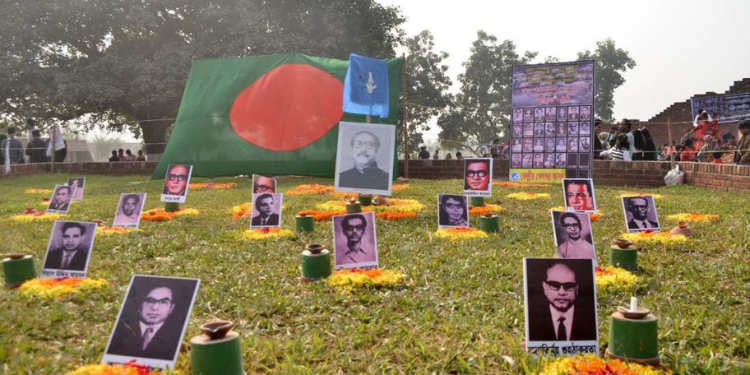
March holds deep historical significance in South Asia, symbolizing both tragedy and resilience. It echoes with the sounds of gunfire in Dhaka, the silence of mass graves across rural Bangladesh, and the anguish of millions forced to flee. What began as a political crisis in March 1971 escalated into one of the most brutal yet under-recognized genocides of the twentieth century. Today, as a resolution before the United States Congress seeks to formally recognize the Bangladesh Genocide, the moment calls for both political acknowledgment and historical truth.
Even though such recognition comes decades later, it is not merely symbolic—it serves as a necessary corrective.
The roots of the crisis lie in political disenfranchisement. Following the electoral victory of the Awami League in 1970, the refusal of Pakistan’s ruling regime to transfer power triggered a severe political breakdown. According to the resolution under consideration in the U.S. Congress, after failed negotiations, the Pakistani state launched a calculated military campaign—Operation Searchlight—on March 25, 1971.
What followed was not a conventional military operation but a systematic campaign of violence. The resolution notes that Pakistani forces carried out widespread massacres of civilians. Historical records and academic research confirm that the violence, which began in Dhaka, rapidly spread to rural areas, targeting intellectuals, students, and ordinary citizens.
Eyewitness testimonies describe a coordinated effort supported by radical Islamist factions linked to Jamaat-e-Islami. Armed with prepared lists, Pakistani forces reportedly targeted teachers, journalists, and community leaders. These acts were not random but formed part of a deliberate attempt to eliminate a population. The resolution therefore calls on the U.S. President to recognize the atrocities committed against Bengali Hindus in 1971 by Pakistani forces and their allies, including Jamaat-e-Islami, as genocide, war crimes, and crimes against humanity.
The human toll was immense. While estimates vary, it is widely cited that approximately three million people were killed. Between 200,000 and 400,000 women were subjected to systematic sexual violence. Nearly ten million refugees fled to India, making it one of the largest forced migrations in modern history.
The resolution itself acknowledges “tens to hundreds of thousands” of deaths and “over 200,000 women… raped.” However, broader evidence suggests the actual figures may be significantly higher. Regardless of the precise numbers, the pattern is unmistakable: mass killings, widespread sexual violence, and forced displacement—defining characteristics of genocide.
These atrocities occurred across the country. In Chuknagar, Khulna District, an estimated 10,000 to 12,000 civilians, mostly Hindus, were killed in a single day. In Jathibhanga, Thakurgaon District, more than 3,000 people were executed within hours. Entire villages were destroyed, homes burned, and survivors driven into exile.
A significant aspect of the 1971 violence was its religious dimension. Although people of various faiths suffered, the Hindu community was specifically targeted. The resolution states that there was a deliberate campaign—particularly in East Pakistan—to exterminate Hindus through killings, rape, forced conversions, and expulsions. Reports submitted to the U.S. government, eyewitness accounts from journalists, and documentation from international institutions, including the World Bank, indicate that Pakistani forces identified Hindus by verifying their religion, looted their property, and systematically executed them. In some instances, victims were marked with the letter “H” on their bodies. These acts occurred under the martial law regime imposed by Islamabad.
The religious nature of the violence aligns with the United Nations definition of genocide, which refers to acts committed with intent to destroy, wholly or partially, a national, ethnic, racial, or religious group. The U.S. congressional resolution argues that the events of 1971 meet this definition.
Despite attempts to suppress the truth, global awareness eventually emerged. On June 13, 1971, Pakistani journalist Anthony Mascarenhas published a landmark report titled “Genocide” in The Sunday Times, exposing the atrocities carried out by the Pakistani military. His reporting marked the first major international revelation of the systematic violence in East Pakistan.
Dissent also arose within U.S. diplomatic circles. Archer Blood, the U.S. Consul General in Dhaka, sent what became known as the Blood Telegram, criticizing Washington’s inaction. He described the situation as a “selective genocide” and warned of ongoing mass killings.
However, these warnings were largely ignored. Subsequent analyses suggest that Cold War geopolitics—particularly U.S. relations with Pakistan and China—influenced the decision not to intervene.
The failure to act in 1971 remains a significant moral lapse. The Blood Telegram itself expressed regret that the United States had “opted not to intervene, even on a moral level,” allowing the violence to continue unchecked for months.
This pattern has been repeated throughout history. From the Armenian Genocide to the Rwandan Genocide, hesitation in recognizing atrocities has often led to delayed or absent intervention, worsening human suffering.
The Bangladesh Genocide reflects this same pattern. Despite clear and timely evidence, the international community failed to act decisively.
The current resolution before the U.S. Congress goes beyond legislative action; it seeks to correct the historical record. It emphasizes that “history demands truth” and that recognition is long overdue.
Such recognition serves several important purposes.
First, it restores dignity to the victims. Genocide not only destroys lives but also seeks to erase identity. Official acknowledgment affirms that the suffering was real, intentional, and unjust.
Second, it challenges denial. Even today, the events of 1971 remain contested in some quarters. Recognition by influential nations helps establish historical and moral clarity.
Third, it strengthens global norms. The principles of the Genocide Convention hold value only when applied consistently. Acknowledging the events of 1971 reinforces the commitment to confront such crimes, regardless of when they occurred.
March, therefore, is not only a time of remembrance but also a call to responsibility. The legacy of 1971 demonstrates that genocide begins not with mass killing, but with dehumanization, discrimination, and the normalization of hatred.
At the same time, it highlights resilience. Despite immense suffering, the people of Bangladesh resisted and ultimately achieved independence in December 1971. Their struggle remains a powerful example of the pursuit of dignity and self-determination.
The resolution currently under consideration urges the U.S. President to formally recognize the 1971 atrocities as genocide, war crimes, and crimes against humanity. This is not merely a political step but a moral imperative.
Recognizing the Bangladesh Genocide means confronting a long-overlooked truth, honoring the victims, and standing with survivors.
Above all, it sends a clear message—that the world must not remain silent in the face of such crimes.
Each year, March returns with renewed significance. The question remains whether the global community will continue to remember—and whether it will finally give history the recognition it deserves.