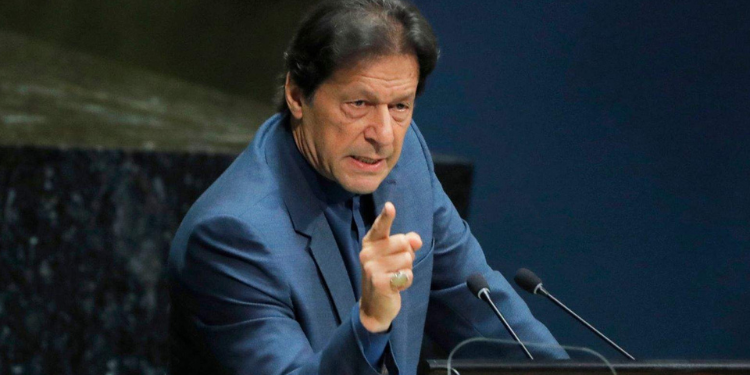
The controversial imprisonment of former Prime Minister Imran Khan, along with reports of mismanagement and harassment, has not only narrowed democratic space in Pakistan but has also intensified political polarisation, weakening public trust in the country’s already fragile state institutions. Khan’s detention has become a focal point of Pakistan’s deep political divisions, with many observers—including members of Khan’s Pakistan Tehreek-e-Insaf (PTI)—warning of potential consequences for the country’s economic and political stability.
Khan’s London-based sons, Suleman and Kasim, have accused the Pakistani government of “deliberately” denying them visas despite their father reportedly suffering from a serious eye ailment. “Yet authorities continue to block his treatment and deny him the doctors he trusts. I am even denied the right to speak to him,” Kasim said. “Now the government is deliberately refusing to process our visas. Denying a prisoner treatment is cruel.”
The government, however, has maintained that Khan has been provided with proper medical treatment. Khan’s sister rejected the government’s claims about his health improvement during court proceedings, accusing the Shehbaz Sharif administration of misleading the country regarding Khan’s health condition. Kasim also expressed concern over being denied the right to communicate with his father. “This is not governance. This is authoritarian cruelty,” he said. “The world must see that in Pakistan today, democracy is hollow and basic human rights are being crushed.”
Reports suggesting that Khan is being forced to live in inhuman conditions have drawn strong reactions from 14 international cricket veterans, including players from England and Australia. “We believe that a person of Imran Khan’s stature deserves to be treated with dignity and basic human consideration befitting a former national leader and global sporting icon,” they said in an open letter addressed to the Pakistani government.
After visiting the jail, senior counsel Salman Safdar told the Supreme Court of Pakistan that government inaction had worsened Khan’s health condition. Without directly naming Pakistani Army Chief Asim Munir and Prime Minister Shehbaz Sharif for allegedly violating the Constitution and due process, Sohail Afridi, the Chief Minister of Khyber Pakhtunkhwa province, warned of violent public unrest if Khan is not provided with proper medical treatment. “Matters are moving in the wrong direction, and no one will be able to stop us if we give a call,” he said.
Many Pakistanis have also criticised the government over the situation surrounding Khan’s confinement. “This is a totally failed strategy. How can we trust someone who has continuously lied and deceived us? We must make our own plan without relying on any assurances of Asim Munir or the military establishment,” said Pakistani national Sohail Khattak. Supporters of PTI also accused the government of avoiding accountability by forcefully detaining Khan. “Governance that fears dialogue risks losing credibility over time,” said Ayman Khan, a supporter.
Another Pakistani national, Iram Khan, warned that the ongoing crisis could have disastrous consequences for the country. “If anything happens to Imran Khan, Pakistan will be consumed by fire; not just on the streets, but in its institutions, its economy, and its fragile social fabric,” he said. Afzal Khan Jamali from Sindh also described the situation as a major threat to Pakistan’s democracy and political stability. “Every day in detention fuels public unrest and shakes trust in our institutions. Our economy suffers, investors hesitate, and the nation pays the price for political uncertainty,” he said.
Pakistan’s civilian government and powerful military have also been accused of launching a widespread crackdown on PTI workers through stringent laws. Political commentators and journalists have reportedly been targeted as well. Journalist Wajahat Saeed Khan, who was convicted under anti-terrorism laws for online activity in support of Khan, said he had never received any summons nor had he been contacted by the court. “This ruling is not justice. It is political theatre, conducted without due process, jurisdiction, or credibility,” he said.
US-based geopolitical expert Saad Hafiz stated that the Pakistani military’s refusal to provide political space may have brought temporary calm but warned that continued hostility could erode not only political stability but also the country’s social fabric. “The stakes are high. A youthful population presses against a brittle economy. Ultimately, this is not about Khan alone; it is about whether legitimacy flows from the ballot box or from the barracks,” he said. “History shows that suppressing mass political figures rarely eliminates their influence; it intensifies polarisation.”