


Crude Oil Prices Fall in Early Asian Trading; Sri Lanka Raises Fuel Prices Again
Crude oil prices fell during early Asian trading on Tuesday morning.
Brent crude oil prices dropped by about 8.5% to $92.50 (£68.85) per barrel, while US crude oil prices declined by around 9% to $88.60 per barrel.
At one point on Monday, crude oil prices had surged to $115 per barrel.
Despite the recent drop, crude oil prices remain about 30% higher than when the conflict began.
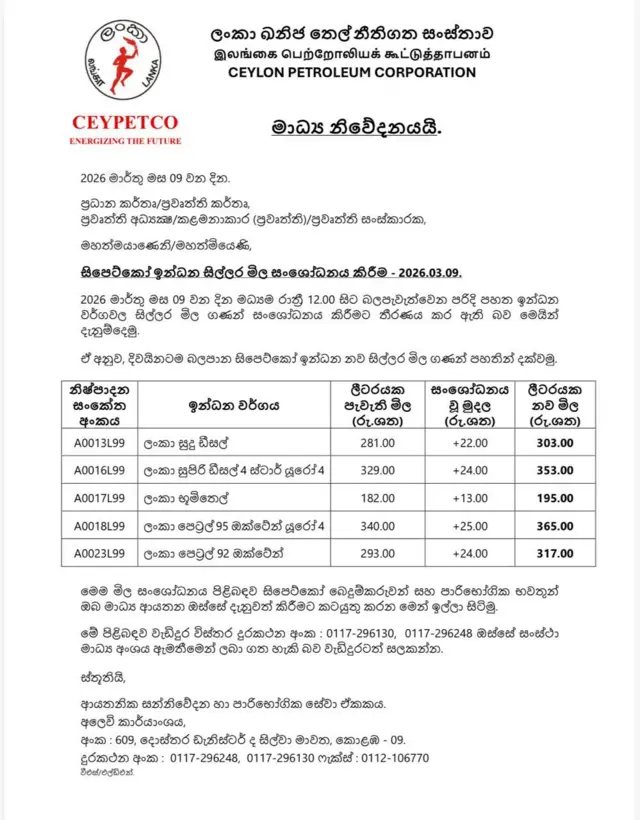
Meanwhile, Sri Lanka also moved to increase fuel prices again from midnight on March 9, 2026, just 10 days after a previous increase implemented from midnight on February 28, 2026.
Under the latest revision, prices of all types of fuel — including petrol, diesel, and kerosene — have been increased.
How Rising Oil Prices Have Affected Asian Countries
Several Asian countries have introduced measures to cushion the impact of rising oil prices linked to the Iran conflict.
Authorities in South Korea and Thailand announced that restrictions would be imposed on fuel price increases.
South Korean leaders also warned oil companies that action would be taken against firms attempting to take advantage of the crisis.
In other parts of the region, governments have taken additional steps to conserve energy. Some countries have closed buildings to reduce energy consumption, while universities in Bangladesh have been closed since Monday.
In the Philippines, government agencies have introduced a four-day workweek policy, while essential services such as fire stations and hospitals remain exempt. Authorities have also set a standard temperature of 24°C (75°F) for air conditioners.
Oil prices across Asia fell by around 10% on Tuesday morning, but they remain significantly higher than levels recorded before the war began.
Trump Signals War Will End ‘Very Soon’
The fall in oil prices followed comments made on Monday by US President Donald Trump, who said the war would end “very soon.”
Trump also warned that Iran would unleash “death, fire and fury” if it disrupted global oil shipping routes.
The warning was made in reference to possible disruptions in the Strait of Hormuz, a key global shipping route.
“If Iran does anything to stop oil shipments in the Strait of Hormuz, the United States will strike back twenty times harder than it has ever attacked before,” Trump said in a statement.
Approximately 20% of the world’s oil supply passes through the Strait of Hormuz, and the conflict has significantly reduced shipping activity, pushing global oil prices higher.
“In addition, we are destroying targets that are easy to destroy, so that Iran will never be able to rebuild as a nation; they will burn in death, fire and fury — but I hope and pray that it will not happen,” he added.
Speaking in Florida, President Trump also said the war “will be over very quickly.”
“They were going to hit us 100% within a week. They were ready. They had all these missiles more than anyone thought. They were going to hit us, they were going to hit the entire Middle East and Israel,” he said.
“If they had a nuclear weapon, they would use it on Israel. This would be a big attack. I know they have destroyed about 80% of all those missile sites.”
Trump also praised the military, describing them as “amazing.”
“The missiles are pretty much down. The drones are down. We’re hitting the places where they’re making the drones,” Trump said.
“Now they’re making the drones. Great job. But once they’re destroyed, we’ll have a much safer world and it’ll be over very quickly,” he added.
Source: BBC Sinhala