

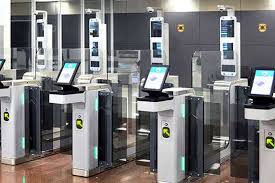
The New Automated Border Control (ABC) e-gates system is set to commence operations at Bandaranaike International Airport (BIA), enabling travellers to experience faster, smarter, and more secure travel, following the completion of installations of four additional departure gates and the integration of IT and operational technology (OT), the Ministry of Ports and Aviation said.
Four e-gates have already been installed at the arrival terminal and are now ready for use by Sri Lankan passport holders, offering quicker and more secure immigration clearance. However, passengers are still required to obtain a physical stamp on their passports, adding an additional step to the process until amendments are made to the Immigrants and Emigrants Act, a senior ministry official disclosed.
The Cabinet of Ministers has approved the installation of an additional four e-gates for the departure terminal this week. These gates are scheduled to be installed by 2026 to ensure a unified system and further improve operational efficiency. The entire e-gate project is part of a broader airport modernisation initiative funded through a 1,170 million yen grant (US$ 7.49 million or approximately Rs. 2.32 billion) from the Japanese government and implemented in collaboration with the International Organisation for Migration (IOM).
Although the project was initially launched in 2017, it was not implemented due to various reasons. Four years later, bids were called to award the tender for four e-gates—two at the arrival terminal and two at the departure terminal—on December 15, 2021, with four suppliers submitting bids.
The awarding of the tender was delayed due to technical evaluations and other tender procedures. While bids were called in December 2021, the contract was eventually awarded to the highest bidder in July 2022 at a cost of Rs. 430 million during the previous administration. This decision raised concerns, as significantly lower bids were reportedly rejected.
The project’s implementation faced further delays due to administrative and technical challenges, including the requirement for e-passport integration and legal amendments to eliminate physical passport stamping.
The long-delayed e-gate project at BIA—introduced as a solution to passenger congestion—has now been expedited under the present government, the Ministry of Ports and Civil Aviation revealed, adding that the entire procurement process was reviewed by a special committee.
The Ministry noted that approval processes were fast-tracked, inter-agency coordination was strengthened, and localised solutions aligned with international standards were incorporated.
Under the Japanese grant, BIA is expected to be equipped with advanced baggage scanners, full-body scanners, automated border control gates with facial recognition, and e-passport scanners, along with infrastructure upgrades such as touchless washrooms. The automatic arrival gates under this initiative are expected to become operational soon, enabling faster and contactless immigration clearance for eligible passengers. The new departure gates will mirror the same system, allowing for “more efficient and correct” clearance, according to a Cabinet statement.