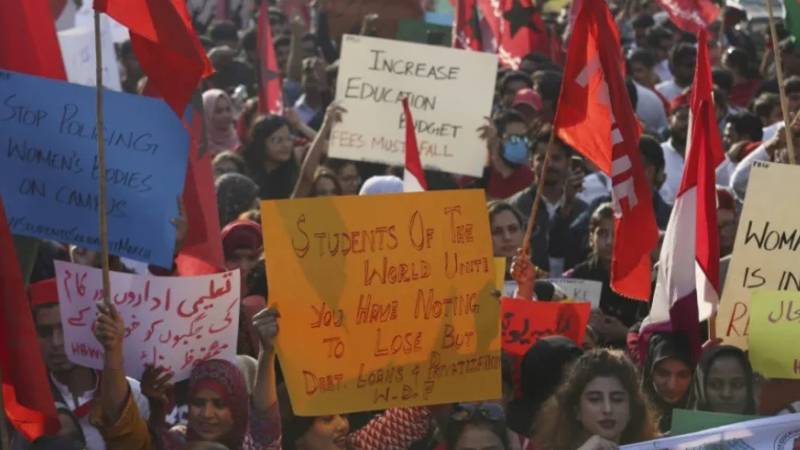
For decades, progressive politics in Pakistan have been dismissed as a relic of the past, incapable of inspiring mass support. This perception, however, is only partly accurate. Pakistan has a deep progressive tradition rooted in grassroots movements, labour organisation, and social justice advocacy. Yet this tradition has been repeatedly undermined and marginalised—most significantly by a military establishment that has shaped the political order in ways that leave little room for alternative visions.
The roots of Pakistan’s leftist politics stretch across both wings of pre-1971 Pakistan. In East Pakistan, leaders such as Maulana Bhashani championed rural empowerment, land reform, and workers’ rights, mobilising millions of peasants with a distinctly progressive, grassroots vision. His politics contrasted sharply with the elite-dominated structures of West Pakistan, offering a potential counterweight to entrenched power. But this trajectory was abruptly cut short in 1971 with the breakup of Pakistan and the creation of Bangladesh. The loss of East Pakistan removed a crucial base for progressive thought, leaving the remaining state even more tightly concentrated in the hands of West Pakistani elites and the military.
Even before 1971, progressive politics faced harsh repression. By the late 1950s, the Communist Party of Pakistan had been banned, its leaders jailed, and its networks dismantled. Activists were branded as “anti-national” or “foreign agents,” their ideas framed as incompatible with Pakistan’s Islamic identity. This revealed an early recognition by state elites and the military that left-wing politics—focused on redistribution and empowerment of the masses—posed a direct threat to their monopoly on power.
The military’s hostility escalated under General Zia-ul-Haq, who seized power in 1977. His coup ended the government of Zulfiqar Ali Bhutto, the PPP leader who had risen on a socialist platform and enacted landmark land and labour reforms in the 1970s. Bhutto’s execution in 1979 was not only a personal tragedy but also the end of Pakistan’s most successful experiment with mass-based progressive politics. Zia’s Islamisation programme entrenched conservative laws, curtailed women’s rights, and promoted a rigid moral order enforced by the state. Progressive and leftist ideas were branded un-Islamic, while religious parties and militant groups were cultivated as allies. Conservatism became institutionalised, and the space for dissent narrowed dramatically.
Military dominance did not end with Zia. Pakistan’s intermittent returns to democracy have been shallow, with elected governments permitted to function only within limits set by the barracks. Dynastic families such as the Bhuttos and Sharifs have monopolised political leadership, but their survival has depended more on accommodation with the military than on challenging its authority. Politics has been reduced to patronage and personality rather than ideology, leaving little room for genuinely progressive, grassroots movements.
Economic crises have further weakened progressive possibilities. Military adventurism, costly wars, and chronic mismanagement have forced governments into dependence on foreign aid and IMF bailouts. Short-term stabilisation and austerity measures dominate policy agendas, sidelining redistributive social programmes central to progressive platforms. Elite-controlled feudal estates, crony capitalism, and military-owned enterprises leave little incentive to empower workers, peasants, or marginalised groups.
Still, progressive politics has never disappeared. It has adapted and survived outside the traditional corridors of power. Feminist groups, most visibly the Aurat March, have mobilised young women across urban centres to confront gender-based violence, workplace discrimination, and patriarchal norms. Despite harassment and threats, these marches remain powerful symbols of contemporary progressive activism.
Student movements are also re-emerging. Once vibrant, student unions were banned under Zia and remain largely absent, but recent years have seen renewed activism. Annual Student Solidarity Marches demand the restoration of unions, fair education funding, and safe campuses. Though modest in scale, they represent a new generation pushing back against authoritarian structures and envisioning a more inclusive political culture.
Smaller political parties continue to carry the progressive banner. The Haqooq-e-Khalq Party contests elections on platforms of social justice, workers’ rights, and redistribution. Civil society organisations, meanwhile, campaign for labour rights, minority protections, and environmental justice—often at considerable personal risk. While their reach is limited compared to dynastic parties, their persistence highlights the resilience of progressive thought in a hostile political environment.
Across all these efforts, the military remains the common adversary. For seven decades, the barracks have shaped Pakistan’s politics, cultivating an elite system that privileges loyalty, patronage, and religious conservatism over democratic inclusion and progressive reform. Whenever progressive movements threaten this order, they are met with bans, intimidation, or violence.
Today, Pakistan faces deepening crises: economic collapse, political paralysis, and rising intolerance. These are precisely the challenges that progressive politics—focused on equity, social justice, and democratic empowerment—are best suited to address. Yet such politics remains sidelined, not due to irrelevance, but because the military-backed power structure systematically excludes it.
The endurance of feminist activists, students, and grassroots organisers is remarkable. Their struggle is not only for individual rights or piecemeal reforms but for a fundamental challenge to an entrenched order that has long denied Pakistanis the possibility of a just and inclusive society. In a country where the ballot has so often been subordinated to the barracks, their persistence is both an act of defiance and a reminder: progressive politics in Pakistan, though marginalised, is far from dead.
The loss of East Pakistan’s progressive base in 1971 remains a cautionary tale. Pakistan’s journey toward social justice and equity has been repeatedly cut short—but the struggle continues, from the streets of Karachi to the campuses of Lahore.