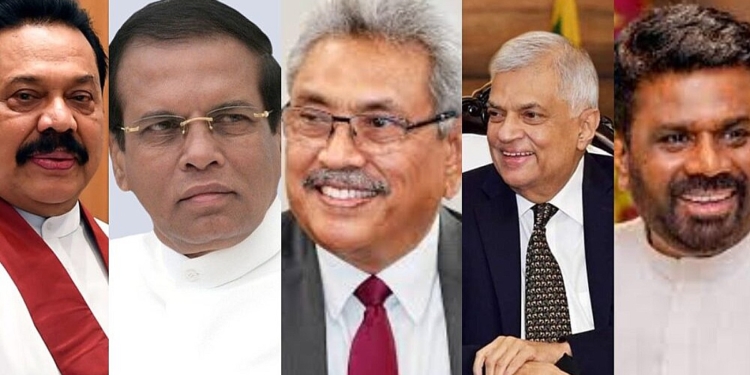
“Thieves, thieves, thieves, thieves, thieves, thieves”—calling people thieves has now become a habit. At different times, in different tones, in different ways, people are called thieves. Sometimes even with sympathy, people say “thief,” and even those accused of being victims are calling others thieves. Everyone is calling everyone else a thief.
While people talk about thieves from different groups, a special statement was made at the 79th United National Party (UNP) convention. During that discussion, SLPP General Secretary Sagara Kariyawasam said:
“A big mistake we made was calling ourselves thieves. That was a mistake we made.”
What we want to talk about now is how Sri Lanka’s political history has been built around thieves—or rather, stories believed to be about thieves. “Not us, the others are thieves.” It’s because they stole that the country cannot be fixed. Many came to power saying they would catch thieves. But the truth is, no real thief has ever been caught. On various occasions, some people were imprisoned over small matters, but no one can point to a clearly caught thief.
In 1994, Chandrika’s government came to power after toppling the United National Party (UNP), which had ruled for 17 years. As soon as they came in, they said there were lots of thieves, that they would catch them, take them to Galle Face, and punish them. But whether those thieves were actually caught is questionable. That journey ended with a group of UNP members joining Chandrika’s government, sharing power, and ruling together. So across different times, power has changed hands with accusations of theft, and there are many names to mention in this regard.
A special point to mention is 2015. The Yahapalanaya (Good Governance) government came to power accusing Mahinda Rajapaksa—and especially the Rajapaksa camp—of being thieves, murderers, and having committed massive corruption and killings. But the Maithripala government that took power in 2015, or rather the Ranil–Maithri coalition, never proved any of those accusations. They made allegations, but no real punishment ever happened inside the country. The government moved on. No real thieves were caught.
Later, the bond scam involving Ranil Wickremesinghe started to be talked about. People said Ranil was responsible. And based on that, Mahinda’s camp came back to power. But though the bond scam was discussed in various forums, neither Ranil nor anyone else was ever properly caught or punished, nor was any money recovered. At best, some individuals were jailed for a few months. There was no proper action or follow-through.
We remember how in Parliament at that time, one group chanted: “Who’s the thief? Ranil is the thief.” Another group replied: “Who’s the thief? Mahinda is the thief.” But not a single thief was apprehended. There is no record of it.
Similarly, the current government also came to power claiming both previous parties were full of thieves. But the people they accused still haven’t been arrested. Instead, at various times, they imprison individuals for minor offenses—those accused of being criminals, drug smugglers, etc.—but not for the grand-scale corruption and thefts mentioned earlier. We remember the massive accusations like “I don’t know where the money is; it’s hidden in another country,” yet no one has been taken into custody for that.
And still, regarding the Easter Sunday attacks, no proper suspects have been identified. Some were arrested over minor or unrelated matters, including old suspicions, but they were later released. So ultimately, we don’t know who the real thieves are, or who are not.
Because we don’t know—we can’t say who is or isn’t a thief. We’re not experts. Investigations must be done. Things must be looked into carefully. Especially, one cannot call someone a thief until it’s proven. Until they are identified and proven guilty through proper investigations and a court ruling, no one should be called a thief.
What actually happens in Sri Lanka is the opposite. Before the courts prove anything, politicians accuse others of being thieves just to gain political power.
Now, we are seeing serious accusations being made against the current government too. We are not calling them thieves—but the very government that came to catch thieves is now facing serious issues regarding their asset declarations, policy statements, and wealth disclosures. They are giving various and often contradictory answers. We know that enormous wealth owned by different individuals has come to light. They’re telling different stories, and because of that, this is now a matter of public concern and serious discussion.
So now, the old accusations are coming back—this time against the current rulers. That situation is once again giving others the chance to say the same things back at them.
But now, it’s time for us to make a decision. Just because someone says “We didn’t steal—they did,” and asks for power, we should not give it to them. Leaders should be elected based on development policies. Leaders who want to build the country, who have a clear and actionable plan, who show genuine commitment to progress, and who can demonstrate real results on the ground—those are the kinds of people we should elect to power.
We must appoint leaders who will develop the country, who will implement well-regulated, transparent projects, and who are capable of driving development. Not just those who appear from time to time claiming they will catch thieves—because such people never actually do anything for the country. That’s something we must clearly understand.
So this is what we have to say when talking about thieves. Since the time of President Premadasa, every political party that came to power did so by claiming the other party was full of thieves. “We’re not the thieves—they are. We’re coming to catch them.” But at no point were they able to prove it. Various frauds and deceptions took place, they fooled us, they said “we’ll catch them tomorrow… next week… later…” and kept some people in jail for a few months—but in the end, the story always ends there.
So the final point is this: when forming future governments, we should set aside the whole idea of “catching thieves” and instead elect people who will actually build the country. That’s the only thing worth doing now.

Jeewana Pahan Thilina