
India and the United Arab Emirates have agreed to jointly develop an energy hub in Sri Lanka, India’s Ministry of External Affairs announced on Saturday, marking a significant move as New Delhi intensifies its strategic engagement in the Indian Ocean region, where it faces increasing competition from China.
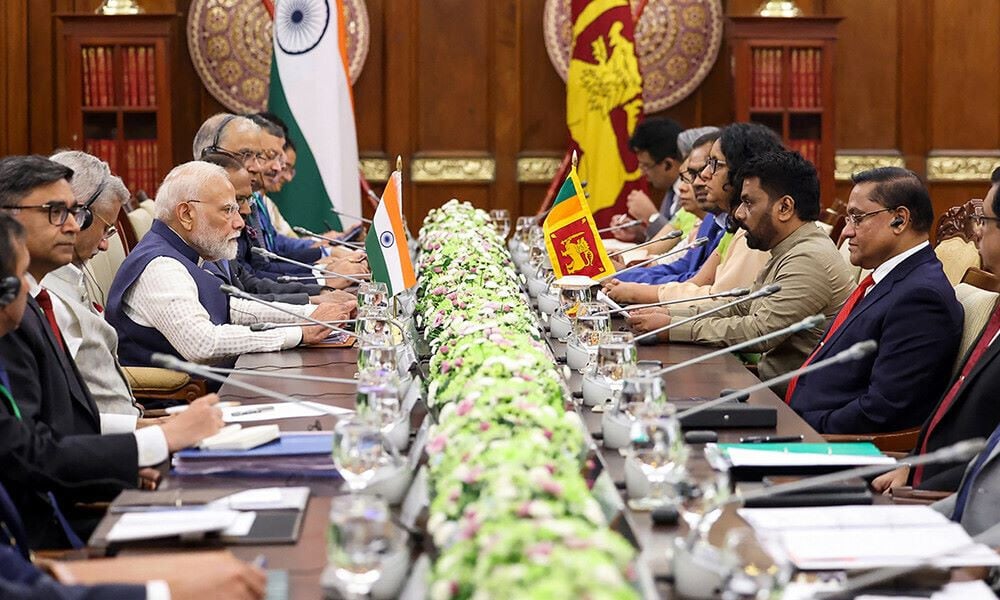
The trilateral agreement was signed during Indian Prime Minister Narendra Modi’s official visit to Sri Lanka — the first by a global leader since Anura Kumara Dissanayake assumed the presidency in September.
India and Sri Lanka have been working to strengthen bilateral ties as Colombo emerges from a crippling financial crisis that struck in 2022. During this period, India extended critical financial assistance totaling $4 billion to its southern neighbor.
The latest agreement is viewed as a direct boost to India’s regional presence, especially as China continues to expand its influence. Notably, Chinese state-owned energy giant Sinopec has signed a $3.2 billion agreement to construct an oil refinery in Hambantota, a southern port city of strategic significance.
The newly planned energy hub will be situated in Trincomalee, a key natural harbor on Sri Lanka’s eastern coast. According to Indian Foreign Secretary Vikram Misri, the project will include the construction of a multi-product pipeline and may utilize a World War II-era oil tank farm, which is partially owned by the Sri Lankan subsidiary of Indian Oil Corporation.
“The UAE is a strategic partner for India in the energy space and therefore was an ideal partner for this exercise that is being done for the first time in the region,” Misri told reporters in Colombo. “The exact contours of UAE’s role will be elaborated once the business-to-business discussions kick off.”
He further stated that the next phase will involve selecting business entities to assess the financing and feasibility aspects of the proposed energy hub.
In addition to the energy hub, Prime Minister Modi also inaugurated a $100 million solar power project, a joint venture between Sri Lanka’s Ceylon Electricity Board and India’s National Thermal Power Corporation (NTPC).
Foreign Secretary Misri also confirmed that India and Sri Lanka have successfully concluded their debt restructuring process. According to Sri Lanka’s Ministry of Finance, the country owes approximately $1.36 billion in loans to India’s EXIM Bank and State Bank of India.
Sri Lanka began debt restructuring negotiations after defaulting on its sovereign debt in May 2022. A preliminary agreement was reached in June of the following year with bilateral creditors, including Japan, India, and China.
Furthermore, India and Sri Lanka signed a series of bilateral agreements covering areas such as power grid connectivity, digitalisation, security, and healthcare.