
During the tenure of President Premadasa, an urgent fax landed at the Sri Lankan embassy in Washington. The contents were unequivocal: the services of the young Milinda Moragoda, then living in the U.S., were to be obtained without delay. This directive, the message stressed, came directly from President Ranasinghe Premadasa himself.
‘President made Milinda an ambassador with one fax message…’
This story was the biggest joke of the Foreign Ministry at that time.
Nonetheless, Premadasa did not use him for nothing. Around 1970, the American government granted tariff concessions to countries importing from Third World countries, including Sri Lanka. He wanted to take advantage of this concession and build factories that would create jobs for the youth of Sri Lanka.
He wanted to build those factories in rural areas outside Colombo. Considering the fear of young women in the villages, especially young women, coming to Colombo for jobs, and the cost of finding food and lodging, not only for young women but also for young men from the village, he wanted to move the factories to the villages. He planned to develop the villages through this.
A clock tower was built in every village where garment factories were built so that a town could be built there. By now, the JVP youth revolt had ended, and the first recommendation of the committee appointed to investigate the causes of the revolt was unemployment in the villages. By now, Asian countries had not yet figured out ways and means to take advantage of this tariff concession from America. Premadasa planned to take maximum advantage of it. That is, to create 200 garment factories throughout the country.
As soon as he became president, he requested all leading businessmen in Sri Lanka to come and meet him.
‘I want to find an answer to this JVP youth uprising. Can’t I devise a system that will provide jobs to the youth in the villages…?’
Premadasa asked. The businessmen looked down, afraid of wasting their money by fulfilling Premadasa’s wishes.
‘If you don’t have a method, I will teach you a method…’
Premadasa said. He called businessman Kumar Devapura and asked him.
‘Can you start a garment factory in Kurunegala…?’
Kumar Devapura did not say no.
‘Then how will you get the garment quota, sir…?’
Kumar asked.
‘You start building the factory. I will take care of that..’
Premadasa spoke with great determination. From there, Premadasa got down to work. He sent a message to US President George Bush and to all the US State Department officials and senators who were interested in Sri Lanka.
‘There was a youth uprising in Sri Lanka. Tens of thousands were killed. One reason for this uprising was unemployment. Building factories in Colombo is not a solution to unemployment. When factories are built in the villages and young men and women are given jobs, their travel expenses and boarding fees are saved. The villages will also develop. Help Sri Lanka for that…’
This was the message that Premadasa sent. He used not only Milinda Moragoda, the grandson of former Central Bank Governor N.U. Jayewardene, but also everyone who had connections to the US government in the US for this purpose.
When the first garment factory was opened, he invited the American ambassador to the opening ceremony. He obtained quotas for the production of not only garments but also many other goods. Many garment industries, such as Mars, Brandix, Hydramani, Maliban Group, Hela Clothing, Star Garment, Smart Shirt, Penguin, Omega Line, and Aitken Spence Apparel, were born because of this Premadasa concept.
Today, the decision of US President Trump to increase tariffs has placed these various manufacturing factories, including those started by Premadasa, in an extremely helpless situation. Many of these factories, including those started by Premadasa, supported the National People’s Power, including Anura Kumara, in the last presidential election and general election. Mini presidential elections were held in some factories before the presidential election. When the results showed that Anura would win by 80%, those results went to the factory owners, who also supported Anura and the National People’s Power. The executives of these institutions publicly told them to vote in favor of Anura.
However, the owners, officers, and employees of these institutions had no idea that Anura’s government would be able to cope with such a decision if America made such a decision.
The 1970-77 Samagi Peramuna government was an anti-American leftist government. At that time, America had provided flour subsidies to the world’s poorest countries under a food subsidy scheme. The United States stopped providing it to several countries, including Sri Lanka, in 1973.
There was a flour crisis in Sri Lanka. A bread rationing system was established. Then Prime Minister Mrs. Bandaranaike wrote a letter to the then US President Richard Nixon officially requesting that the flour subsidy be provided. US President Nixon replied by return mail and said that he would consider Sri Lanka’s request. With her letter, the lady launched a diplomatic mission to change the US decision. For this, she obtained the services of foreign relations experts who had ties with the US. The US commenced again providing flour subsidies to Sri Lanka.
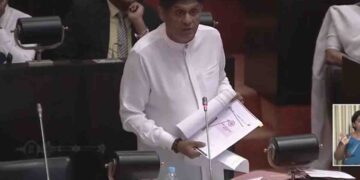
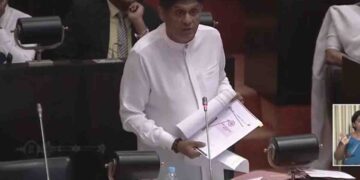
Opposition Leader Sajith requested the government to raise a question about Trump’s tax policy in Parliament on March 18. The government did not answer the question properly. Sajith asked what the government’s strategy was to confront Trump’s tax policy. The ruling party MPs turned off microphones and insulted Sajith and the opposition.
The whole world became aware of Trump’s tax policy as soon as Trump became president. That was in November. It has been almost 6 months now. While other countries were trying all they knew to reduce this tax, our government was counting the monkeys. The result is that Sri Lanka imposes the highest tax rate. Sri Lanka is a bankrupt country. If leaders like J.R., Premadasa, and the like were there today, they would be marketing bankruptcy to reduce the tax rate. This government is so bankrupt that even the bankruptcy cannot be marketed.
‘Well, if Ranasinghe Premadasa was alive today, what would he do with Trump’s taxes?’
If Premadasa was alive, the garment industry project would not have stopped at 200. Sri Lanka is the Asian country that produces the most garments not only for America but also for Europe. So by now, this tax would not have been such a disaster for Sri Lanka.