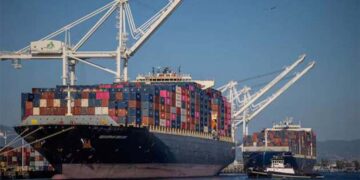
The much-anticipated operationalization of the Colombo Port East Container Terminal (ECT) appears increasingly unlikely, despite government commitments to have it up and running by July.
Shipping lines and ship agents have repeatedly called for improved services at the port, with a key concern being inter-terminal trucking delays during peak hours. This issue has led to congestion, impacting port efficiency.
Currently, approximately 30,000 containers await transfer between terminals. If these delays persist, shipping lines may choose alternative routes rather than incur additional costs due to extended waiting times, warned Chairman of the Ceylon Association of Shipping Agents (CASA), Shano Sabar, in an interview with The Sunday Times Business.
In response to the mounting concerns, discussions are ongoing between CASA, the Minister, and the Sri Lanka Ports Authority (SLPA) to mitigate congestion issues.
Infrastructure Challenges and Performance Decline
A critical issue exacerbating delays is the deteriorating condition of the road leading to the container yard. Mr. Sabar highlighted that the turnaround time at the port has declined significantly, with container movement dropping to less than 20 moves per hour—far below the optimal rate of 30 moves per hour.
He emphasized the urgent need to bring the ECT online, as its activation is crucial for attracting higher shipping volumes to Colombo.
Failure to commission the terminal promptly could result in shipping lines diverting to alternative ports, such as the Vizhinjam Port in southern India. Operated by Adani Ports, Vizhinjam also manages the West Container International Terminal (WCIT), posing a competitive threat to Colombo.
Equipment Shortages and Tender Cancellations
The ECT, which was initially scheduled to become operational by mid-2024, has faced repeated setbacks due to the unavailability of essential equipment. Previously awarded tenders were canceled by the current administration, further delaying the process.
One of the critical requirements for efficient terminal operations is the use of straddle carriers, which facilitate container movement between the quay and the yard. Tenders had been awarded for the procurement of twin-lift straddle carriers capable of handling two twenty-foot equivalent units (TEUs) simultaneously. However, these tenders were later revoked.
Industry experts caution that relying on prime movers instead of straddle carriers may not be a viable solution, warning that the absence of the correct equipment could turn operations into a logistical “nightmare.”
Potential Further Delays
Sources indicate that authorities are now exploring alternative, cost-effective solutions, including the procurement of prime movers or other equipment to replace straddle carriers. However, if straddle carriers are re-tendered and ordered now, it could take up to 14 months for them to be manufactured and shipped to Colombo—raising further concerns about the timeline for ECT’s commissioning.
With increasing pressure from the shipping industry and potential competition from regional ports, the timely resolution of these challenges remains critical for Colombo Port’s future standing in global trade.