
U.S. President Donald Trump’s approval rating has edged slightly lower in recent days as growing concerns about the economy weigh on public sentiment. A recent Reuters/Ipsos poll indicates that more Americans are uneasy about the country’s economic direction as Trump continues to threaten multiple nations with tariffs.
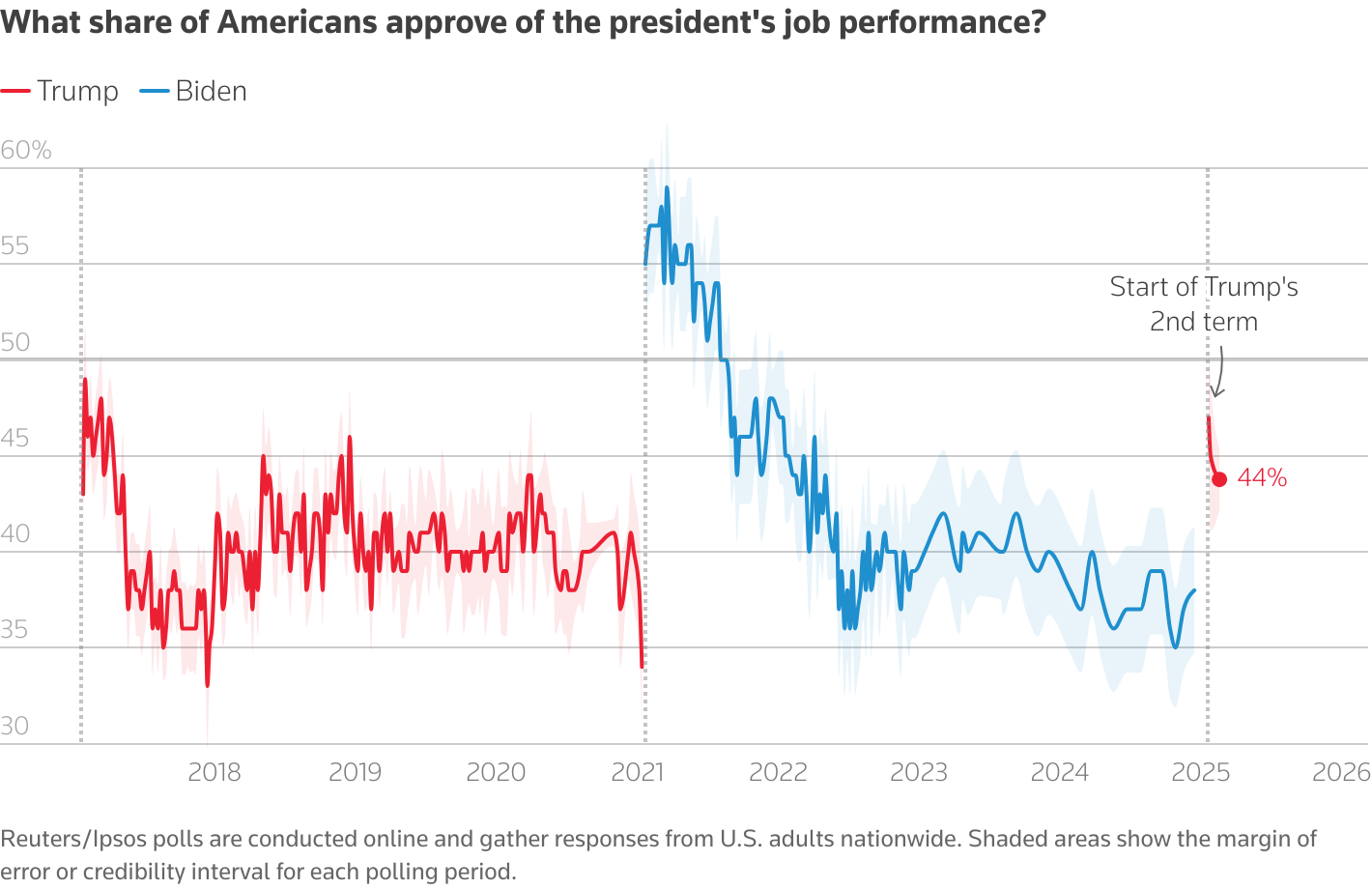
The six-day poll, which concluded on Tuesday, found that 44% of respondents approve of Trump’s job performance, a slight decline from 45% in the previous Reuters/Ipsos survey conducted between January 24-26. His approval rating had reached 47% in a January 20-21 poll, shortly after his return to the White House.
Meanwhile, disapproval of Trump’s presidency has climbed more significantly, rising to 51% in the latest poll—up from 41% immediately after he took office.
Trump continues to receive relatively strong support for his immigration policies, with 47% of respondents approving of his approach, which includes pledges to ramp up deportations of undocumented migrants. This figure remains largely unchanged from January.
However, economic concerns are mounting. The percentage of Americans who believe the economy is on the wrong track has surged to 53% in the latest poll, up from 43% in the January 24-26 survey. Public approval of Trump’s handling of the economy has dropped to 39%, compared to 43% in the prior poll.
A key pillar of Trump’s political appeal has been public confidence in his economic policies. While his current rating on economic stewardship remains higher than that of his predecessor, Democrat Joe Biden—who ended his term with a 34% approval rating on the economy—it is notably lower than the 53% approval he held in Reuters/Ipsos polling from February 2017, the first full month of his initial presidency.

Concerns over inflation also pose a challenge for Trump. In the latest poll, only 32% of respondents expressed approval of his performance in managing inflation—an early indication of public dissatisfaction with his handling of a key economic issue. Inflation had been a significant factor in weakening Biden’s approval ahead of last year’s presidential election.
Trump secured victory over Biden’s vice president, Kamala Harris, in the Electoral College and narrowly won the popular vote. Meanwhile, a recent U.S. Labor Department report revealed that consumer prices rose in January at the fastest pace in nearly one and a half years, further burdening Americans with higher costs across a range of goods and services.