
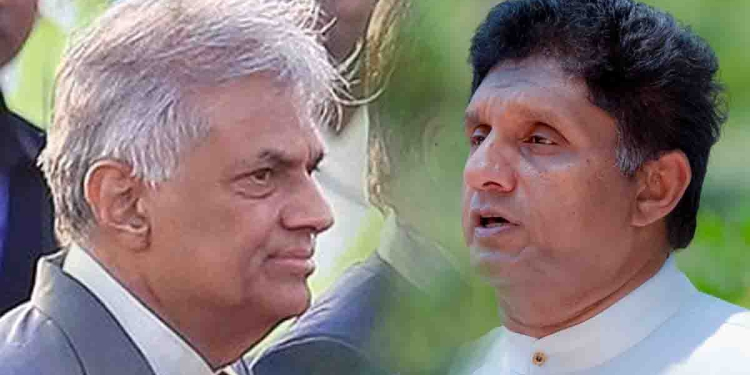
Former President Ranil Wickremesinghe is reportedly at the center of a significant political maneuver aimed at diminishing Sajith Premadasa and the Samagi Jana Balawegaya (SJB) in the upcoming local government elections.
Sources indicate that Mr. Wickremesinghe is strategizing to pressure the SJB into contesting under a new symbol and a broader alliance rather than under the Samagi Jana Balawegaya and its iconic “Telephone” symbol. Reports suggest that several SJB Members of Parliament, believed to have close ties with Mr. Wickremesinghe, are playing a role in this effort.
These MPs allegedly benefited from privileges such as liquor licenses and decentralized government funds during Mr. Wickremesinghe’s previous administration. They are now reportedly advocating for an electoral alliance with the United National Party (UNP), aligning with Mr. Wickremesinghe’s political objectives.
A History of Targeted Political Operations
This alleged strategy is viewed as an extension of earlier efforts by Mr. Wickremesinghe to weaken the SJB and its leader, Sajith Premadasa. According to political analysts, these operations date back to his ascent to the presidency, following the resignation of Gotabaya Rajapaksa. Critics claim that Mr. Wickremesinghe’s presidency, achieved through parliamentary support from the Rajapaksa faction, has been characterized by attempts to consolidate power by undermining the opposition.
One of these operations involved enticing SJB MPs with ministerial portfolios and government privileges to lure them into supporting the government. Prominent defections to the government included MPs Harin Fernando, Manusha Nanayakkara, Vadivel Suresh, and Velukumar.
Further reports allege that Mr. Wickremesinghe provided a range of benefits, including bar licenses and funding from the government’s decentralized resources, to create internal discord within the SJB. Some MPs were even reportedly granted licenses to manufacture alcohol, further solidifying their allegiance to his administration.
Although the SJB successfully unseated some of these MPs in the last general election, a few remain in Parliament, continuing to stir internal conflicts, allegedly under Mr. Wickremesinghe’s influence.
Postponing Elections for Political Gain?
Critics argue that the indefinite postponement of local government elections under the pretext of a financial crisis was another deliberate move by Mr. Wickremesinghe to hinder the SJB’s growth. Observers claim that holding elections at the originally scheduled time would have allowed the SJB to secure a significant number of municipal, urban, and provincial councils. This, in turn, would have established a robust grassroots network for the party, boosting its political prospects ahead of national elections.
Historical parallels have been drawn to the 2018 Yahapalana government, during which the Pohottuwa party leveraged its success in local government elections to gain national prominence. Analysts believe Mr. Wickremesinghe sought to prevent the SJB from achieving a similar trajectory by delaying the elections.
Conclusion
As the political landscape heats up, Mr. Wickremesinghe’s actions have sparked widespread speculation and criticism. Whether his strategies will succeed in reshaping the electoral dynamics remains to be seen. Meanwhile, the SJB and its leader, Sajith Premadasa, face mounting challenges as they navigate these turbulent political waters.