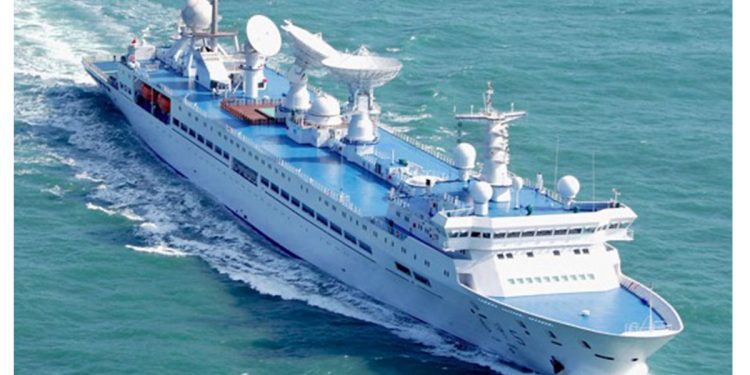
Sri Lanka has relaxed its one-year ban on foreign research vessels entering the island’s waters for research purposes. Cabinet Spokesperson Minister Nalinda Jayatissa announced that such requests would now be evaluated on a case-by-case basis.
China’s plans to deploy research vessels into Sri Lankan waters in the Indian Ocean have sparked significant concerns in India over regional security. Addressing the matter, Minister Jayatissa emphasized Sri Lanka’s diplomatic approach to balancing relations with both nations.
“We are managing our engagements with these two countries in a very diplomatic manner. We are open to discussions,” Jayatissa stated when asked about the government’s stance on the ban. The restriction was initially imposed last year following strong objections from India regarding the presence of Chinese research vessels in Sri Lankan waters.
Minister Jayatissa clarified the government’s updated position: “Whenever research vessels arrive, we can study and inspect them, and engage with relevant parties. We are adopting a long-term diplomatic vision and addressing each request individually. Assurances from the Security Council are also part of our considerations.”
The minister’s remarks came shortly after a senior Chinese official announced Beijing’s intentions to commence marine research in the Indian Ocean.
Sri Lanka’s previous government had introduced the temporary ban in December 2022, citing security concerns raised by India regarding Chinese research vessels. While the Sri Lankan Foreign Ministry has acknowledged the need to establish standard operating procedures (SOPs) for managing such vessels, officials admit that these protocols are yet to be implemented.
During the 14-month ban, two Chinese research vessels visited Sri Lankan ports. The Yuan Wang 5 of the Chinese Navy docked at the southern Hambantota port in August 2022 for refueling, while the Xi Yan 6 arrived at the Colombo port in October 2023 for research purposes. Both visits faced strong objections from India, citing potential threats to security in the Indian Ocean.
India, a key stakeholder in the region’s maritime activities, expressed confidence that Sri Lanka would address its security concerns. Indian Foreign Secretary Vikram Misri stated on Monday, November 16, that Sri Lanka was considering the issue and highlighted India’s vision for maritime security and marine research.
Sri Lankan President Anura Kumara Dissanayake also reassured Indian Prime Minister Narendra Modi during a meeting on Monday that Sri Lankan territory would not be used in ways detrimental to India’s security.
The port of Colombo serves as India’s primary transshipment hub, handling approximately 70% of the port’s total transshipment volume. This underscores the strategic importance of maritime operations in the region and the sensitivities surrounding research vessel activities.