The Philippines and the United States have signed a landmark military intelligence-sharing agreement, marking a significant step in bolstering security ties between the two long-standing defense treaty allies. This move comes as both nations aim to address growing concerns over China’s increasingly assertive actions in the region.
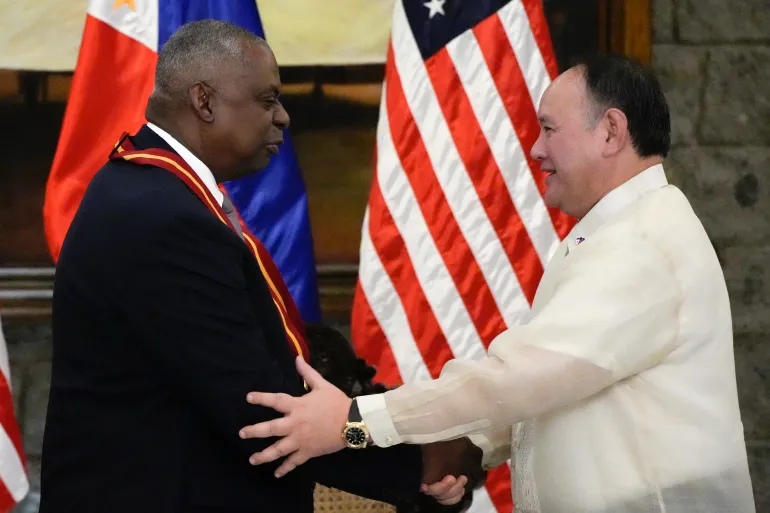
The agreement, formally known as the General Security of Military Information Agreement, was signed on Monday by Philippine Secretary of Defense Gilberto Teodoro and his visiting U.S. counterpart, Lloyd Austin, during a ceremony at the Department of National Defense (DND) headquarters in Manila.
The pact facilitates the exchange of classified military information crucial to national defense and simplifies the process for transferring specific classified technologies to the Philippines, according to officials.
In a statement shared on X (formerly Twitter), Austin highlighted the enduring commitment between the two nations. “The U.S. and the Philippines are committed to deepening our alliance, strengthening regional security, and upholding our shared values in the Indo-Pacific,” he stated.
Although Secretary Teodoro refrained from making comments during the signing ceremony, the DND underscored the agreement’s importance. It described the deal as “a critical step to enhance information sharing and deepen interoperability” between the two nations’ armed forces.
Deepening Security Engagements
This latest agreement reflects the strengthening of bilateral security relations under U.S. President Joe Biden and Philippine President Ferdinand Marcos Jr. Both leaders have expressed concerns over China’s aggressive policies, particularly in the South China Sea and around Taiwan.
The Philippines and the U.S. share a Mutual Defense Treaty dating back to 1951, which commits both nations to defend each other in the event of an armed attack. Recent months have seen increased cooperation, including Manila’s interest in acquiring the U.S. Typhon midrange missile system and joint military exercises featuring advanced U.S. military technologies.
In July, the U.S. pledged $500 million in military funding to the Philippines. Earlier in 2023, the two nations also expanded their defense cooperation with a deal granting U.S. troops access to four additional military bases in the Philippines.
Rising Tensions in the South China Sea
China’s territorial claims in the South China Sea, dismissed by an international tribunal as lacking legal basis, remain a source of conflict. Chinese navy and coastguard vessels have reportedly harassed Philippine ships, blocking access to reefs and islands claimed by Manila.
Such incidents have escalated over the past 18 months, causing injuries to Filipino personnel and damage to their vessels. The situation has raised fears that the U.S. could be drawn into a potential conflict, given its defense treaty obligations.
High-Level Engagements
Following the signing ceremony, Austin met with President Marcos at the Malacañang Palace. His visit marks his fourth trip to the Philippines as Defense Secretary and is expected to be his last before stepping down in January.
The DND confirmed that Austin would also travel to Palawan on Tuesday to meet with Philippine forces tasked with patrolling the South China Sea. Palawan, strategically located near the contested waters, plays a critical role in Manila’s regional security operations.
This enhanced cooperation underscores the Philippines’ and the U.S.’s resolve to counter regional threats and ensure stability in the Indo-Pacific.