
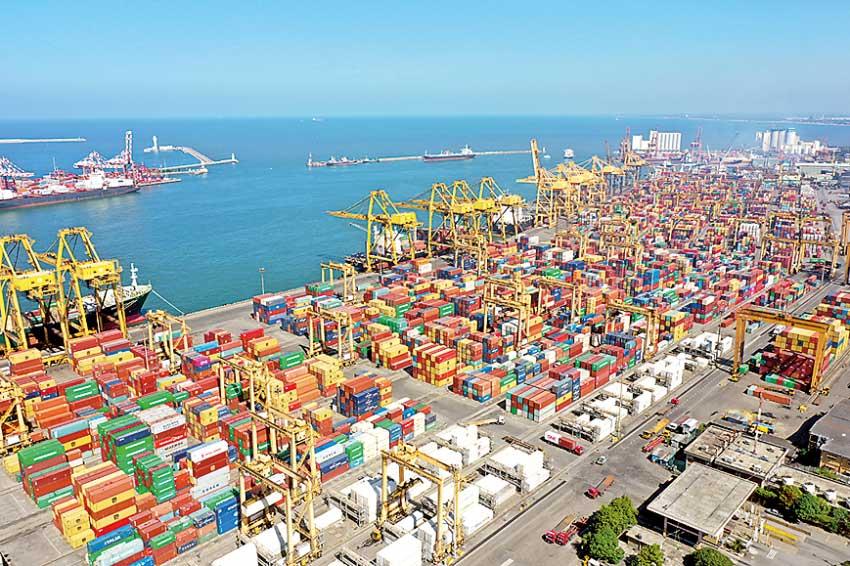
In July, the number of transshipment containers at the Port of Colombo dropped for the second month in a row, by a record 7.5% year-on-year (YoY) to 460,736 TEUs. This was because the main shipping lines temporarily chose other routes when the country’s political and social unrest was at its worst.
Even though there were a lot of protests and a political crisis, the Port of Colombo kept running for the most part. However, a local shipping agent said that the 9th of July made the main shipping lines even more worried about law and order in Sri Lanka.
People in the industry are worried that it could take several months for main shipping lines to trust the industry again.
During the seven-month period, the number of containers that were moved from one ship to another dropped by 0.2% YoY, to 3.35 million TEUs
Overall, the number of containers moving through the Port of Colombo fell by 10.5% year over year in July, to 553 890 TEUs. In particular, the number of loaded import containers dropped sharply by 21.4% YoY to 30,366 TEUs, while the number of loaded export containers dropped by 6.8% YoY to 25,247 TEUs.
The SLPA-run Jaya Container Terminal (JCT) and its partially operational East Container Terminal (ECT) only handled 115,539 TEUs in July, which is a sharp drop of 39 percent from the same month last year. This drop was caused by a big drop in the number of containers being moved from India to other countries.
Colombo International Container Terminal (CICT), the port’s only fully operational deep container terminal, was able to handle 286,419 TEUs in the month, which was up by 1.2% year over year. South Asia Gateway Terminal (SAGT) handled 151,932 TEUs, which is a 3.5 percent increase from the same time last year.
Overall, the number of containers that went through the Port of Colombo dropped by 2.1% from the same time last year to 4.11 million TEUs during the seven-month period. Also in July, the amount of cargo handled by Hambatota Port went down by 48.6% year over year, to 147,495 TEUs.